

Tired of marketing that feels like shouting into the void? We've all been there. The fix is simpler than you think: get to know who you're actually talking to.
Creating a solid buyer persona isn't just a creative exercise; it's a structured process with three core stages. You gather real data about your customers, build a detailed profile from those insights, and then activate that profile to make smarter marketing decisions. It’s how you turn abstract numbers into a relatable story about your ideal customer.
Moving Beyond Guesswork in Marketing
Generic campaigns fall flat because they aren't speaking to anyone in particular. But when you deeply understand your audience, you can finally connect in a meaningful way—and that’s exactly what a buyer persona helps you do.
This isn't about slapping a stock photo on a demographic checklist. It's about building a vivid, data-backed story of who buys from you: what their day looks like, what challenges keep them up at night, and what truly motivates their decisions.
This guide will walk you through a practical workflow for building and using personas that sharpen your messaging, boost engagement, and drive real growth. The entire process boils down to these three key phases.
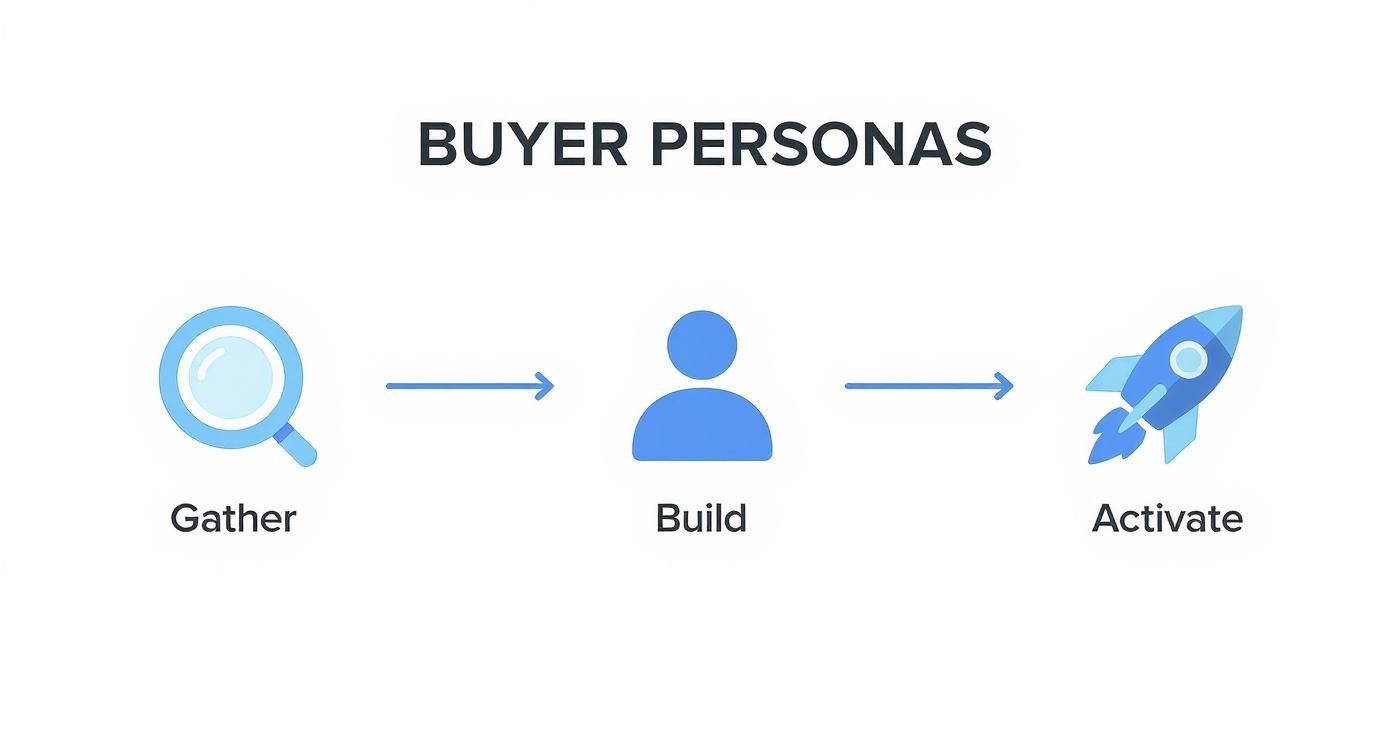
This visual breaks it down perfectly: gather insights, build the profile, and activate it in your campaigns. It’s a clear path from research to results.
To give you a clearer picture of this workflow, here’s a quick summary of what each stage involves.
The Buyer Persona Creation Workflow at a Glance
| Stage | Primary Goal | Key Activities |
|---|---|---|
| 1. Gather Data | Collect raw, unbiased information about your best customers. | Dig into Google Analytics, review CRM data, talk to your sales team, and conduct customer interviews. |
| 2. Build Profile | Synthesize data into a relatable, actionable persona document. | Identify patterns, fill out a persona template, write a narrative, and give your persona a name. |
| 3. Activate Persona | Apply the persona to guide all marketing and sales activities. | Tailor website content, refine SEO keywords, create targeted ad campaigns, and inform product development. |
This table lays out the fundamental steps. Moving from one stage to the next is how you ensure your personas are grounded in reality, not just wishful thinking.
Why Data-Driven Personas Matter
Making the switch from assumptions to data-driven profiles is a game-changer for any marketing strategy. The numbers don't lie. Research shows that 71% of companies that blow past their revenue targets have formally documented their buyer personas.
On top of that, 36% of those high-achieving companies also reported shorter sales cycles after putting personas to work. That’s a direct line between deep customer understanding and a healthier bottom line.
This process is the fuel for a powerful digital marketing strategy, especially for new businesses trying to find their footing. It ensures every dollar you spend and every blog post you write has a clear purpose and a defined audience.
A well-crafted buyer persona is like a compass for your entire business. It makes sure everyone—from content creators to paid ad specialists—is navigating toward the same customer, speaking their language, and solving their real problems.
The Tangible Benefits for Your Business
Once you know exactly who you're talking to, the benefits show up fast. Instead of creating content you think your audience wants, you can produce resources that solve their actual problems.
This shift leads directly to:
- Higher-Quality Leads: You stop wasting time on tire-kickers and start attracting prospects who are a perfect fit for what you offer.
- Improved Engagement: Your emails get opened, your ads get clicked, and your social posts get shared because they resonate on a deeper level.
- Increased Conversion Rates: When your message is laser-focused and relevant, potential customers are far more likely to take that next step.
Ultimately, learning how to create buyer personas is an investment in efficiency. It's about working smarter, not just harder, to get the measurable growth you’re after.
Gathering Your Raw Customer Data
Powerful buyer personas are built on real data, not assumptions. This is where you swap guesswork for facts and uncover what your customers are really about and what they actually need. Think of it as creating a treasure map that leads directly to actionable insights.
The idea is to blend two kinds of information: quantitative data (the ‘what’) and qualitative data (the ‘why’). One tells you what people are doing, and the other reveals the motivations behind their actions. Combine them, and you get a complete, three-dimensional view of your customer.
Uncovering Quantitative Data in Your Tools
Your existing business tools are an absolute goldmine of objective customer data. It's the perfect place to start because the information is already there, just waiting for you to piece it together. You just have to know where to look.
Here are the key places to start digging:
- Google Analytics: Go deeper than just surface-level traffic. Dive into the Audience > Demographics and Interests reports to see the age, gender, and affinity categories of your most engaged visitors. Which pages or blog posts have the highest conversion rates? That tells you what content is truly hitting the mark.
- CRM Software: Your Customer Relationship Management system is packed with patterns about your best customers. Filter your contacts to spot common job titles, company sizes, or industries. You can also analyze purchase histories to see which services are the most popular with your highest-value clients.
- Social Media Analytics: Platforms like Facebook, Instagram, and LinkedIn offer up detailed audience insights. Pay close attention to the demographics of your followers, see which posts get the most engagement, and look at the questions people ask in the comments.
This process is about more than just pulling numbers; it's about understanding the story they tell. It starts with analyzing your current customer segments and backing it up with hard metrics. In fact, research shows that companies using data-driven methods saw a 100% increase in the number of pages visited on their websites simply by tailoring content to specific personas.
Gathering Qualitative Insights
While numbers tell you what’s happening, qualitative data explains why. This is where you capture your customer's voice—their frustrations, their goals, their own words. This context is what brings a persona to life and makes it feel real.
To get this information, you have to listen. It’s critical to collect customer feedback smarter, not harder, because this forms the bedrock of a persona people on your team can actually relate to.
A common mistake is relying solely on analytics. Data tells you a customer from Austin spent 10 minutes on your pricing page, but only a conversation will tell you they were confused about your service packages.
Your best sources for these stories are often right in front of you:
- Customer Support Tickets & Chats: Read through recent support interactions. What are the most common problems or questions that pop up again and again? These are direct signals of your customers' pain points and show you exactly where your messaging or product could be clearer.
- Online Reviews and Testimonials: What specific words do happy customers use to describe your business? Notice the exact benefits they mention—it’s a powerful clue into what they value most. Don't just look at the star rating; read the text.
- Sales Team Feedback: Your sales team is on the front lines every single day. They hear the objections, answer the tough questions, and understand what finally pushes a prospect to make a decision. Schedule a quick chat with them and just ask, "What are the top three questions you always get from leads?" The answers will be pure gold.
These qualitative sources provide the direct quotes, real-world challenges, and emotional drivers that will make your persona feel less like a spreadsheet and more like a real person. This deep understanding is a core part of any successful local business digital marketing strategy, ensuring your message truly connects with the community you serve. When you blend both the numbers and the stories, you build a profile that is not only accurate but deeply empathetic.
Mastering the Customer Interview
Analytics and CRM data are great for telling you what your customers are doing. But if you want to understand why they're doing it, you have to talk to them. The customer interview is, without a doubt, the most powerful tool you have for building personas that actually feel like real people.
This is where you uncover the motivations, the frustrations, and the real human story behind all those data points.
It’s not about running through a checklist of questions. Think of it more as a conversation—a genuine chat where you can dig up rich, actionable insights you just can’t find anywhere else. The goal is to stop asking leading questions like, "So, you like our product, right?" and start asking story-based questions that get to the core of their experience.

Who Should You Talk To?
Don't just line up interviews with your happiest, longest-term customers. To get a truly well-rounded perspective, you need to chat with a strategic mix of people. For each persona you're trying to build, aim for at least 3-5 interviews.
Here’s who should be on your list:
- Your Best Customers: These are your fans. They can tell you exactly what’s working, what they value most, and why they picked you over the competition. They're your key to understanding your core strengths.
- Recent Customers: The buying journey is still fresh in their minds. They can give you a play-by-play of their research and decision-making process, which is invaluable for understanding your current customer experience.
- Prospects Who Chose a Competitor: This group is pure gold. They’ll give you the brutally honest feedback you need on where your messaging fell flat, what objections you couldn't overcome, and why a competitor's offer looked better.
Seriously, don't be afraid to talk to people who didn't buy from you. Their insights will shine a spotlight on weaknesses and opportunities you’d otherwise completely miss.
Crafting Questions That Uncover Stories
The quality of your personas hinges entirely on the quality of your questions. You need open-ended questions that prompt people to tell you a story, not just give a simple "yes" or "no."
Your real goal is to understand what their world looked like before they even started searching for a solution like yours.
A great interview makes you feel like a journalist uncovering a story, not a marketer checking boxes. Your main job is to listen, and your most powerful tool is asking, "Can you tell me more about that?"
Here are some powerful, story-driven questions to get you started:
Understanding the Trigger
- "Walk me through the day you realized you needed to find a solution for [the problem your business solves]."
- "What was happening in your business or life that made this a priority?"
Exploring the Journey
- "Once you started looking for a solution, what were the first steps you took?"
- "What were the most important features or qualities you looked for during your research?"
- "What were some of the biggest barriers or frustrations you encountered while trying to find the right option?"
Analyzing the Decision
- "What other options did you consider, and what made you choose the one you did?"
- "Who else was involved in making the final decision, and what was most important to them?"
- "If you had to explain the value of [our solution/the competitor's solution] to a colleague, what would you say?"
These questions steer the conversation away from your product and put the focus squarely on their experience—which is exactly where the best insights are hiding.
How to Run an Effective Interview
How you conduct the interview is just as important as the questions you ask. You want to create a space where people feel comfortable enough to share openly and honestly.
Best Practices for Interviewing:
- Set the Stage Clearly: Kick things off by making it clear this is not a sales call. Let them know you're doing research to better understand their world and that their honest feedback is what you're after.
- Build Rapport First: Don't just jump into the questions. Spend a few minutes on small talk. Ask about their role, their company, or something you noticed on their LinkedIn profile. A little human connection goes a long way.
- Listen More Than You Talk: Stick to the 80/20 rule—they should be doing the talking 80% of the time. When you get that urge to jump in to correct them or pitch a feature, just bite your tongue. Your only job is to listen and understand.
- Ask Follow-Up Questions: Never take an answer at face value. When you hear something interesting, dig in with follow-ups like, "Why was that important?" or "How did that make you feel?" This is how you get to the core motivations.
- Embrace the Awkward Silence: When someone finishes a thought, just wait a few seconds before asking your next question. More often than not, they'll fill the silence with an extra detail or unplanned insight that turns out to be incredibly revealing.
Once you master the customer interview, you’ll have all the qualitative details you need to breathe life into your data. These conversations give you the direct quotes, emotional drivers, and real-world scenarios that will turn your persona from a flat document into a go-to tool for your entire team.
Building Your Actionable Persona Profile
You've done the hard work. After hours of digging through analytics and having real conversations with your customers, you’re sitting on a pile of raw data. This is where the real magic begins. It’s time to shape all those scattered notes and spreadsheet rows into a living, breathing story that your whole team can get behind.
The goal here isn't just to list a bunch of facts. It's to weave your research into a clear, compelling document that tells the story of your ideal customer. A truly effective persona is more than a demographic snapshot—it’s a narrative about their world, their goals, and the challenges that keep them up at night.

From Data Points to a Cohesive Story
Your first job is to start connecting the dots. As you sift through your interview transcripts and analytics, you'll start to see patterns emerge. Do several customers keep mentioning the same frustration? Are they using the same words to describe what they want to achieve? These recurring themes are the foundation of your persona.
Start bucketing your findings into a few key categories. A solid persona template should always cover these bases:
- Background and Demographics: Give your persona a name, a job title, and some basic details like their age and industry. This simple step makes them feel like a real person, not just a concept.
- Goals: What are they actually trying to accomplish? Think about both their professional goals (like "increase team efficiency by 15%") and their personal ones (like "get home in time for dinner without stressing about work").
- Challenges and Pain Points: What’s standing in their way? This is arguably the most critical section. It’s where you uncover the problems your business was built to solve.
- Watering Holes: Where do they hang out online to get information? Pinpoint the specific blogs, social media platforms, or industry leaders they follow. This tells you exactly where to find them and how to speak their language.
But the real secret sauce? Capturing their actual voice. Pulling direct quotes from your interviews is the fastest way to make your persona feel authentic.
"I spent weeks trying to compare software options, and I just felt overwhelmed by technical jargon. I needed someone to explain the real-world benefits in plain English."
A quote like that hits so much harder than a bullet point saying "is frustrated by complex terminology." It makes their struggle real and gives your team something tangible to rally around.
An Example Persona: Marketing Manager Mary
Let's walk through a quick example. Imagine you run a project management software company. After your research, you've identified a key customer segment. Let's call her "Marketing Manager Mary."
- Name: Marketing Manager Mary
- Role: Head of Marketing at a 75-person tech startup.
- Demographics: 34 years old, lives in a major tech hub, earns $95k/year.
- Goals: To successfully launch three major campaigns per quarter and clearly prove her team's ROI to the executive board.
- Challenges: Her team is drowning in a chaotic mix of emails and spreadsheets, which causes missed deadlines and frequent communication breakdowns. She feels like she never has a clear, real-time overview of who is working on what.
- Watering Holes: Follows top marketing influencers on LinkedIn, listens to marketing podcasts during her commute, and reads industry blogs like HubSpot.
- Direct Quote: "My biggest fear is having a major launch go off the rails because someone missed a crucial email. I just need a single source of truth for my team."
See how a clear story starts to form? Mary is no longer just a collection of data points. She’s a person with relatable professional pressures and a specific problem we can solve.
The Difference Between Weak and Strong Personas
Nailing the details is what separates marketing that works from marketing that gets ignored. A weak, generic persona is useless—it gives you no real direction. A strong, data-backed persona, on the other hand, becomes the north star for your entire strategy. The difference is night and day.
To give you a clear benchmark, let's put a weak persona and a strong one side-by-side.
| Component | Weak Persona Example | Strong Persona Example |
|---|---|---|
| Job Title | Business Owner | "Service Pro Sam," Owner of a local plumbing business with 5 employees. |
| Challenge | Needs more leads. | Struggles to manage incoming calls while on job sites, losing potential business to competitors who answer faster. |
| Goal | Grow the business. | Wants to increase annual revenue by 20% to hire another technician and reduce his own time in the field. |
| Quote | "I want to be successful." | "Every missed call is a job I can't bid on. I feel like I'm letting money slip through my fingers every single day." |
The strong persona gives you something you can actually work with. You know Sam's team size, his specific revenue goal, and the emotional frustration driving his problem. This is the kind of detail that lets you craft messaging that connects, showing him you truly understand his world and have the exact solution he needs. That’s the standard to aim for every single time.
Putting Your Personas to Work in Your Marketing
Let's be honest: a beautifully detailed buyer persona is completely useless if it just sits in a folder on your server gathering digital dust. You’ve done the hard work of digging through data and talking to real people. Now it’s time to put those insights into action and make smarter, more effective marketing decisions every single day.
This is where your data-driven stories become the compass for your content, the blueprint for your ad campaigns, and your secret weapon for SEO. You're shifting from simply understanding your customer to actively connecting with them where they hang out, using messages that actually mean something to them.

Fueling Your Content Strategy
Your buyer personas are the ultimate cure for writer's block. Instead of staring at a blank page and guessing what to write, you can now create content that speaks directly to the goals and challenges you’ve already documented for a specific person.
Let's say your research led you to "Project Manager Paul," a persona who constantly struggles with "keeping remote teams aligned." Boom. You have a clear mandate for your next series of blog posts, videos, or guides.
- Blog Topics: You can immediately brainstorm relevant titles like "5 Communication Workflows That Actually Work for Hybrid Teams" or "The Top Tools for Real-Time Project Tracking."
- Content Formats: If you know Paul is always crunched for time and prefers scannable content, you'd lean into checklists, templates, and short, punchy videos. For marketers looking to create engaging visual content, exploring the best AI video generators can be a great way to produce high-quality videos efficiently.
- Messaging Tone: Speak his language. If Paul is all about efficiency and proving ROI, your content should be direct, data-driven, and focused on tangible results. No fluff.
Sharpening Your SEO and Keyword Research
Understanding your persona’s day-to-day problems helps you uncover the long-tail keywords they’re actually typing into Google. People don't just search for broad terms like "project management software." They search for solutions to their very specific headaches.
Project Manager Paul isn't looking for your product by name. He's searching for things like:
- "how to reduce missed deadlines with remote team"
- "asana vs monday for small teams"
- "best way to get status updates without more meetings"
These are the keywords you should be building your content around. When you create blog posts and guides that answer these specific questions, you position your brand as a helpful expert at the exact moment your ideal customer needs a hand. This is how you attract high-intent organic traffic that’s far more likely to convert.
Transforming Your Paid Ad Campaigns
For anyone running paid ads, persona insights are pure gold for writing ad copy that resonates and building landing pages that convert. Generic ads get ignored. Ads that speak to a specific pain point get clicked.
For Paul, a generic ad listing software features would fall flat. An effective ad, however, would mirror his reality:
Ad Copy Example:
Tired of chasing status updates? Get a clear view of every project without another meeting. Try [Your Software] free.
This copy hits on his exact frustration ("chasing updates") and offers a clear, desirable benefit ("clear view without meetings").
You can also use this data to sharpen your audience targeting on platforms like LinkedIn or Facebook. Instead of casting a wide, expensive net, you can layer interests, job titles, and company sizes that perfectly match your "Project Manager Paul" profile. This makes your ad spend incredibly efficient.
A study by THM Agency found that businesses using buyer personas in their email campaigns saw open rates two to five times higher than those that didn't. This just goes to show how powerful a tailored message can be.
This same thinking applies directly to your website. When Paul clicks that ad, he needs to land on a page that continues the conversation, not starts a new one. To nail this, check out our guide on how to create an engaging and converting homepage. The headline, the images, and the call-to-action should all be crafted with Paul’s goals and challenges in mind. That seamless, persona-driven experience is what turns clicks into customers.
Got Questions About Buyer Personas? We’ve Got Answers.
As you start digging in and building out your personas, you’re bound to hit a few snags. That’s totally normal. A few questions pop up almost every single time someone goes through this process.
Getting these cleared up now will save you a ton of headaches and keep the project from grinding to a halt. Think of this as your quick-and-dirty FAQ for getting personas right.
How Many Buyer Personas Do I Actually Need?
This is the big one, the question I hear most often. But honestly, there's no magic number. The real key is to focus on quality over quantity.
For most small and local businesses, starting with 1-3 core personas is the sweet spot. It keeps you focused. Any more than that, and your marketing can get spread way too thin.
Zero in on the customer groups that are either driving the most revenue right now or represent your biggest opportunity for growth. You can always add more later as you scale. But if your business serves two completely different crowds—say, a local gym that caters to both young professionals after work and active retirees in the morning—you’ll absolutely need a separate persona for each.
What If I Can’t Get Enough People to Interview?
This is a real challenge, especially if you're just starting out or have a smaller customer list. If you’re struggling to get people on the phone, don’t sweat it. It just means you’ll need to lean a bit more heavily on your other data sources.
Even a handful of great interviews is better than none. To get more people to say yes, try offering a solid incentive, like a generous gift card or a free month of your service. If you’re still coming up short, your other data becomes your goldmine:
- Go deep on your website analytics. What are people actually doing on your site? Where do they drop off?
- Survey your email list. Even a small list can give you powerful insights.
- Read through every customer support ticket and chat log. Look for the common questions and complaints—they’re telling you exactly what their pain points are.
- Talk to your sales team (if you have one). They’re on the front lines every single day and know your customers better than anyone.
How Often Should I Update My Buyer Personas?
Personas are not a "set it and forget it" kind of thing. They’re living documents that need to evolve right along with your customers and the market. Customer needs change, competitors pop up, and your personas have to keep up.
A persona that hasn't been updated in three years isn't a strategic tool; it's a historical artifact. Regularly refreshing your personas ensures they remain relevant and actionable for your team.
A good rule of thumb is to give them a proper review and refresh at least once a year. That said, you should also plan to revisit them after any big change in your business—like launching a major new service, pivoting your marketing strategy, or noticing a big shift in how customers are behaving.
Can I Use AI to Help Create Buyer Personas?
Absolutely. AI tools can be a massive help here, especially when you’re swimming in data. You can use AI to tear through huge volumes of customer feedback, survey results, or reviews to spot patterns and common themes way faster than any human could.
But here’s the catch: AI should supplement, not replace, talking to actual humans. The empathy, the emotional drivers, the little stories you hear in a real conversation—that’s stuff AI just can’t replicate. Use AI for the heavy lifting, but rely on real conversations to capture the true voice of your customer.
Ready to turn these insights into real growth for your business? At Gidds Media, we specialize in building data-driven SEO and Google Ads strategies based on a deep understanding of your ideal customer. Get your free, no-pressure SEO audit today and discover how we can connect you with the right audience.


