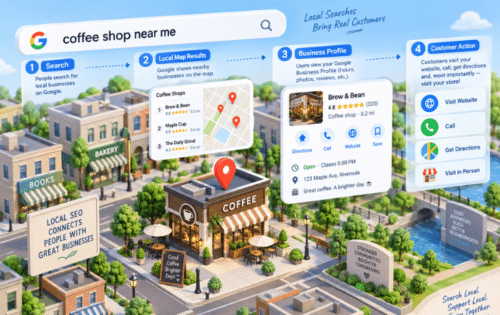
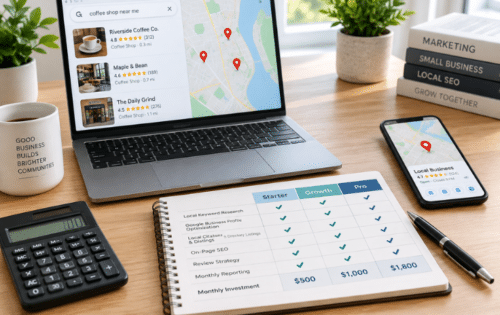
In today's competitive local market, simply having a website isn't enough. Potential customers are searching for services 'near me' every second, and if you're not showing up in Google's Local Pack or on Google Maps, you're essentially handing business to your competitors. The problem often lies in a series of small, overlooked errors that accumulate over time, from an inconsistent business address online to a poorly optimized Google Business Profile.
This isn't about complex, enterprise-level SEO; it's about mastering the foundational elements that Google prioritizes for local search. To truly understand why a local business might be invisible and how to achieve local dominance, it's crucial to consider a broader set of essential local marketing strategies, but a technical audit is the critical first step. An audit provides the data-driven roadmap needed to make impactful improvements.
This comprehensive local SEO audit checklist is designed specifically for small and medium-sized businesses to systematically identify and fix the exact issues holding them back. We will walk through 10 critical areas, providing a prioritized, step-by-step framework to transform your local online presence from invisible to unmissable. You'll get actionable advice on everything from your Google Business Profile and online reviews to on-page optimization and citation management.
Follow this guide to stop guessing and start implementing the changes that drive real-world traffic and customers through your door. Let's get started.
1. Google Business Profile (GBP) Optimization
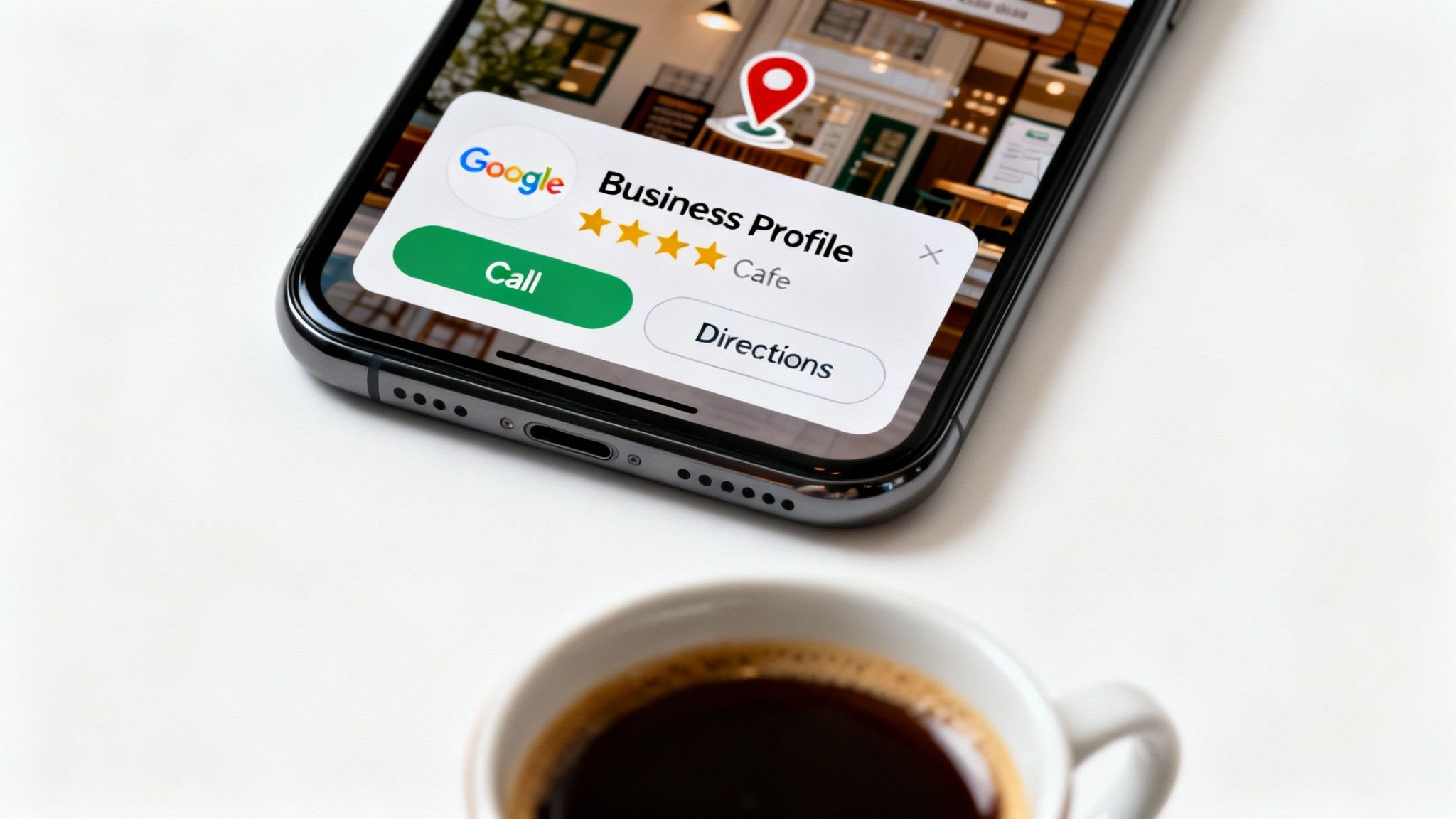
The cornerstone of any effective local SEO audit checklist is a deep dive into your Google Business Profile (GBP). This free, powerful tool is your digital storefront on Google Search and Maps. A complete, accurate, and actively managed profile is non-negotiable for achieving high visibility in local search results, building customer trust, and driving direct engagement like calls, direction requests, and website visits.
An optimized GBP acts as a primary signal to Google that your business is legitimate, active, and relevant to local searchers. It's often the very first impression a potential customer has of your business.
Why It's a Priority
Your GBP is the most significant ranking factor for the "Local Pack," the block of three business listings that appear at the top of many local search results. For example, a restaurant that regularly uses Google Posts to share weekly specials and adds high-quality food photos can see a significant increase in click-through rates. Similarly, a local plumber who meticulously defines their service areas within GBP is more likely to rank for "plumber near me" searches within those zones.
Actionable Audit Steps
During your audit, verify the following key areas are fully optimized:
- Complete & Accurate Information: Is your business name, address, and phone number (NAP) exactly correct and consistent with your website and other citations? Have you selected the most specific primary and secondary business categories?
- Visuals: Do you have at least 10 high-quality, recent photos of your storefront, team, and work? Aim to add new photos monthly to show your business is active.
- Reviews: Are you responding to all reviews, both positive and negative, within 24-48 hours? This demonstrates excellent customer service to both Google and potential clients.
- Engagement: Are you using Google Posts weekly to announce offers, events, or updates? Have you filled out the Q&A section with common customer questions?
For a more comprehensive guide, you can learn more about optimizing your Google Business Profile here.
2. NAP Citation Consistency and Management
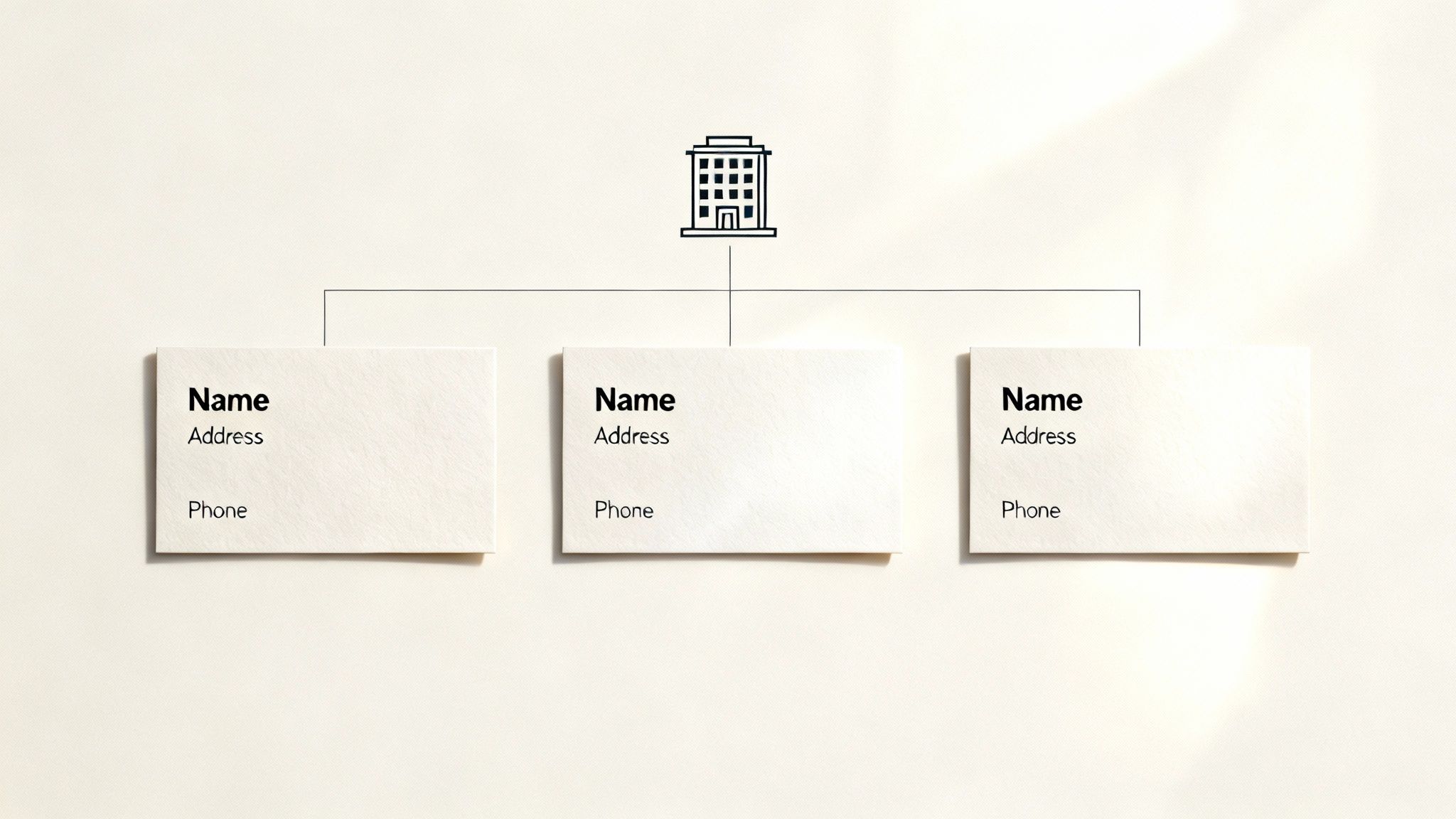
After optimizing your Google Business Profile, the next critical step in a local SEO audit checklist is to scrutinize your NAP citation consistency. NAP stands for your business Name, Address, and Phone number. Citations are online mentions of this core data on various websites, such as Yelp, Facebook, Apple Maps, and industry-specific directories. Search engines like Google cross-reference this information to verify your business's existence, location, and legitimacy.
Inconsistent NAP data creates confusion for search engines and erodes their trust in your business, directly harming your local search rankings. It's the digital equivalent of having multiple, slightly different addresses on official documents. Ensuring this information is identical everywhere is a foundational trust signal.
Why It's a Priority
NAP consistency is a major ranking factor for the local pack and localized organic results. When Google finds the exact same NAP information across dozens of reputable online sources, it validates that your business is a legitimate local entity at a specific location. For example, a landscaping company that discovered and standardized 15 different versions of its address across the web saw its local rankings improve significantly. Similarly, law firms that maintain identical NAP information across over 50 legal and local directories often see higher and more stable placement in local search results.
Actionable Audit Steps
During your audit, you must identify and correct every instance of incorrect or inconsistent business information. Focus on these steps:
- Establish a Standard: Decide on one, official format for your NAP. For example, will you use "Street" or "St."? "Suite 100" or "Ste. #100"? Document this standard and use it for all future listings.
- Conduct an Audit: Use a tool like SEMrush, Moz Local, or Whitespark to run a citation audit. These tools will scan the web and provide a report of your existing citations, highlighting inconsistencies and missing listings on key directories.
- Prioritize and Correct: Start by correcting your most important listings first: Google Business Profile, Facebook, Apple Maps, and major data aggregators. Then, work your way through other high-authority directories like Yelp and any industry-specific sites.
- Track and Monitor: Create a simple spreadsheet to track your login details, listing status, and NAP information for each directory. This helps you stay organized and allows for easy quarterly check-ins to catch any new errors or changes.
To dive deeper into this topic, you can explore this detailed guide on what local citations are and why they matter.
3. Local Link Building and Authority Assessment
While on-page and GBP optimizations are crucial, your off-page authority, primarily built through local links, is a powerful signal to search engines. Local link building is the process of acquiring hyperlinks from other geographically relevant websites, such as local news outlets, blogs, business associations, and complementary companies. These links act as local votes of confidence, telling Google your business is a trusted and authoritative entity within your community.
A strong local backlink profile directly impacts your website's authority, helping you outrank competitors for geographically-specific keywords. It solidifies your digital connection to a specific area, making you more relevant for "near me" searches.
Why It's a Priority
Links from locally respected sources are a major ranking factor. For example, a local dental practice that earns a link from the city's health department website or a local parenting blog's "best family dentists" roundup will see a significant boost in authority. This is far more valuable for local SEO than a random link from a non-relevant national website. This part of your local SEO audit checklist identifies opportunities to build these high-impact local connections.
Actionable Audit Steps
During your audit, analyze your current backlink profile and identify new opportunities:
- Analyze Existing Links: Use a tool like Ahrefs or Moz to see who currently links to you. Are they local? Are they high-quality? Disavow any spammy or low-quality links that could be hurting your profile.
- Competitor Backlink Gap: Review the backlinks of your top three local competitors. Where are they getting links from that you aren't? This can reveal local directories, news sites, or event sponsorships you should target.
- Local Sponsorships & Partnerships: Have you sponsored a local youth sports team, charity event, or festival? Ensure you are receiving a link from their website in return. Look for opportunities to partner with non-competing local businesses for guest posts or resource page links.
- Directory & Citation Health: Are you listed in high-authority local directories beyond just general ones? Think about your local Chamber of Commerce, the Better Business Bureau (BBB), and industry-specific association websites.
For deeper insights into strategic local link acquisition, you can explore Whitespark's definitive guide to local link building.
4. Online Review Generation and Management
A crucial component of any comprehensive local SEO audit checklist involves evaluating your strategy for online reviews. Customer reviews on platforms like Google, Yelp, and industry-specific sites are a powerful ranking signal and a primary driver of consumer trust. Your review volume, velocity (how frequently you get them), average rating, and how you respond all directly impact your local search visibility and conversion rates.
Online reviews provide the social proof that modern consumers demand before making a purchasing decision. For Google, a steady stream of positive feedback signals that your business is active, valued by its community, and deserving of a prominent position in local search results.

Why It's a Priority
Reviews are a direct line of communication between you, your customers, and potential new clients. A home services company that systematically requests feedback after each job can see its average star rating climb from 3.8 to 4.7 within months, significantly boosting trust and leads. Similarly, medical practices with over 100 recent, positive reviews often dominate the top three local search positions, as this demonstrates authority and reliability to both Google and prospective patients.
Actionable Audit Steps
During your audit, assess your current review management process and identify areas for improvement:
- Systematic Request Process: Do you have a consistent method for asking for reviews? Implement a system using email, SMS, or even a simple QR code at your point of sale that links directly to your review profiles.
- Response Protocol: Are you responding to every single review quickly? Aim to reply within 24-48 hours. Thank customers for positive feedback, and address negative comments professionally by acknowledging the issue and taking the conversation offline.
- Review Showcase: Are you leveraging your positive reviews as marketing assets? To effectively manage your online reputation and build social proof, consider practical ways for displaying Google reviews directly on your WordPress site.
- Performance Monitoring: Are you tracking key review metrics? Monitor your total number of reviews, average rating, and review velocity across all important platforms to measure progress.
5. Website Local SEO Technical Foundation
While on-page content and your Google Business Profile are crucial, the technical foundation of your website ensures search engines can properly crawl, index, and understand your local business information. This behind-the-scenes framework is vital; without it, even the best local content may never reach its intended audience. A technically sound website allows Google to efficiently process your local relevance signals.
Think of technical SEO as the plumbing and wiring of your business's digital home. If it's faulty, nothing else functions correctly, making it a critical component of any comprehensive local SEO audit checklist.
Why It's a Priority
Your website's technical health directly impacts user experience and search engine rankings. A slow-loading or mobile-unfriendly site will have a high bounce rate, signaling to Google that users are not finding it valuable. For instance, a local contractor who improved their mobile page speed and fixed crawl errors saw their site's bounce rate drop from 65% to 42% in local searches. Another powerful tool is schema markup, which helps Google understand your business's NAP, hours, and services, often resulting in rich snippets in search results.
Actionable Audit Steps
During your audit, inspect your site’s technical health by checking these key areas:
- Schema Markup: Have you implemented
LocalBusinessstructured data using Schema.org (JSON-LD format is preferred)? This markup should explicitly state your business name, address, phone number (NAP), and hours. - Mobile-Friendliness: Is your website fully responsive and easy to navigate on a smartphone? Use Google's Mobile-Friendly Test to confirm.
- Page Speed: How quickly does your site load? Use Google's PageSpeed Insights to test your Core Web Vitals and identify opportunities for improvement, such as optimizing images.
- Crawlability & Indexing: Have you submitted an XML sitemap to Google Search Console? Regularly check Search Console for crawl errors or indexing issues that could prevent key local pages from being seen.
- Site Security: Is your entire site secured with HTTPS? A secure site is a confirmed ranking signal and builds trust with users.
For a deeper understanding of these elements, you can discover more about technical SEO best practices here.
6. Local Keyword Research and Content Strategy
A fundamental part of any local SEO audit checklist involves analyzing how you attract geographically-qualified customers through search. This is where local keyword research comes in. It's the process of identifying the specific search terms your target audience uses when looking for your services in their area, often including modifiers like city names, neighborhoods, or "near me." A solid content strategy then uses these keywords to create valuable, location-specific pages and posts.
This approach aligns your website content directly with local search intent. By creating dedicated content for these terms, you signal to Google that your business is the most relevant answer for searchers in a particular location, significantly boosting your visibility for high-intent queries.
Why It's a Priority
Targeting generic keywords is often a waste of resources for local businesses. A local keyword and content strategy focuses your efforts on terms that drive convertible traffic. For example, a plumbing company targeting the keyword "24/7 emergency plumber in Austin" will see a much higher conversion rate than from a broad term like "plumber." Similarly, law firms that create specific pages for "[practice area] attorney [neighborhood]" often see those pages rank in the top three for relevant local searches within months.
Actionable Audit Steps
During your audit, review your keyword targeting and content to ensure they are optimized for local search:
- Keyword Identification: Are you using tools like Google Keyword Planner or SEMrush to find location-based keywords? Look for variations like "[service] in [city]," "[service] near me," and "[service] [neighborhood]."
- Competitor Analysis: Have you analyzed the top-ranking local competitors to see what keywords they are targeting on their service and location pages? Identify gaps you can fill.
- Content Creation: Does your website have unique, high-quality service pages for each of your primary offerings combined with your main service area? Are you creating blog posts that answer common local questions (e.g., "best HVAC system for Texas heat")?
- On-Page Targeting: Is each page optimized for a primary local keyword? Check if the keyword is present in the title tag, meta description, H1 heading, and within the body content naturally.
For a deeper understanding of how this fits into a broader strategy, you can learn more about local business digital marketing here.
7. Local Content Creation and Service Pages
Beyond your homepage, your website needs to prove its local relevance to both search engines and potential customers. Localized content, including specific service and location pages, blog posts, and neighborhood guides, is how you achieve this. This content directly targets local search intent, answers the specific questions of your community, and establishes your business as the go-to authority in your geographic area.
Creating dedicated pages for each service you offer and each area you serve sends powerful relevance signals to Google. It allows you to rank for a much wider array of specific, high-intent keywords that a generic homepage simply cannot capture.
Why It's a Priority
Effective local content is critical for moving beyond broad, competitive keywords and capturing highly qualified, "ready-to-buy" traffic. For instance, a real estate agent creating detailed neighborhood guides can rank for "[neighborhood name] homes for sale," attracting users much further down the sales funnel. Similarly, a home cleaning service with unique pages for 20+ different suburbs is far more likely to capture "house cleaning near me" searches originating from those specific locations, leading to higher conversion rates. This strategy is a core component of a thorough local SEO audit checklist.
Actionable Audit Steps
Review your site’s content strategy and check for the following optimization points:
- Dedicated Service/Location Pages: Do you have a unique, well-written page for each core service and each city or neighborhood you serve? Each page should have at least 300-500 words of non-duplicated content.
- Local Keyword Integration: Are local keywords (city names, neighborhoods, landmarks) used naturally in page titles, H1 headings, body content, and image alt text?
- Local Proof & Features: Do your pages include local testimonials, case studies, or photos from jobs completed in that specific area? Have you embedded a Google Map of your service area?
- Internal Linking: Are you linking between your main service pages and your specific location pages? For example, your "Roof Repair" page should link to your "Roof Repair in [Neighborhood A]" and "Roof Repair in [Neighborhood B]" pages.
8. Mobile Optimization and Local Search User Experience
With over 75% of local searches happening on mobile devices, optimizing for smartphones and tablets is no longer optional; it's a fundamental requirement. Mobile optimization ensures your website, GBP, and local content are accessible, fast, and intuitive on smaller screens. This process directly impacts local search rankings, user engagement, and, ultimately, conversion rates.
A seamless mobile experience caters to the "on-the-go" nature of local searchers. If a potential customer lands on your site and can't easily find your phone number or navigate your menu, they will immediately bounce to a competitor with a better mobile interface. Google recognizes this user behavior and rewards sites that provide a superior mobile experience.
Why It's a Priority
Google's "mobile-first" indexing means it predominantly uses the mobile version of your content for indexing and ranking. A poor mobile site can therefore hurt your visibility across all devices. A local retailer with a mobile-optimized store locator function can increase foot traffic by over 25%. Similarly, service providers who feature a prominent click-to-call button often see a significant increase in inbound phone leads directly from mobile search results.
Actionable Audit Steps
As part of your local SEO audit checklist, meticulously evaluate your mobile presence with these steps:
- Test Functionality: Use Google's Mobile-Friendly Test tool to get a baseline report. Manually test your site on different smartphones and tablets. Can you easily tap all buttons and links?
- Prioritize Speed: Check your site's mobile performance using PageSpeed Insights. Focus on Core Web Vitals, especially on mobile, as this is a confirmed ranking factor. Optimize images and leverage browser caching to improve load times.
- Streamline User Actions: Ensure key actions are effortless. Implement a persistent, one-click "Call Now" button and a "Get Directions" link that opens directly in Google Maps or Apple Maps.
- Simplify Forms: Are your contact or booking forms easy to complete on a small screen? Use minimal fields, large tap targets, and auto-fill capabilities where possible to reduce friction.
9. Local Search Competition Analysis and Gap Identification
Understanding your local digital landscape is impossible without a thorough analysis of your competitors. This process involves systematically examining what the top-ranking local businesses are doing right, where their strategies fall short, and how you can strategically position your own business to fill those gaps. It’s not about copying but about identifying opportunities they've missed.
A comprehensive competitor analysis within your local SEO audit checklist provides a clear roadmap. It helps you benchmark your efforts, discover proven tactics, and avoid the pitfalls that are holding others back. This insight allows you to compete more effectively for valuable local search visibility.
Why It's a Priority
Analyzing your competition reveals the standard of excellence Google expects in your specific market and location. If every top-ranking plumber has 100+ positive reviews, you know that's a benchmark you must aim for. For instance, a local dental practice might discover its main competitor has no service-specific pages for high-value treatments like "Invisalign" or "dental implants." By creating detailed, optimized pages for those services, the practice can swiftly capture those targeted search rankings and dominate a profitable niche.
Actionable Audit Steps
During your audit, perform a deep dive into 3-5 of your most visible local competitors:
- GBP Profile Scrutiny: How complete is their Google Business Profile? Are they using Google Posts, answering Q&A, and uploading fresh photos frequently? A competitor with a stale profile is a prime target to outperform.
- Review Strategy Analysis: Look at their total review count, average rating, and response rate. A real estate agent who notices competitors have poor-quality photos can invest in professional photography and highlight it in their GBP, creating a significant competitive advantage that increases lead generation.
- Keyword & Content Gaps: Use tools like Ahrefs or Semrush to see which local keywords they rank for that you don't. Do they have blog posts or service pages covering topics relevant to your audience that you've neglected?
- Backlink Profile: Who is linking to them? Identifying their local backlinks, such as a local chamber of commerce or a community event sponsorship, can reveal partnership opportunities for your own business.
10. Local Audit Tracking and Performance Monitoring
A local SEO audit is not a one-time task; it's the beginning of an ongoing process. Implementing continuous tracking and performance monitoring is crucial to validate your efforts, identify what works, and pivot your strategy when necessary. This involves regularly checking key performance indicators (KPIs) specific to your local search visibility, traffic, and lead generation.
Without consistent monitoring, you are flying blind. Tracking your progress is the only way to prove the return on investment of your local SEO efforts and make data-driven decisions for future optimization.
Why It's a Priority
Effective tracking transforms your local SEO from a set of guesses into a measurable marketing channel. For instance, a local service provider tracking the conversion rate from Google Business Profile clicks to phone calls might discover that mobile users convert at a much higher rate. This insight allows them to double down on mobile optimization and see a direct increase in qualified leads. Similarly, a multi-location business can monitor ranking progress across all its markets, identify underperforming locations, and reallocate resources to boost their visibility.
Actionable Audit Steps
As part of your ongoing local SEO audit checklist, establish a routine for monitoring these metrics:
- Set Up Analytics: Ensure Google Search Console and Google Analytics 4 are properly configured to filter and track traffic specifically from local search queries and your Google Business Profile.
- Monitor GBP Insights: Weekly, check your Google Business Profile Insights to track how customers find you, the actions they take (calls, website clicks, direction requests), and photo views.
- Track Keyword Rankings: Use a tool like SEMrush or BrightLocal to monitor your rankings for core local keywords (e.g., "plumber Austin") in your target service areas.
- Implement Call Tracking: Use a service like CallRail to measure the exact volume of phone leads generated directly from your local SEO campaigns, attributing calls to specific sources.
- Create a Dashboard: Build a simple monthly reporting dashboard that consolidates your most important local KPIs, such as Local Pack rankings, organic traffic from your city, and GBP-driven conversions.
10-Point Local SEO Audit Comparison
| Local SEO Tactic | Implementation Complexity 🔄 | Resource Requirements ⚡ | Expected Outcomes 📊 | Ideal Use Cases 💡 | Key Advantages ⭐ |
|---|---|---|---|---|---|
| Google Business Profile (GBP) Optimization | Low → Medium (verify + ongoing updates) | Low (time for photos/posts) | Increased local visibility, higher CTR & map-pack presence | Brick‑and‑mortar or service-area businesses seeking local leads | Free, direct control, appears in Maps/local pack |
| NAP Citation Consistency and Management | Medium (audit many listings) | Moderate (time or citation tools) | Stronger local rankings and trust; fewer listing conflicts | Businesses with inconsistent listings or multi-locations | Improves trust signals and map-pack eligibility |
| Local Link Building & Authority Assessment | High (outreach & relationship work) | High (time, outreach, sponsorship costs) | Improved local authority and keyword rankings over time | Competitive markets or community‑engaged brands | Highly relevant backlinks; referral traffic & defensibility |
| Online Review Generation & Management | Medium (process + response workflow) | Moderate (staff time, review tools) | Better rankings, conversions and consumer trust | Customer-facing businesses (restaurants, services, clinics) | Direct impact on conversions and local ranking signals |
| Website Local SEO Technical Foundation | High (developer & schema work) | High (dev time, tools) | Improved crawlability, indexation and long-term rankings | Sites needing technical fixes or multi-location setups | Foundational for sustained local SEO performance |
| Local Keyword Research & Content Strategy | Medium (research + mapping) | Moderate (tools, content resources) | Targeted organic traffic and higher intent conversions | Businesses targeting city/neighborhood search intent | Easier to rank for local intent; higher conversion rates |
| Local Content Creation & Service Pages | Medium → High (many unique pages) | High (writers, editors, maintenance) | Broader local keyword coverage and higher conversions | Multi-location businesses or service-rich offerings | Builds relevance, answers local queries, supports featured snippets |
| Mobile Optimization & Local UX | Medium → High (responsive design, testing) | Moderate‑High (dev & testing resources) | Higher mobile conversions, lower bounce rates | Businesses with high mobile search or "near me" queries | Critical for mobile users; improves click-to-call and directions |
| Local Search Competition Analysis & Gap ID | Medium (tool-based analysis) | Moderate (tools, analyst time) | Actionable opportunities and prioritized tactics | Markets with active competitors or planning expansion | Identifies quick wins and strategic gaps to exploit |
| Local Audit Tracking & Performance Monitoring | Medium (dashboard & reporting setup) | Moderate (tools/subscriptions, reporting time) | Data-driven improvements and ROI visibility | Ongoing campaigns and multi-location reporting | Enables measurement, troubleshooting, and optimization |
From Audit to Action: Your Path to Local Dominance
You've made it through the comprehensive local SEO audit checklist, a critical journey into the very foundation of your digital presence. This isn't just a list of tasks to complete; it’s a strategic roadmap designed to transform your business from a local competitor into a local leader. By meticulously examining everything from your Google Business Profile to the technical health of your website, you have armed yourself with the most powerful tool in marketing: actionable data.
The insights you've gathered are the starting point. The real momentum builds when you systematically address the weaknesses and capitalize on the opportunities uncovered. Think of this audit not as a one-time event, but as the beginning of an ongoing, dynamic process of refinement. Local search algorithms are constantly evolving, and your competitors are not standing still. A proactive, cyclical approach to your SEO is what separates fleeting success from sustained growth.
Turning Your Checklist into a Winning Strategy
The power of completing this local SEO audit checklist lies in what you do next. Don't let your findings gather digital dust. It's time to prioritize and execute.
Start by categorizing your audit findings into three buckets:
- Quick Wins (High Impact, Low Effort): These are the low-hanging fruit. Think of updating your GBP hours, adding new photos, responding to recent reviews, or fixing a broken internal link. These tasks can often be completed in a few hours and can yield noticeable results quickly, boosting morale and initial momentum.
- Strategic Projects (High Impact, High Effort): This category includes more involved initiatives like a complete NAP citation cleanup, building new local service pages, or launching a targeted local link building campaign. These require dedicated time and resources but offer the most significant long-term returns on investment, solidifying your authority and rankings.
- Ongoing Maintenance (Low Effort, Cumulative Impact): These are the habits of successful local businesses. This includes regularly monitoring your keyword rankings, consistently requesting new reviews, and publishing a steady stream of localized content. These actions, performed consistently, build a powerful moat around your business that is difficult for competitors to cross.
By transforming your detailed audit into a prioritized action plan, you create a clear path forward. This prevents overwhelm and ensures your efforts are always focused on the activities that will drive the most meaningful results for your Austin-based business, whether that’s more phone calls, more foot traffic, or more online bookings.
Knowing When to Call in the Experts
As a business owner, your time is your most valuable asset. While many items on this checklist are manageable for a motivated team, some tasks demand specialized expertise and significant time investment. Complex technical SEO issues, such as implementing advanced schema markup or conducting a deep competitive backlink analysis, can quickly become a major drain on your resources.
This is often the pivotal moment when partnering with a specialist becomes a strategic advantage, not just a cost. An experienced local SEO agency can accelerate your progress, navigate technical complexities, and implement advanced strategies that go beyond the checklist. They can turn the data from your audit into a professionally executed campaign that delivers measurable growth, freeing you to focus on what you do best: running your business and serving your customers. The goal is to move from simply checking boxes to actively dominating your local market, and sometimes, the right partner is the key to making that leap.
Ready to turn your local SEO audit checklist into a powerful engine for growth? The team at Gidds Media specializes in implementing these exact strategies for Austin businesses, turning audit findings into top rankings and tangible revenue. Let us provide a professional, no-obligation analysis and show you a clear, actionable roadmap to local dominance. Request your free SEO audit from Gidds Media today.