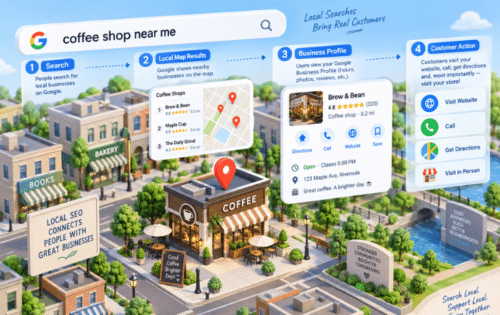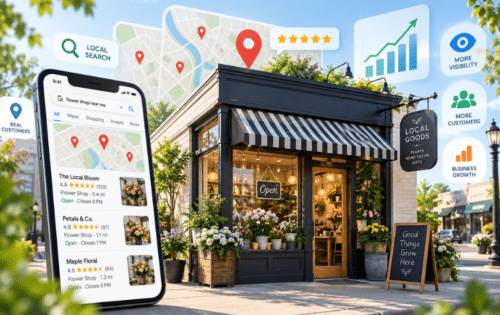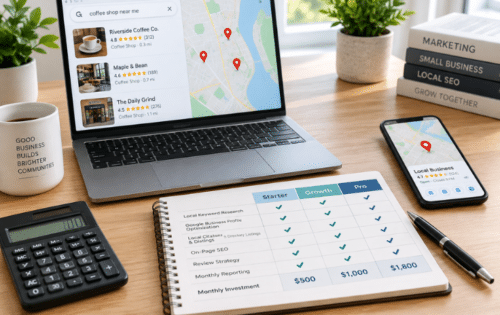
Local digital marketing is all about using online tools to bring nearby customers through your door. It’s a mix of local search engine optimization (SEO), a rock-solid Google Business Profile, and smart, geographically-targeted ads that make your business the obvious choice for people in your community.
Think of it as your modern-day storefront sign, but one that’s visible to every single person in your area searching on their phone.
Why Your Business Needs Local Digital Marketing
If you run a business that serves a specific area—a bakery, a dental clinic, or a plumbing service—your best customers are right around the corner. The real challenge is making sure they can actually find you.
In the past, you might have bought a Yellow Pages ad or sent out flyers. Today, your customers are looking for you on their phones and computers. That's where the game is played now.
This is why local digital marketing isn't just a "nice-to-have"; it's essential. It’s not about just having a website. It’s about aggressively showing up wherever your local audience is searching. When someone in your town Googles "best coffee near me" or "emergency plumber in [Your City]," you need to be the first name they see.
Connect Directly with Nearby Customers
Digital marketing levels the playing field, giving small, local businesses a fighting chance against the big chains. You can aim your efforts with laser precision, targeting a specific radius around your location. This ensures every dollar you spend is reaching people who can actually become customers.
No more wasting money advertising to people who live three counties away.
A well-executed strategy builds an online presence that delivers real-world results. The benefits are clear:
- Increased Visibility: You’ll show up at the top of local search results and on Google Maps.
- Higher Foot Traffic: More online searches will turn into actual customers walking into your shop.
- Better Lead Quality: You'll attract people who are actively looking for exactly what you offer.
- Stronger Community Trust: Positive online reviews and local engagement build a reputation money can't buy.
The data is crystal clear: companies that maintain a blog produce an average of 67% more leads monthly than those that don't. It just goes to show how creating relevant, local content directly fuels customer growth.
Build Authority and Trust in Your Community
Ultimately, a strong digital presence makes you the go-to expert in your neighborhood. When potential customers consistently see your business pop up with helpful info, great reviews, and easy-to-find details, they start to trust you before they’ve even walked through your door.
This guide will walk you through the core pieces of a winning local marketing plan, giving you the tools to turn those online searches into loyal, local customers.
Dominating Your Neighborhood with Local SEO
For any local business, showing up online the moment a nearby customer starts searching is the new Main Street. It’s prime real estate. This is the whole point of local Search Engine Optimization (SEO). It's not about being found by everyone, everywhere. It’s about becoming the most visible, trusted, and obvious choice for customers right in your backyard.
Think of local SEO as a powerful magnet pulling nearby customers straight to your door. When someone searches for "pizza place near me" or "emergency plumber in Austin," a solid local SEO strategy is what gets you featured in the "Local Pack"—that coveted block of three businesses highlighted on the Google Maps results.
Winning here means you have to understand how Google thinks. The search engine relies on three core pillars to decide which local businesses earn those top spots.
The Three Pillars of Local SEO Rankings
Google's goal is simple: give the user the best possible answer. For local searches, it measures your business against three key factors. Getting these right is the foundation of any effective digital marketing plan.
- Relevance: How well does your business actually match what the person is looking for? This is all about using the right keywords and categories on your website and online profiles to describe what you do, like "family dentist" or "auto repair shop."
- Distance: How close are you to the person searching? You can't move your shop, but you can clearly define your service areas. This tells Google exactly which neighborhoods and towns you cover.
- Prominence: How well-known is your business? Google figures this out by looking at your online reviews, how many times your business is mentioned across the web (these are called citations), and the quality of links pointing to your site.
A strong local SEO strategy is a direct signal to search engines that your business is a legitimate, active, and trusted part of the local community. It builds authority not just with algorithms, but with the real people searching for your services.
Building Your Foundation with Citations and Consistency
A huge part of proving your prominence comes from building local citations. These are simply mentions of your business's name, address, and phone number (what we call NAP) on other websites. Think of each one as a vote of confidence from another corner of the internet.
But there's a catch: consistency is everything. Your NAP information has to be identical everywhere it appears—from your website and Google Business Profile to directories like Yelp. Even a small difference, like "St." versus "Street," can confuse search engines and hurt your rankings.
The diagram below breaks down the must-have components for your Google Business Profile, which is the absolute cornerstone of any local SEO effort.
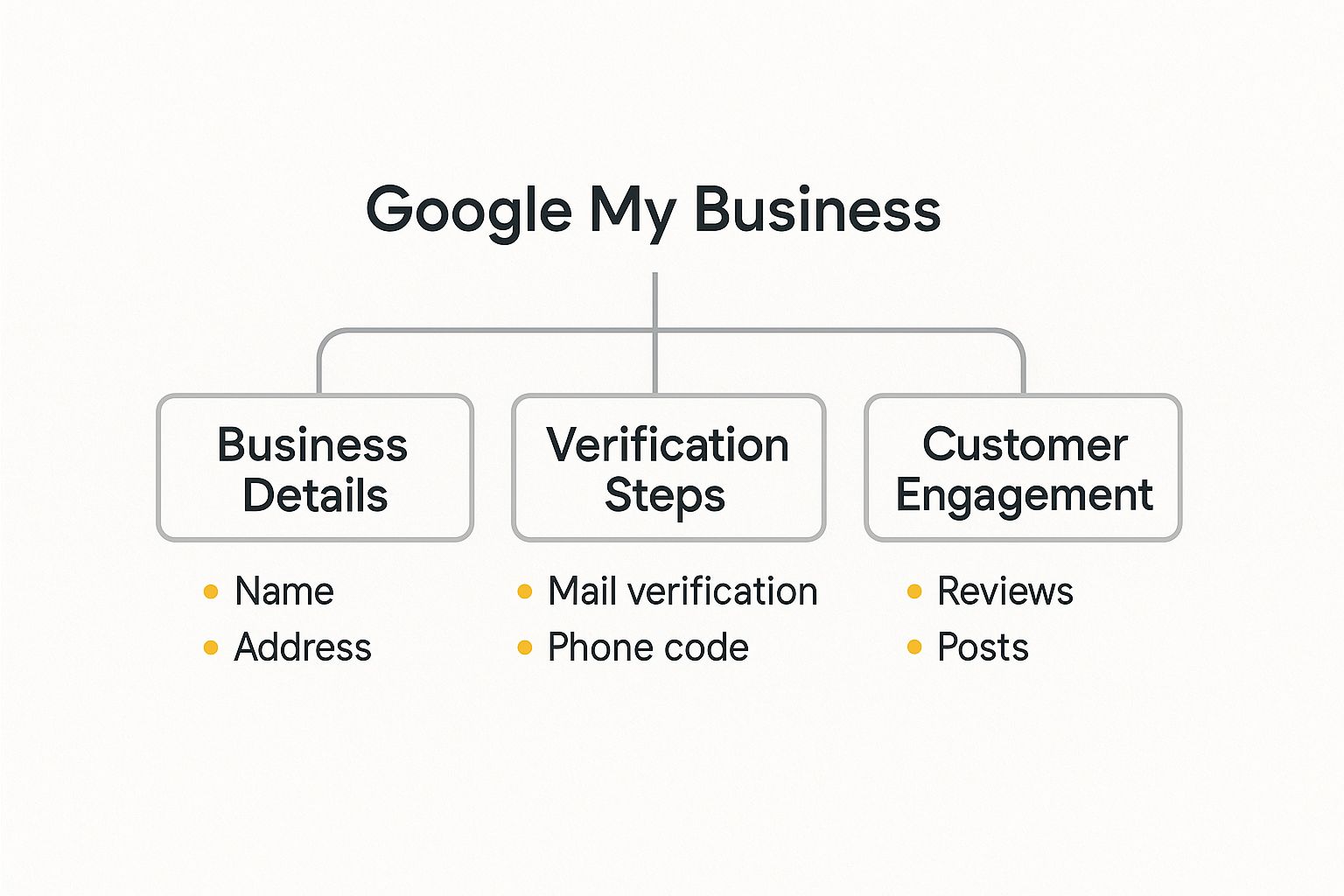
As you can see, a complete profile is more than just data entry. It requires accurate business details, a verified location, and ongoing engagement with customers to truly build authority.
Turning Customer Voice into Ranking Power
Online reviews are one of the most powerful signals of prominence, period. A steady flow of positive reviews tells Google that people like you and that you provide great service, making your business a safer bet to recommend. It's no secret that businesses with more frequent, positive reviews often rank higher.
Don't just wait for reviews to happen. You have to actively encourage your happy customers to share their feedback. It’s easier than you think:
- Send a follow-up email or text with a direct link to your review page.
- Put a QR code on your receipts or in-store signs.
- Just ask! A simple, personal request after a great service experience goes a long way.
This digital word-of-mouth is no longer a "nice-to-have." A staggering 99% of people use the internet to find local businesses, and "near me" searches have skyrocketed with a 900% increase in recent years. This proves people are searching locally more than ever, making local SEO a non-negotiable part of your marketing. For more practical tips, check out this guide on how to improve your local SEO rankings.
Turn Your Google Profile Into a Customer Magnet

Think of your Google Business Profile as the digital front door to your business. For a lot of your customers, it’s the very first impression they’ll get—often before they even think about clicking over to your website. An empty, bare-bones profile is like a closed door with a faded sign. But a fully fleshed-out profile? That’s a bright, welcoming lobby that invites people right in.
This free listing is, without a doubt, the most powerful tool in your local business digital marketing kit. It’s so much more than a simple directory entry. It’s an interactive hub where people find your hours, get directions, scan reviews, and ask questions. It’s where they decide whether to pick you or the other guy down the street.
Just claiming your profile isn’t the finish line. The real goal is to turn it from a static placeholder into an active, compelling magnet for local customers.
Optimizing Every Detail for Maximum Impact
Success with your Google profile lives in the details. Every single section is a new chance to provide value, build trust, and send good signals to Google about your business. Leaving fields blank is a missed opportunity to connect with a customer and boost your local search ranking.
Start with the basics, but make sure they're not just complete—they have to be strategic.
- Business Categories: Get specific here. Instead of just "Restaurant," choose "Italian Restaurant" or "Vegan Restaurant." Pick one primary category that nails what you do, then add secondary ones to cover all your other services.
- Service Areas: If you’re a plumber, landscaper, or any other business that travels to customers, you need to define your territory. This tells Google exactly which towns and neighborhoods you cover, helping you show up when people search from those locations.
- Business Description: Treat this as your elevator pitch. You have 750 characters to write a compelling summary that shows off what makes you unique. Weave in your keywords naturally, focusing on the problems you solve for your community.
Nailing these first steps sets a strong foundation. For a much deeper dive into making your profile truly shine, check out our complete guide on https://giddsmedia.com/optimizing-your-google-business-profile/.
To help you get started, here's a quick checklist of the most important components you'll want to tackle. Think of this table as your roadmap to a profile that not only looks good but actively works for you.
Key Components of a Winning Google Business Profile
| Component | Optimization Tip | Impact on Customers |
|---|---|---|
| Complete NAP Info | Ensure Name, Address, and Phone are 100% consistent everywhere online. | Builds immediate trust and makes it easy for them to find or call you. |
| Primary & Secondary Categories | Choose the most specific primary category, then add all relevant secondary ones. | Helps you show up for niche, high-intent searches (e.g., "emergency plumber"). |
| High-Quality Photos & Videos | Upload clear, professional images of your work, team, and location. | Gives a real sense of your business and what to expect, building confidence. |
| Customer Reviews | Actively request reviews and respond to every single one—good or bad. | Shows you care about feedback and provides social proof for new customers. |
| Google Posts | Share weekly updates, offers, or news to keep your profile fresh. | Catches the eye in search results with timely and relevant information. |
| Q&A Section | Proactively add and answer your own Frequently Asked Questions. | Answers common questions upfront, removing friction for potential buyers. |
Filling out each of these areas sends strong signals to both Google and your potential customers that you're an active, engaged business worth their time.
Engaging Customers with Dynamic Features
Beyond the static info, your profile has several tools designed to get you interacting with your audience. Using these regularly tells Google that your business is alive and well, which can give your rankings a nice little boost.
A well-maintained Google Business Profile is a living, breathing asset. It tells both customers and search engines that you are an active, engaged, and reliable part of the local community. Consistently updating it keeps your business relevant and top-of-mind.
To turn your profile into an engagement engine, get comfortable with these features:
- Google Posts: Think of these as free mini-billboards. Share updates, promotions, events, or new products right on your profile. They show up prominently in search results for seven days and are perfect for grabbing attention with timely info.
- Question & Answer (Q&A): This is where anyone can ask questions about your business. Don't wait for them to ask—get in there first! Seed the section with your own FAQs about parking, services, or pricing.
- Messaging: Turn this on to let customers send you a direct message from your profile. A quick response—ideally within a few hours—is fantastic customer service and shows you’re accessible and ready to help.
The Undeniable Power of Visuals
In a world where people scan first and read second, photos and videos aren't just nice to have—they are essential. High-quality images of your storefront, your team, your products, and your happy customers build instant trust and give people a real feel for your business before they ever step inside.
The data doesn't lie. While verified profiles already get a lot of eyeballs (over 21,643 views annually on average), the difference visuals make is staggering. Profiles with over 100 images get a mind-blowing 1065% more clicks than those with just a few. With about 28% of local searches leading to a purchase, those clicks translate directly into revenue.
So don't just upload a couple of pictures and call it a day. Build a full visual library that tells your story. Get shots of the outside, the inside, your team at work, and your products or services in action. This isn't just about attracting clicks; it's about turning curious searchers into paying customers.
Reaching More Customers with Local Advertising
While building up your organic search presence is a fantastic long-term play, sometimes you just need to get in front of customers right now. That's where paid local advertising comes in. It’s a direct, high-speed connection to people who are actively looking for exactly what you offer.
Think of it like this: SEO is like building a great reputation that brings people to your door over time through word-of-mouth. Local advertising, on the other hand, is like putting up a giant, flashing sign on the busiest street corner in town, but only showing it to people who are looking for exactly what you sell.
Setting Your Sights with Geo-Targeting
The real power of local advertising is its precision. You aren’t just shouting into the void; you're speaking directly to potential customers within a specific geographic footprint. This is called geo-targeting, and it’s the key to making sure every dollar you spend has the best possible chance of turning into real business.
Instead of targeting an entire state or country, you can draw a virtual fence around your service area. This could be:
- A specific radius (like a 5-mile circle around your shop).
- A list of zip codes you serve.
- Individual neighborhoods or entire cities.
This level of control ensures your ads for a Houston-based plumbing service aren't wasting money on someone in Dallas. To see how this works in the real world, checking out a guide to PPC in Houston can offer some sharp, location-specific insights.
Choosing Keywords with Local Intent
Once you’ve locked down where you're advertising, you need to decide when your ads show up. This all comes down to keywords. For any local business, the most valuable keywords are the ones that scream local intent—these are the search terms people use when they're ready to find something nearby and take action.
A few examples of keywords with strong local intent include:
- "Emergency AC repair near me"
- "Best coffee shop in downtown Austin"
- "Landscapers in [Your Zip Code]"
By bidding on these specific, location-based phrases, you make sure your ads are hitting the screen when people aren't just browsing—they're looking to buy.
Local advertising on platforms like Google Ads and Facebook allows you to bypass the gradual climb of SEO and instantly place your business in front of ready-to-buy customers, turning search intent directly into foot traffic and phone calls.
Crafting Ad Copy That Connects with Your Community
Your ad copy is your three-second elevator pitch. It needs to be clear, compelling, and speak directly to what your local audience actually cares about. A great local ad doesn’t just state what you do; it highlights why a local customer should choose you.
Ad copy that really works often includes:
- A mention of your location: "Serving the Austin area for 20 years."
- A unique local offer: "Free estimates for Travis County residents."
- Trust-building language: "Your neighborhood's most trusted electrician."
This approach makes your ad feel more relevant and personal, which makes people far more likely to click. The reality of small business marketing is that resources are tight. A whopping 78% of marketers operate in small teams of one to three people. Despite this, lead generation is the main event, with 53% of marketers putting at least half their budget toward it. You can dig into more digital marketing statistics on theloopmarketing.com. This just goes to show how critical budget-friendly, targeted local ads are for getting the most bang for your buck when every dollar counts.
Creating Content That Builds a Local Following
When it comes to digital marketing for a local business, your content needs to do more than just chase Google rankings. It’s about building a real, genuine connection with your community. While SEO and ads can bring people through your digital door, great content is what makes them want to stick around.
Think of it as your digital handshake. It’s how you show off the personality and expertise behind the business name, moving beyond just a simple transaction. When you consistently offer up valuable information, you stop being just another service provider and become a trusted neighborhood resource.
Go Beyond Generic Blog Posts
For a local business, a generic blog post about some national trend is a completely wasted opportunity. To really connect with your audience, your content strategy has to be hyper-local. The goal is to create material that reflects the unique character and needs of your community, proving you’re an invested member of the neighborhood.
This means shifting your focus from broad, generic topics to the stuff that matters right here, right now. For example, instead of a hardware store writing "Five Tips for Home Maintenance," they could create a video on "Fixing Common Issues in Austin Homes." That specific, localized angle immediately builds relevance and shows you know your stuff.
The most effective local content answers the questions your community is actually asking. It solves their specific problems, celebrates shared experiences, and showcases your business as an integral part of the neighborhood's fabric.
Ready to get started? Here are a few practical, community-focused content ideas:
- Neighborhood Guides: Create a list of the "Best Patios in Your Neighborhood" or a guide to "Family-Friendly Weekend Activities."
- Customer Success Stories: Feature a local customer (with their permission, of course) and tell the story of how your product or service made a difference for them.
- Highlight Community Events: Are you sponsoring or participating in an upcoming farmers' market, local festival, or charity run? Write about it!
- Behind-the-Scenes Content: Show the human side of your business. Introduce your team, share a day-in-the-life video, or explain how your products are made.
These kinds of ideas position you as a valuable local expert, not just another business trying to make a sale. For a ton of other proven strategies, check out this guide to Local Business Content Marketing designed specifically to attract nearby customers.
Using Social Media for Community Engagement
Your social media presence should feel more like a neighborhood block party than a corporate press conference. It's your prime opportunity to have real conversations, show off your brand’s personality, and build a sense of belonging among your followers. The secret is engagement, not just broadcasting.
Ask questions. Run polls about local topics. Respond to every comment thoughtfully. Share photos of happy customers in your shop (always with permission!) or give a shout-out to other local businesses to build goodwill. This approach transforms your social media feed into a genuine community hub.
And here’s the kicker: this type of content is a massive driver for your website. Research shows that companies with blogs produce an average of 67% more leads each month than businesses that don't bother. We dive deep into why this works in our guide on the top benefits of blogging for small businesses.
Ultimately, when you create content that truly serves your community, you build a loyal following that supports you online and, more importantly, shows up for you offline.
How to Measure Your Digital Marketing Success
Launching a digital marketing plan without tracking your results is like driving with your eyes closed. You’re putting in the time, money, and effort, but you have no real idea if you're even heading in the right direction. Measuring your success isn't about getting lost in spreadsheets; it's about figuring out what’s actually working so you can do more of it.
This whole process is about making smarter decisions and proving your marketing is worth the investment. It’s a huge priority for most, but there's a big gap between knowing you should do it and actually doing it well. While a staggering 83% of marketers say that proving return on investment (ROI) is their top priority, only 36% feel they can actually measure it accurately. You can read more about these marketing statistics on theloopmarketing.com. Closing that gap is what separates the businesses that thrive from those that just spend money.
Focusing on What Truly Matters
For a local business, success isn't about going viral or making national news. It's measured in real-world actions from customers right in your neighborhood.
Forget the complicated dashboards and "vanity metrics" that don't mean anything for your bottom line. Instead, just focus on a handful of key performance indicators (KPIs) that directly translate to revenue.
And the best part? You can find most of this data for free using two essential tools you already have access to:
- Google Business Profile Insights: This is your command center for understanding how local customers find you on Google Search and Maps.
- Google Analytics: This gives you a much deeper look into who is visiting your website and what they do once they're there.
Key Metrics for Local Success
When you log into your dashboards, you need to zero in on the numbers that signal real customer intent. These are the metrics that lead directly to more foot traffic, ringing phones, and booked appointments.
The whole point of measurement isn’t just to see what happened, but to understand why it happened. A sudden spike in direction requests right after you publish a Google Post tells a powerful story: your content is driving real-world action.
Here are the most important numbers to keep an eye on:
- Phone Calls from Your Profile: This is a golden metric. Someone saw your listing and was motivated enough to pick up the phone right then and there. That's a hot lead.
- Website Clicks: How many people are jumping from your Google profile over to your website? This tells you that your profile is doing its job and sparking enough curiosity for them to want to learn more.
- Requests for Directions: This is the digital equivalent of someone walking toward your front door. It’s one of the strongest signs that your online presence is directly driving physical traffic.
- Local Organic Traffic: Inside Google Analytics, look at how many visitors are coming from organic search within your specific city or service area. This tells you if your local SEO efforts are actually paying off and reaching the right people.
Frequently Asked Questions
Jumping into digital marketing always sparks a few questions. We get it. Here are some of the most common ones we hear from local business owners, with straight-shooting answers to help you get started.
How Much Should a Small Business Budget for Digital Marketing?
There’s no magic number here. Your budget really depends on how competitive your market is and what your growth goals look like. The best way to think about it is as a percentage of your overall revenue.
Most small businesses put somewhere between 5% and 15% of their revenue toward marketing. If you're brand new or in a crowded space like home services, you'll want to aim for the higher end of that range to get noticed. For more established businesses just looking for steady growth, the lower end can work just fine.
Key Takeaway: Your marketing budget isn't just an expense—it's an investment. Start where you're comfortable, track what's working, and don't be afraid to double down on the channels that bring you the best return.
You don’t need a massive war chest on day one. Just focus on one or two high-impact areas, like local SEO and a killer Google Business Profile. These often deliver the best long-term value for a modest initial investment.
How Long Until I See Results from Local SEO?
Think of local SEO as more of a marathon, not a sprint. Unlike paid ads, which can get you seen almost instantly, building up your organic ranking takes time and consistent effort. It's a lot like planting a tree—you won't get a towering oak overnight, but with steady attention, it will grow strong and pay dividends for years to come.
Generally, you can expect to see some early signs of life within 3 to 6 months. This could be ranking for a few less competitive local keywords or getting more calls directly from your Google profile. The big wins, like landing in the top three for your main services, usually take a solid 6 to 12 months of dedicated work.
What Is the Most Important First Step?
If you only do one thing to kickstart your local marketing, make it this: fully claim and optimize your Google Business Profile (GBP).
This free listing is your business's digital storefront on Google. It's often the very first thing a potential customer sees and controls how you show up in both Google Search and Maps. A complete, active profile builds instant credibility and is the foundation for everything else you'll do with local SEO. Before you spend a dime on ads or write a single blog post, get this right.
- Verify your address so you actually show up on Google Maps.
- Upload at least 10 high-quality photos of your work, your team, and your location.
- Fill out every single section—services, hours, Q&A, you name it.
- Actively ask for and respond to reviews to build trust with new customers.
Nailing your GBP puts you miles ahead of competitors who've let theirs go stale and gives you an immediate boost in those critical "near me" searches.
Ready to turn your website into your best salesperson? Gidds Media combines expert WordPress design with powerful SEO and Google Ads strategies to drive measurable growth for Austin businesses. Get your free, no-pressure SEO audit and discover your path to more leads and customers. Learn more at https://giddsmedia.com.
Article created using Outrank