

In today's competitive local market, simply existing online isn't enough. Customers are searching for services 'near me' every second, and if your business isn't at the top of those results, you're losing valuable leads to competitors just down the street. A comprehensive local SEO audit is your roadmap to visibility, revealing the exact weaknesses holding you back and the precise opportunities for growth.
This isn't about just tweaking a few keywords; it's a systematic health check for your entire digital storefront, ensuring you connect with customers actively seeking your services. A thorough review helps diagnose issues with inconsistent business information, poor mobile experience, or a weak review profile, all of which can severely damage your ranking potential.
Our definitive local SEO audit checklist breaks down this complex process into manageable, high-impact categories. You'll gain a clear, prioritized plan to attract more local customers and drive measurable growth.
We will cover critical areas including:
- Google Business Profile Optimization: Turning your profile into a customer-magnet.
- NAP and Citation Consistency: Ensuring your business information is accurate everywhere online.
- Local Keyword & Content Strategy: Targeting the exact phrases your local customers use.
- Review Management: Building trust and social proof to attract new business.
- Technical & On-Page SEO: Fine-tuning your website for local search engine crawlers.
This guide provides the actionable insights and practical tools you need to stop guessing and start ranking with confidence. Let's begin building your blueprint for local search success.
1. Google Business Profile Optimization
Your Google Business Profile (GBP), formerly Google My Business, is the single most important element in your local SEO arsenal. It’s the dynamic business card that appears in Google Maps and the Local Pack search results, often providing the first impression a potential customer has of your business. A comprehensive audit of your GBP is the foundational first step in any local SEO audit checklist because its accuracy and completeness directly influence your visibility, rankings, and customer engagement.
Why It's the Foundation of Local SEO
Think of your GBP as your business's digital storefront on Google. A fully optimized profile provides Google with strong signals about your business’s location, services, and relevance to local search queries. This verification and data accuracy builds trust with both the search engine and users, leading to higher placement in the coveted "Map Pack" for local searches like "plumber near me" or "best tacos in Austin."
For example, a local medical practice that meticulously lists its services, insurance information, and real-time hours is more likely to be shown to a user searching for an urgent care clinic than a competitor with an incomplete profile. Similarly, a retail store that uses GBP to showcase new products and highlight positive reviews can capture foot traffic directly from a search results page.
How to Audit and Optimize Your GBP
To ensure your profile is working for you, conduct a point-by-point review. Start by verifying that all core information is 100% accurate and consistent with your website and other online directories.
- Complete All Sections: Fill out every available field, including services, products, accessibility options, and business attributes. The more data you provide, the better Google can match you to relevant searches.
- Add High-Quality Media: Consistently upload high-resolution photos and videos. Aim for a mix of exterior shots, interior photos, team pictures, and images of your products or services in action.
- Leverage Google Posts: Use Google Posts to share updates, events, offers, and news. This keeps your profile active and provides fresh content that signals relevance to Google.
- Engage with Q&As and Reviews: Proactively answer questions in the Q&A section and respond to every single review, both positive and negative. This demonstrates excellent customer service and engagement.
2. NAP (Name, Address, Phone) Consistency Across Citations
If your Google Business Profile is your digital storefront, then your NAP (Name, Address, Phone Number) information is the digital foundation it's built upon. NAP consistency refers to ensuring your core business details are identical across every online directory, social profile, and website where they appear. This element is a critical component of any local SEO audit checklist because search engines like Google cross-reference this data to verify your business's legitimacy and physical location.

Why It's a Core Trust Signal
Think of each online citation as a vote of confidence for your business's location data. When Google finds the exact same NAP information on Yelp, Apple Maps, your industry-specific directories, and your own website, it reinforces its trust in your business. This consistency acts as a powerful signal that your business is real, operational, and located where you claim to be. Inconsistent data, even minor variations like "St." vs. "Street" or "(555)" vs. "555-", can create confusion and erode this trust, negatively impacting your local search rankings.
For example, a law firm that recently moved offices must update its address across dozens of legal directories. If old, incorrect addresses persist, Google may become uncertain about the firm's actual location, potentially dropping it from the Local Pack for relevant "near me" searches and sending potential clients to competitors with consistent, reliable data.
How to Audit and Optimize Your Citations
Auditing your NAP consistency requires a systematic approach to find and correct discrepancies across the web. The goal is to create a single, uniform identity for your business online.
- Establish a Master NAP: First, define the one, official version of your business Name, Address, and Phone Number. This should match your GBP and website contact page exactly.
- Use Citation Audit Tools: Employ tools like Semrush's Listing Management or Moz Local to automatically scan the web for your business citations. These tools will identify inconsistencies and missing listings.
- Prioritize High-Authority Directories: Begin your cleanup process with the most important platforms: Google, Apple Maps, Yelp, Facebook, and major industry-specific directories. Correcting these first provides the biggest impact.
- Track and Monitor Manually: Create a spreadsheet to log every citation you find. Note the URL, its NAP accuracy, and the status of your correction requests. This helps you manage the process and monitor for future errors.
- Remove Duplicate Listings: Search for and request the removal of any duplicate business listings you find. Duplicates can dilute your authority and confuse both search engines and customers.
3. Local Citation Building and Directory Submission
Beyond your Google Business Profile, local citations are digital mentions of your business's core information (Name, Address, Phone Number – NAP) across the web. These citations, found on directories like Yelp, Angie's List, and industry-specific sites, act as third-party verifications of your business's existence and location. A key part of any local SEO audit checklist involves auditing these citations for accuracy and consistency, as they are a crucial ranking signal for local search engines.
Why Citations are Digital Endorsements
Think of each consistent citation as a vote of confidence for your business in the eyes of Google. When search engines find the same accurate NAP information listed across multiple reputable websites, it reinforces the legitimacy and location data of your business. This consistency builds trust, which can directly lead to higher rankings in the Local Pack and on Google Maps, especially for "near me" searches.
For instance, a new restaurant in Austin that ensures its NAP is identical on Yelp, TripAdvisor, and local food blogs is sending strong, clear signals to Google about its location and legitimacy. This makes it more likely to appear for a search like "new Italian restaurants in downtown Austin" than a competitor with inconsistent or missing citation information across the web.
How to Audit and Optimize Your Citations
The goal is to ensure your business information is accurate, consistent, and present on the most relevant platforms. Begin by searching for your business name and address online to see where you are currently listed and identify any inconsistencies.
- Ensure NAP Consistency: Your Name, Address, and Phone number must be 100% identical across every single platform. Even minor variations like "St." vs. "Street" can confuse search engines.
- Prioritize High-Authority Directories: Focus on building citations on well-known, authoritative general directories (e.g., Apple Maps, Foursquare) and crucial industry-specific sites (e.g., HomeAdvisor for contractors, Healthgrades for doctors).
- Clean Up Inaccurate Listings: Identify and correct any incorrect or outdated citations. This might involve claiming existing listings or contacting directory administrators to request changes.
- Build New, Relevant Citations: Systematically create new listings on quality directories where your business is not yet present. Aim for quality over quantity; 20-30 high-value citations are better than hundreds of low-quality ones.
4. Local Keyword Research and Optimization
Understanding how local customers search is the key to connecting with them online. Local keyword research involves identifying the specific, location-based terms and phrases people use when looking for your products or services. Optimizing your website and online profiles for these keywords is a critical part of any local SEO audit checklist, as it ensures your business appears in the exact moments potential customers are ready to buy.
Why It Drives Relevant Traffic
Simply targeting broad keywords like "plumber" or "bakery" is not enough. Local SEO thrives on specificity. By focusing on geo-targeted keywords, you attract a highly qualified audience that is actively seeking services in your area. This precise targeting tells search engines that your business is the most relevant answer for a user’s immediate, location-specific need, leading to higher rankings in local search results and more valuable website traffic.
For instance, an HVAC company in Arizona would benefit far more from ranking for "emergency AC repair in Phoenix" than the generic term "AC repair." Likewise, a law firm can attract more qualified leads by targeting "personal injury lawyer in Austin 78704" instead of just "attorney." This level of detail directly connects your business with users who have strong commercial intent.
How to Audit and Optimize for Local Keywords
Auditing your keyword strategy means evaluating whether your current content aligns with what local customers are actually searching for. Start by analyzing your existing content and then expand your research to find new opportunities.
- Analyze Search Queries: Use Google Search Console to see the exact local queries that are already bringing users to your site. Look for patterns and high-impression keywords you can better optimize for.
- Create Location-Specific Pages: If you serve multiple areas, build dedicated landing pages for each city or neighborhood. Optimize each page with unique content and keywords relevant to that specific location (e.g., "Roofer in Round Rock," "Plumber in Cedar Park").
- Integrate Keywords Naturally: Weave your local keywords into page titles, meta descriptions, H1 tags, body content, and even image alt text. The goal is natural integration, not keyword stuffing. Learn more about how this fits into a broader local business digital marketing strategy.
- Optimize for "Near Me" Searches: The rise of voice and mobile search has made "near me" queries incredibly common. While you can't directly target the phrase, optimizing your GBP and having a strong local presence helps you capture this traffic automatically.
5. Website Content Localization and Location Pages
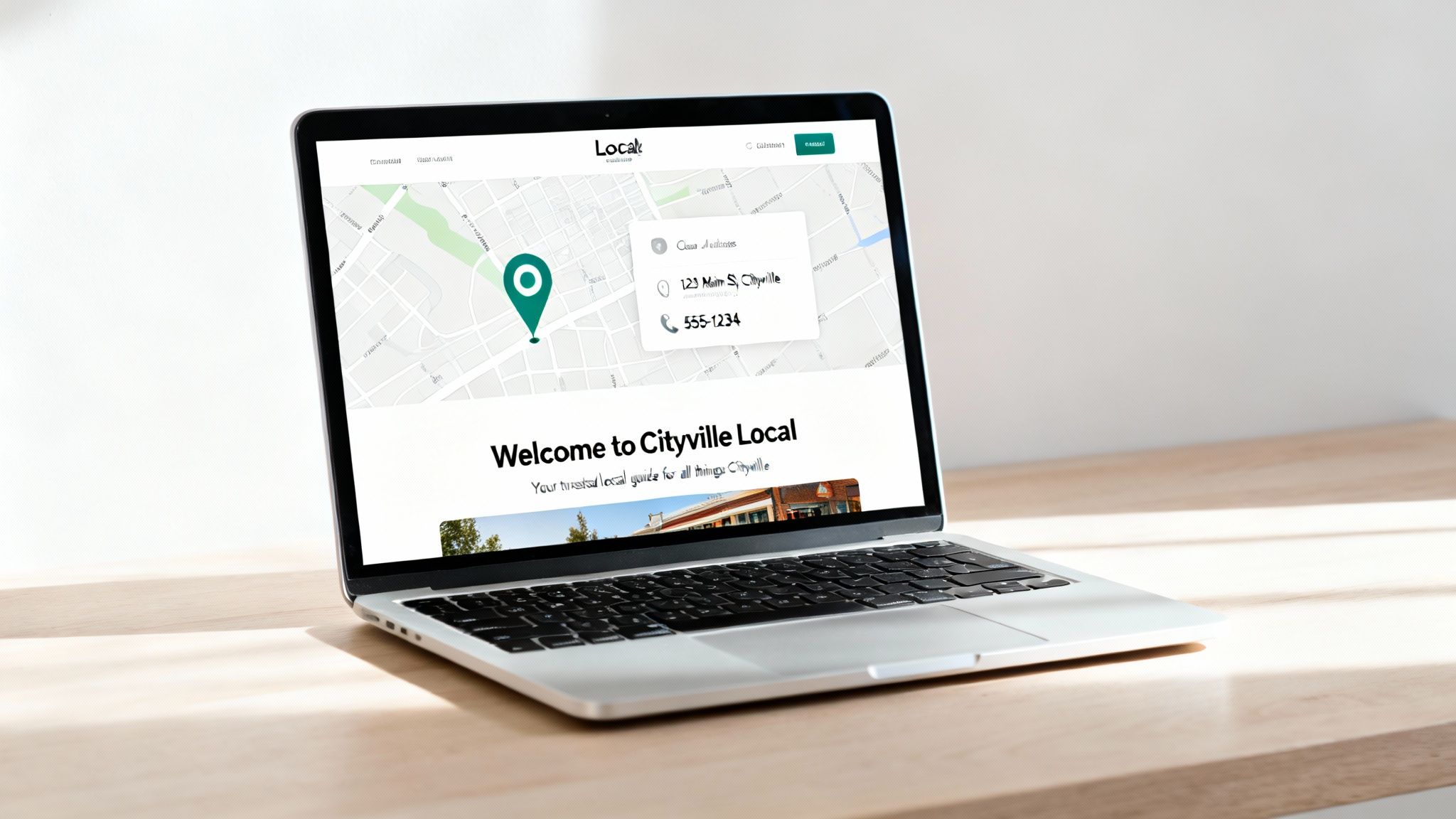
For businesses serving multiple areas or operating from several physical locations, simply listing addresses on a contact page is not enough. Creating dedicated, optimized location or service-area pages is a critical step in a local SEO audit checklist. These pages act as targeted digital hubs for each specific market, signaling to Google that you have a strong, relevant presence in that community and creating powerful entry points for local searchers.
Why It's Crucial for Local Authority
Dedicated location pages tell Google you are a legitimate local authority, not just a national entity with a minor footprint. When a user searches for "HVAC repair in Round Rock," a company with a detailed page specifically about its Round Rock services, team, and testimonials will have a significant advantage over a competitor with a single generic "service areas" page. This hyperlocal focus builds relevance and trust with both search engines and potential customers.
For example, a healthcare provider with clinics in North and South Austin should have separate pages for each. The North Austin page could feature its local doctors, specific services offered there, and directions from nearby landmarks. This unique content proves its commitment to that specific neighborhood, making it a better answer for a user searching for a doctor in that part of the city.
How to Audit and Optimize Your Location Pages
Auditing these pages involves checking for uniqueness, local relevance, and core on-page SEO elements. Your goal is to make each page a valuable, standalone resource for its target community.
- Create Unique, Substantial Content: Each location page must have unique content, avoiding duplication. Aim for at least 400-500 words describing your services in the context of that specific area, highlighting local projects, or introducing the local team.
- Include Local Business Information: Ensure each page clearly displays the unique Name, Address, and Phone number (NAP) for that specific location, along with its business hours.
- Embed a Google Map: Add an embedded Google Map showing the exact business location. This is a strong, tangible signal of your physical presence.
- Incorporate Local-Specific Elements: Use high-quality photos of the local storefront or team, and feature customer testimonials from that area. Linking these elements together helps in deconstructing SEO and provides a more holistic view of how to optimize your online presence for local searchers. Learn more about optimizing your online presence on giddsmedia.com.
6. Review Management and Response Strategy
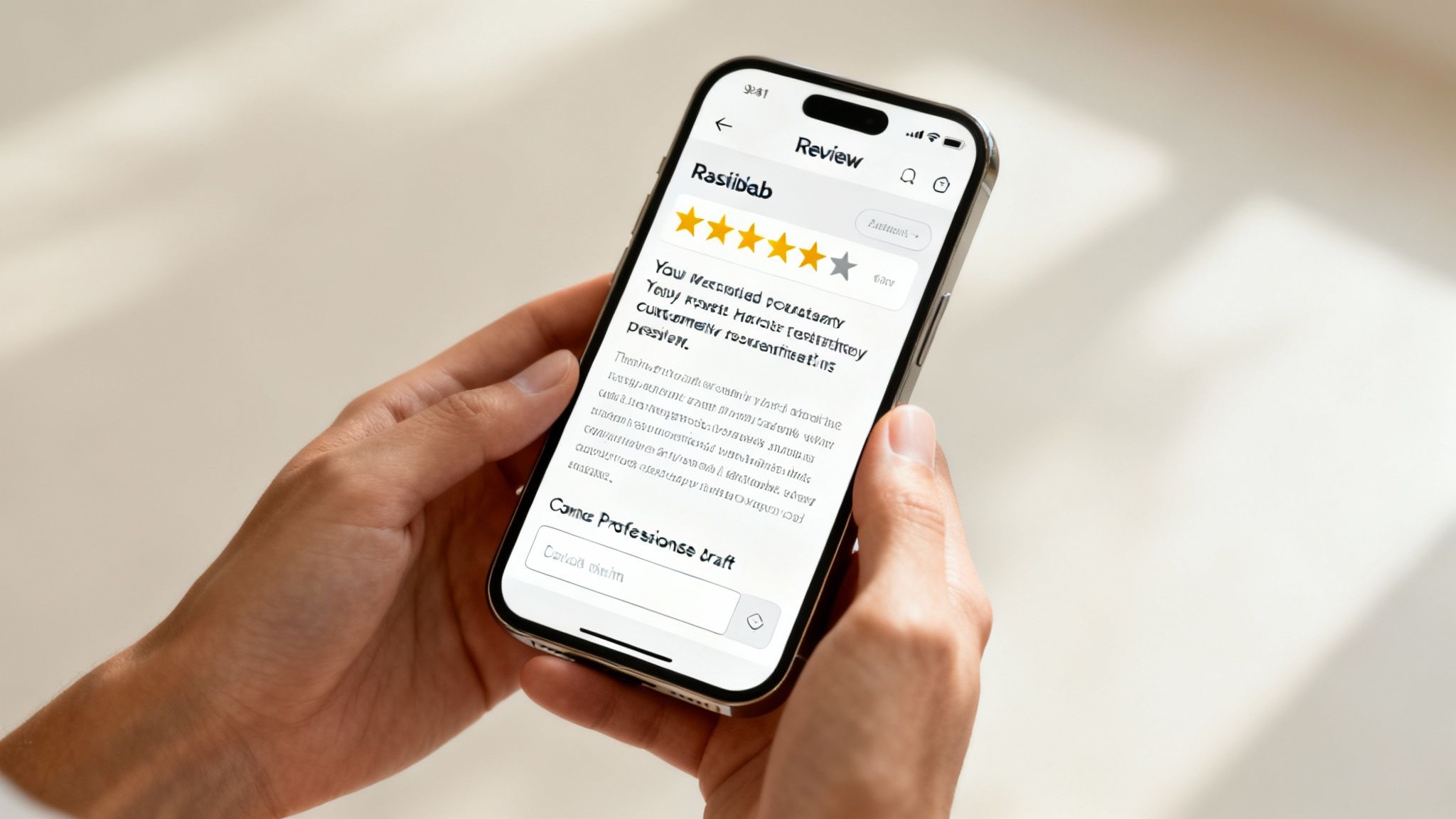
Your online reviews are a direct reflection of your business's reputation and a powerful ranking factor in local search. A systematic approach to monitoring, encouraging, and responding to customer feedback is not just good customer service; it's a critical component of any local SEO audit checklist. Google's algorithm rewards businesses that are actively engaged with their customers, and reviews provide rich, user-generated content that signals trustworthiness and relevance.
Why It’s a Key Trust Signal
Reviews are the digital equivalent of word-of-mouth marketing, directly influencing both search engine rankings and consumer decisions. A steady stream of positive reviews tells Google that your business is active, popular, and provides a quality experience, boosting your visibility in the Local Pack. Furthermore, 93% of consumers say that online reviews influenced their purchase decisions, making your review profile a crucial conversion tool.
For instance, a local plumber who actively requests reviews after a successful job and promptly thanks customers for their feedback builds a strong, positive reputation. In contrast, a salon that ignores a negative comment about a bad haircut risks deterring countless potential clients who see the unanswered complaint. Effectively managing online feedback includes a thoughtful approach to negative comments; learn effective strategies for how to respond to negative Google reviews.
How to Audit and Optimize Your Review Strategy
Auditing your review management involves assessing your current volume, sentiment, and response rate across all relevant platforms (Google, Yelp, Facebook, etc.). The goal is to create a proactive system rather than a reactive one.
- Establish a Response Protocol: Aim to respond to all reviews, both positive and negative, within 24-48 hours. A prompt reply shows that you value customer feedback.
- Create an Easy Review-Request Process: Implement a simple system to ask satisfied customers for reviews. This can be an automated email or SMS link sent after a service, or a QR code on a receipt.
- Respond Professionally and Empathetically: Thank customers for positive feedback. For negative reviews, acknowledge their experience, apologize sincerely, and offer a solution offline to resolve the issue.
- Monitor Review Trends: Regularly analyze your reviews to identify recurring issues or common praises. This feedback is invaluable for making operational improvements to your business.
7. Local Link Building and Authority Development
While high-authority backlinks from major websites are valuable, local link building focuses on acquiring links from sources that are geographically relevant to your business. These links act as powerful local endorsements, signaling to Google that your business is a trusted and established part of a specific community. Auditing your local backlink profile is a crucial step in a comprehensive local SEO audit checklist because it directly impacts your geographic authority and ability to rank for "near me" searches.
Why It's a Key Local Ranking Signal
Think of a local backlink as a digital referral from a neighbor. When a local chamber of commerce, a neighborhood news blog, or a complementary local business links to your website, it tells search engines you are a legitimate and active player in that area. This builds a web of local relevance that is difficult for non-local or national competitors to replicate, giving you a distinct advantage in the local SERPs.
For example, a law firm in Austin that earns a backlink from the Austin Bar Association and is mentioned in a local news story about a community event has stronger local signals than a firm with only generic legal directory links. Similarly, a restaurant sponsoring a local youth sports team and getting a link from the team’s website and local press coverage solidifies its community connection and boosts its local SEO.
How to Audit and Build Local Links
Begin by analyzing your current backlink profile using tools like Ahrefs or Semrush, filtering for links from local domains. From there, identify new opportunities to build a portfolio of geographically relevant links that reinforce your local presence.
- Join Local Organizations: Get listed in the directories of your local Chamber of Commerce, Better Business Bureau, and other relevant business associations.
- Sponsor Local Events: Sponsor a community festival, a charity run, or a little league team. Sponsorship often comes with a backlink from the event or organization’s website.
- Pursue Local PR: Reach out to local bloggers, news outlets, and community publications with newsworthy stories, such as a business anniversary, a new hire, or a charity initiative.
- Form Local Partnerships: Partner with non-competing local businesses for cross-promotions. For instance, a wedding planner could get a link from a local florist’s or venue's website.
8. Mobile-Friendliness and Local Search Performance
With the vast majority of local searches happening on smartphones, your website's mobile performance is no longer a "nice-to-have" feature; it's a critical ranking factor. A site that is difficult to navigate on a mobile device creates a frustrating user experience, leading to high bounce rates and lost customers. Auditing your site's mobile-friendliness is an essential part of any local SEO audit checklist because Google prioritizes mobile-first indexing and rewards sites that provide a seamless experience for on-the-go users.
Why It's Critical for Local Customers
Imagine a potential customer searching for "emergency plumber" or "restaurants near me" on their phone. If your website loads slowly, has tiny, unreadable text, or features buttons that are impossible to tap, they will immediately leave and go to a competitor. A mobile-optimized site ensures these high-intent users can find what they need, like your phone number or address, in seconds.
For example, a local restaurant's mobile site should have prominent buttons for "View Menu," "Make a Reservation," and "Get Directions." Similarly, a home service business should feature a large, easy-to-tap "Call Now" button at the top of the screen. These design choices directly translate local search traffic into actual phone calls and foot traffic, capturing customers at their moment of need.
How to Audit and Optimize for Mobile
The goal is to make it as easy as possible for a mobile user to become a customer. Use Google's Mobile-Friendly Test tool for a baseline analysis, but also conduct a manual review to assess the real-world user experience.
- Implement Responsive Design: Ensure your website automatically adjusts its layout to fit any screen size, from small smartphones to large tablets. This is the standard for modern web design.
- Prioritize Page Speed: Mobile users are impatient. Aim for a load time of under 3 seconds. Compress images, minify code, and leverage browser caching to boost performance. Learn more about the importance of website speed and performance.
- Simplify Navigation and Forms: Use a simple "hamburger" menu and design forms with large fields that are easy to fill out on a small screen. Minimize the number of required fields.
- Make Contact Information Accessible: Your phone number should be "click-to-call," and your address should link directly to Google Maps. Don't make users copy and paste information.
9. Local Schema Markup and Structured Data Implementation
Implementing structured data, specifically local schema markup, is like adding a layer of translation for search engines. It uses a standardized vocabulary (from schema.org) to explicitly tell Google what your content means. This removes guesswork, allowing search engines to understand crucial details like your address, business hours, services, and reviews, which is vital for any comprehensive local SEO audit checklist.
Why It's a Key Signal for Local Visibility
Structured data helps search engines parse and display your information in more engaging ways, such as in rich snippets or the Knowledge Panel. When Google can confidently understand your business's details, it's more likely to feature you prominently for relevant local searches. This direct communication enhances your visibility and can improve click-through rates by providing users with valuable information directly in the search results.
For example, a local restaurant using schema can have its star rating, price range, and even a "reserve a table" link appear directly under its name in search results. A home services company can use it to highlight its service area, phone number, and customer ratings, making it easier for a user to quickly evaluate and contact them without even clicking through to the website.
How to Audit and Optimize Your Local Schema
Auditing your schema involves checking for its presence, accuracy, and validity. The goal is to ensure the information provided to search engines is correct and formatted properly. Start by using Google's Rich Results Test tool to see what structured data is currently detected on your key pages.
- Implement
LocalBusinessSchema: This is the most important type for local entities. Ensure it is implemented on your homepage and contact page, including your business name, address, phone number (NAP), and business hours. - Use JSON-LD Format: While other formats exist, JSON-LD is Google's preferred method for implementing structured data. It's easier to deploy and manage without altering the HTML of your site.
- Include
AggregateRatingandReviewSchema: If you have reviews on your website, mark them up with schema. This can enable the coveted star ratings to appear in your search snippets, building immediate trust. - Validate Your Markup: After implementing or updating schema, always use tools like the Rich Results Test to ensure there are no errors. Incorrect implementation can do more harm than good.
10. Competitor Analysis and Local Ranking Benchmarking
Understanding what your local competitors are doing right (and wrong) is a crucial part of any local SEO audit checklist. This process involves systematically analyzing their online presence, from their Google Business Profile to their website and citation profile, to identify opportunities for you to gain a competitive edge. It's not about copying them, but about benchmarking your performance and discovering strategic gaps you can exploit.
Why It's the Foundation of Local SEO
Local SEO is a zero-sum game; for you to move up in the Local Pack, someone else has to move down. By analyzing the top-ranking competitors for your target keywords, you can reverse-engineer their success. This insight helps you prioritize your own optimization efforts, focusing on the areas where your rivals are strongest or, more importantly, where they are weakest.
For example, a dental practice in a competitive neighborhood might find that the top three competitors all have over 100 Google reviews with a high average rating. This immediately signals that a proactive review generation strategy is non-negotiable. Similarly, a plumber analyzing local rankings might discover a competitor is dominating search results in a specific suburb because they have a location-specific service page that you lack, revealing a clear content opportunity.
How to Audit and Optimize Your GBP
A thorough competitive analysis provides a clear roadmap for your strategy. Start by identifying your top 3-5 direct local competitors, those who appear consistently in the Local Pack for your most important search terms.
- Benchmark Key Metrics: Create a spreadsheet to track your competitors' GBP name, categories, review count, average rating, and frequency of Google Posts. This gives you a clear, data-driven view of the competitive landscape.
- Analyze Their Citations: Use a tool to see which local and niche directories your competitors are listed in that you are not. These are often easy wins to build citation consistency and authority.
- Review Their On-Page SEO: Examine their website's homepage and service pages. Do they use local keywords in their title tags, headers, and content? Do they have dedicated, optimized pages for each service and location they serve?
- Monitor Their Activities: Keep an eye on their new reviews, new photos added to their GBP, and their Google Posts. This helps you stay agile and react to their marketing pushes, ensuring you don't fall behind.
10-Point Local SEO Audit Comparison
| Item | Implementation Complexity 🔄 | Resource & Time ⚡ | Expected Outcomes 📊 ⭐ | Ideal Use Cases 💡 | Key Advantages ⭐ |
|---|---|---|---|---|---|
| Google Business Profile Optimization | Low–Medium — setup straightforward; needs ongoing updates | Low cost; weekly maintenance (photos, posts, replies) | Increased local visibility; improved Maps/Local Pack presence 📊 | Single-location storefronts, restaurants, clinics | Prominent SERP/Maps placement; free; direct customer interaction |
| NAP Consistency Across Citations | Low but meticulous — audit and cleanup required 🔄 | Time-consuming audits; monthly monitoring recommended ⚡ | Stronger trust signals; fewer duplicate/incorrect listings 📊 | Businesses with many listings or recent moves | Builds search engine trust; reduces customer confusion |
| Local Citation Building & Directory Submission | Medium — many manual submissions, some automation possible 🔄 | Moderate time; some paid listings or tools ⚡ | More local citations and referral traffic; backlink opportunities 📊 | New local businesses, trades, service providers | Boosts local visibility and authority; often low-cost listings |
| Local Keyword Research & Optimization | Medium — research then content/metadata updates 🔄 | Tool subscriptions and analyst time; ongoing updates ⚡ | Higher relevance for local queries; better conversion intent 📊 | Businesses targeting city/zip-specific searches | Easier to rank for geo-terms; targets high-intent visitors |
| Website Content Localization & Location Pages | High — content creation and site architecture work 🔄 | Significant content + dev resources; ongoing maintenance ⚡ | Strong ranking gains for multi-location searches; better UX 📊 | Multi-location businesses, franchises, regional services | Scales local relevance; creates targeted entry pages |
| Review Management & Response Strategy | Medium — process + templates and monitoring 🔄 | Ongoing monitoring and response time; review tools ⚡ | Improved credibility, CTR, and local ranking signal 📊 | Hospitality, restaurants, service-based businesses | Builds trust, operational feedback, reputation control |
| Local Link Building & Authority Development | High — outreach, partnerships, and sponsorships 🔄 | Time-intensive outreach; possible sponsorship costs ⚡ | Stronger local authority and referral traffic 📊 | Businesses seeking PR, community presence, or niche authority | High-relevance backlinks; strengthens local signals |
| Mobile-Friendliness & Local Search Performance | Medium–High — responsive design and performance tuning 🔄 | Development, testing, and optimization tools; periodic audits ⚡ | Better mobile UX, faster conversions, mobile-first ranking boost 📊 | Businesses with high mobile search intent (food, services) | Higher conversion rates; click-to-call and map usability |
| Local Schema Markup & Structured Data | Medium — technical implementation (JSON-LD) 🔄 | Developer time and validation tools; occasional updates ⚡ | Enhanced SERP appearance (rich snippets), higher CTR 📊 | Businesses wanting rich results, voice search optimization | Improves search snippet visibility; machine-readable data |
| Competitor Analysis & Local Ranking Benchmarking | Medium — data collection and analysis workflow 🔄 | Tool subscriptions and analyst time; ongoing tracking ⚡ | Identifies gaps, quick wins, and measurable benchmarks 📊 | Competitive local markets; strategy planning and audits | Actionable insights; prioritizes high-impact opportunities |
From Checklist to Action: Your Next Steps for Local SEO Growth
You have now worked through a comprehensive local SEO audit checklist, a crucial first step in diagnosing the health of your online presence. This process, from scrutinizing your Google Business Profile to analyzing local schema markup, is designed to uncover the specific opportunities and weaknesses that define your visibility to customers in your service area. Think of this audit not as a final exam, but as a detailed map that reveals the most direct routes to growth.
The true value of this exercise lies in what comes next: turning insight into sustained action. You have identified inconsistencies in your NAP data, pinpointed gaps in your local keyword strategy, and benchmarked your performance against local competitors. Now, the real work of climbing the local search rankings begins. This isn't about tackling everything at once; it's about strategic prioritization and consistent effort.
Prioritizing Your Action Plan
The severity and impact labels throughout this checklist are your guide. Your initial focus should be on the foundational elements that have the most significant and immediate impact on how search engines and customers perceive your business.
- High-Priority Fixes (The Foundation): Start here. Flaws in your Google Business Profile (GBP) and inconsistent NAP citations are like cracks in your foundation. They undermine every other effort you make. Correcting your business name, address, and phone number across all major directories and optimizing every section of your GBP should be your absolute first priority. These are the non-negotiables of local search.
- Medium-Priority Enhancements (The Framework): Once your foundation is solid, you can build upon it. This includes tasks like developing a proactive review management strategy, creating detailed location pages for each of your service areas, and ensuring your website is perfectly optimized for mobile users. These actions directly improve user experience and build trust signals that Google rewards.
- Long-Term Initiatives (The Finishing Touches): Finally, focus on the ongoing, authority-building activities. Consistent local link building, implementing advanced schema markup, and regularly publishing localized content are marathon tasks, not sprints. While they may not produce overnight results, they are essential for establishing long-term market dominance and defending your rankings against competitors.
The Marathon of Local SEO
Completing this local seo audit checklist is a monumental achievement. It provides clarity and direction where there might have been confusion. However, the digital landscape is constantly evolving. Google updates its algorithms, new competitors enter your market, and customer search behavior changes. Local SEO is an ongoing commitment to monitoring, adapting, and executing.
This checklist should become a recurring tool in your marketing arsenal, revisited quarterly or semi-annually to ensure you remain on the right track. Staying ahead requires vigilance. But if the prospect of managing this intricate process feels overwhelming, or if you simply lack the time and resources to implement these changes effectively, it may be the perfect time to seek a strategic partner. An expert can transform your audit findings into a powerful, executed strategy, freeing you to focus on what you do best: serving your customers and running your business.
Ready to turn your audit into action with expert precision? The team at Gidds Media specializes in executing comprehensive local SEO strategies for Austin businesses, transforming checklist items into measurable growth and increased customer traffic. Get a free, no-pressure analysis from our experts to see exactly what your roadmap to local success looks like.


