

A request for proposal (RFP) for a website redesign is your first, best shot at getting the project right. Think of it as the strategic blueprint that lays out your goals, scope, and technical must-haves for potential web design agencies.
It’s not just a to-do list; it’s the foundational tool that gets your own team on the same page, sets crystal-clear expectations, and—most importantly—attracts the right kind of partner. You want an agency that delivers a real return on investment, not just a fresh coat of paint.
Why a Great RFP Is Your Redesign's Secret Weapon

Let's be honest: writing a request for proposal for a website redesign feels like a chore. It’s tempting to rush through it or download a generic template just to check a box. But cutting corners here is a massive mistake—one that leads straight to mismatched partners, blown budgets, and a final website that completely misses the mark.
Your RFP isn’t a hurdle to jump over. It’s the single best opportunity you have to translate that vision in your head into a concrete plan that a creative agency can actually build.
Getting Your Internal Team Aligned
Before you can explain what you need to an outside agency, everyone on your team has to agree on what that is. The process of building an RFP forces your key stakeholders—from marketing and sales to IT and the C-suite—to get in a room and hash things out.
This is where you answer the big questions that prevent headaches and arguments down the road:
- What’s the real business goal here? Are we trying to generate more qualified leads? Drive e-commerce revenue? Make life easier for our customer support team?
- Who are we building this for? Has our target audience changed? What do they actually need from our site today that they weren’t getting before?
- What are the technical non-negotiables? Does the new site absolutely have to integrate with our HubSpot CRM or Salesforce?
Nailing down these details upfront means you present a united front. The proposals you get back will be based on a coherent, shared vision, not a jumble of conflicting priorities.
A well-crafted RFP does more than just solicit bids; it forces internal clarity and strategic alignment. It’s the difference between asking for 'a new website' and asking for 'a lead generation engine that increases qualified demos by 25%.'
Setting Clear Expectations and Attracting Quality Partners
Vague RFPs get you vague proposals. It’s that simple. If you don't define your objectives, you’ll get cookie-cutter responses from agencies that haven't taken the time to understand your business.
On the other hand, a detailed, thoughtful RFP signals that you're a serious and organized client. This is exactly what attracts high-quality agencies. They appreciate the clarity because it lets them skip the guesswork and propose genuinely innovative solutions to your specific problems.
For example, clearly stating that you need an engaging and converting homepage shifts the entire conversation. It’s no longer about a list of deliverables; it’s about a strategic partnership focused on results. This clarity is your best defense against the dreaded scope creep and budget surprises that derail so many redesign projects.
Building the Core of Your Website Redesign RFP
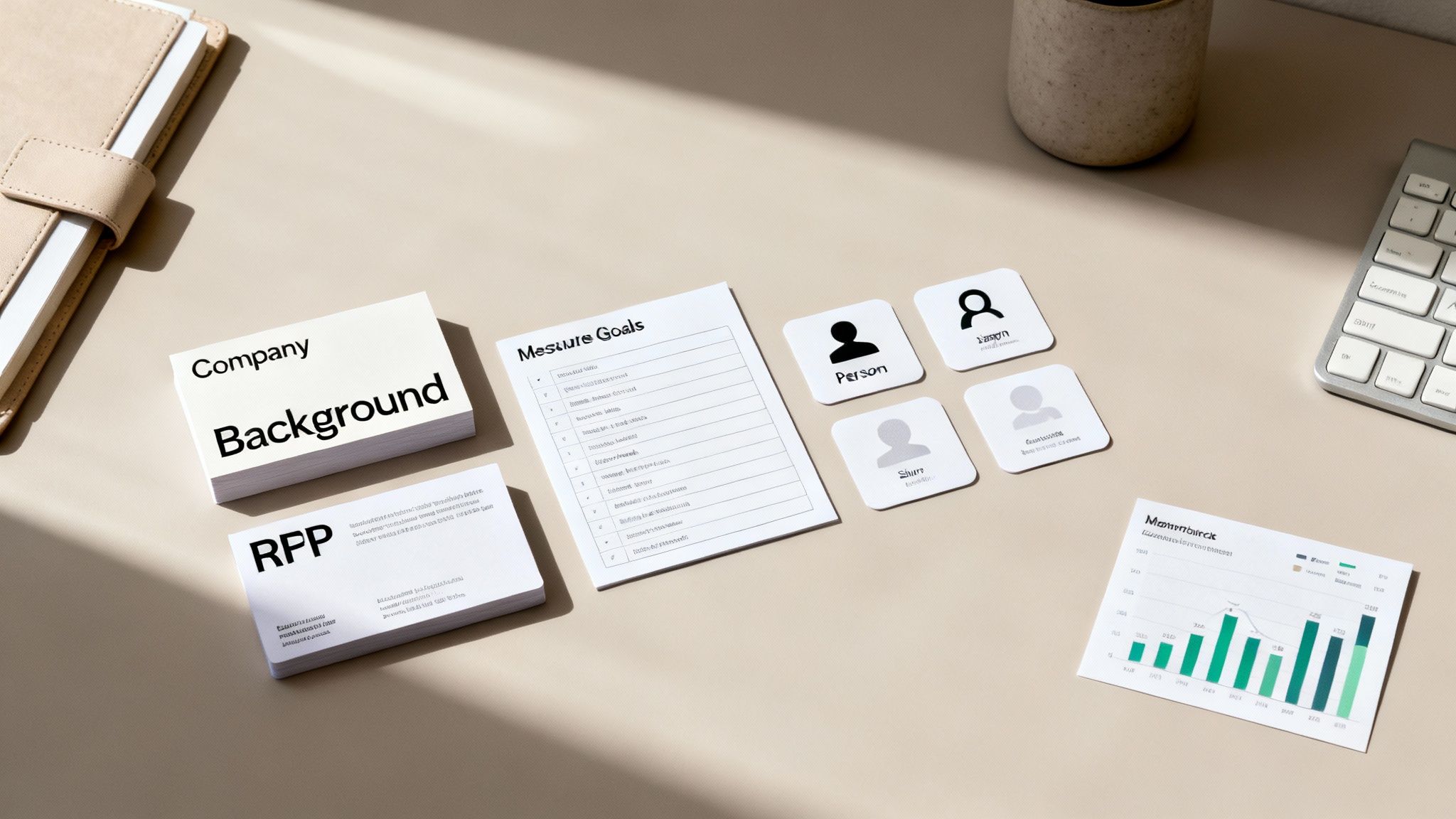
Alright, your team is on the same page. Now it’s time to get into the heart of your request for proposal for a website redesign. This is where you graduate from big ideas to the nitty-gritty details—the stuff a great agency needs to build a proposal that actually solves your problems. Forget generic templates. This is where you tell your story and define what a win looks like for you.
Think of the next few sections as the essential chapters in your project’s story. Each one provides critical context that prevents guesswork and helps potential partners understand not just what you want, but why you want it. This is what separates an RFP that gets a quick glance from one that attracts top-tier agencies.
What’s Your Story? Frame Your Company Background
Kick things off by introducing your company, but please, go beyond just copying and pasting your "About Us" page. This is your chance to give agencies a real feel for your market position, brand personality, and what makes you tick. They need to understand the business they’re being asked to represent online.
Give them the full picture with details like:
- Your Mission and Values: What gets you out of bed in the morning? What principles guide your business?
- Your Market Position: Who are you up against? What do you do better than anyone else?
- A Little History: Share a milestone or two that defines your journey and explains how you got here.
This narrative helps a design team grasp your brand’s authentic voice. It’s the difference between getting a design that feels true to you versus one that looks like a generic theme pulled off the shelf.
From Vague Goals to Real, Measurable Outcomes
"We want a modern, user-friendly website" is where everyone starts, but it’s a wish, not a goal. The best RFPs translate these feelings into SMART objectives—specific, measurable, achievable, relevant, and time-bound. This clarity is the foundation of a project that actually delivers results.
Instead of saying you want "better engagement," get specific. What does that actually mean for your business?
Try aiming for goals like these:
- Increase qualified lead form submissions by 30% within six months of launch.
- Decrease the bounce rate on key service pages by 20% in the first quarter post-launch.
- Improve mobile conversion rates from 1.5% to 3% by year-end.
Metrics like these give agencies a clear target. They can then propose concrete strategies—like a streamlined navigation, faster load times, or punchier calls-to-action—that are directly tied to hitting those numbers. It's a data-driven approach, and for good reason. Poor user experience is the top catalyst for a redesign, motivating 61.5% of all projects. When you pair that with the fact that an outdated design drives 80% of redesigns, it's clear that focusing on measurable UX improvements is where you'll see a real return—a well-executed design can generate up to $100 for every $1 spent.
A great RFP doesn’t just list features; it connects every request to a business outcome. This shifts the conversation from 'How much will this cost?' to 'How will this investment generate a return?'
Who Are You Talking To? Get Deep with Audience Personas
You aren't building this website for your team; you're building it for your customers. So, one of the most valuable things you can put in your RFP is a detailed audience persona. And I mean detailed—go way beyond basic demographics like age and location.
Dig into the "why" behind their behavior. What are their motivations, frustrations, and goals when they land on your site?
Here’s a quick example: "Service-Seeking Sarah"
- Role: Small Business Owner
- Pain Point: Her current supplier is unreliable, which causes project delays and costs her money. She’s stressed out and losing trust in her partners.
- Goal: She needs to find a dependable, local provider with transparent pricing and clear communication. Before she even thinks about making contact, she needs to see social proof like testimonials and case studies.
This level of detail helps an agency map out the user's emotional and practical journey. They can design a flow that directly addresses Sarah’s anxieties, builds her confidence, and guides her straight to a solution.
A Brutally Honest Look at Your Current Website
Finally, it’s time for a frank assessment of your current website. This isn’t about making a list of colors you hate; it's about using data to identify what's actually broken. Dive into your analytics and come back with cold, hard evidence of the problems that need fixing.
Your analysis should touch on these key areas:
- Traffic and Engagement Metrics: Point out pages with sky-high bounce rates or where visitors barely spend any time. Is your blog getting traffic but failing to turn readers into leads?
- Conversion Funnel Drop-offs: Where are people abandoning the checkout process or getting stuck on a contact form?
- Technical and SEO Issues: Be upfront about slow page speeds, a clunky mobile experience, or a drop in organic search rankings for your most important keywords.
- Content and UX Gaps: Is crucial information buried? Is the navigation a confusing mess?
Providing this self-audit shows you've done your homework and are serious about a strategic, data-informed redesign. It gives agencies a clear diagnostic report, allowing them to prescribe an effective treatment plan. A successful redesign is built on this kind of clarity, and a well-defined scope is non-negotiable. If you're struggling, learn how to write a comprehensive website scope document to ensure every detail is covered. It's this level of detail that enables an agency to deliver a proposal that truly solves your problems.
Translating Your Vision into Technical Requirements
This is where the rubber meets the road. All the big ideas and strategic goals for your new website start to become a tangible blueprint right here. It's easy to get intimidated by the technical jargon, but don't sweat it. This part of your request for proposal for a website redesign is just about spelling out what the website needs to do—both for the people using it and for your team managing it.
You aren't expected to be a developer. The real goal is to give agencies enough clear direction so they can scope the project accurately, suggest the right tech, and give you a realistic quote. Getting this part right is your best defense against miscommunications and surprise costs down the line.
Outlining a Clear Scope of Work
Think of the "Scope of Work" as the detailed checklist for your project. This is where you list everything the project needs to cover, and being vague is a surefire recipe for scope creep—when those "small additions" slowly blow up your timeline and budget.
Start by mapping out the site's structure and the key features you absolutely need. Be as specific as you can.
Here are a few things to nail down:
- Estimated Number of Pages and Templates: Give a rough count of the unique page designs you'll need (like a homepage, a service page, a blog post, a contact page) and an estimate of the total number of pages. This directly shapes the design and development effort.
- Critical Functionalities: This is your list of non-negotiables. What must the website do for you to hit your business goals? Think e-commerce checkout, an event calendar, or a members-only portal.
- Third-Party Integrations: Make a list of any software your new site has to play nice with. This could be your CRM (like Salesforce or HubSpot), an email platform (like Mailchimp), or payment gateways (like Stripe or PayPal).
The more specific your scope, the more accurate the proposals you'll get. Don't just say, "we need a contact form." Instead, specify, "we need a multi-step contact form that integrates with HubSpot and sends an automated confirmation email to the user." Big difference.
To help you think through what's essential for launch versus what could maybe wait, we've put together a table to help you prioritize. It's a great way to keep your scope (and budget) in check from the get-go.
Essential vs. Nice-to-Have Website Features
| Feature Category | Essential (Must-Have for Launch) | Nice-to-Have (Phase 2 or Stretch Goal) |
|---|---|---|
| User Experience | Mobile-responsive design, clear navigation, fast load times (Core Web Vitals), basic contact form. | Interactive maps, animated page transitions, advanced search filters, user personalization. |
| Content & Marketing | Blog or news section, basic SEO fields (title, meta), social sharing buttons, email signup form. | Gated content (e-books, whitepapers), video library, customer case study template, multilingual support. |
| E-Commerce | Secure checkout, product pages, shopping cart, basic order management, Stripe/PayPal integration. | Customer accounts, saved payment methods, product reviews, abandoned cart emails, subscription models. |
| Integrations | Google Analytics, CRM integration (e.g., HubSpot), email marketing platform integration (e.g., Mailchimp). | Live chat software, marketing automation workflows, inventory management system sync, webinar platform integration. |
| Admin & Security | SSL certificate (HTTPS), daily backups, user roles and permissions, intuitive CMS interface. | Two-factor authentication for admins, advanced security monitoring, staging environment for testing. |
Use this table as a starting point. Your "essentials" will be unique to your business, but separating the must-haves from the nice-to-haves is a crucial step in building a realistic RFP.
Specifying CMS and Platform Requirements
The Content Management System (CMS) is the engine under the hood of your website. It’s the backend dashboard your team will use every single day to add blog posts, update page copy, and manage the site. Your choice here has long-term consequences for usability, security, and your ability to grow.
You don't need to have a platform already picked out. Instead, describe what you need the CMS to do. This empowers agencies to recommend the best fit, whether that's a workhorse like WordPress, a headless system like Contentful, or something else entirely.
To figure out your needs, ask your team these questions:
- Who will be using the CMS? Just the marketing team, or will you need different access levels for sales, HR, and other departments?
- How user-friendly does it need to be? Are you looking for a simple drag-and-drop interface for non-technical folks, or is your team comfortable with more powerful (and complex) systems?
- What kind of content will you manage? Are we just talking basic pages and a blog, or will you be handling things like event calendars, product catalogs, or a full-blown knowledge base?
For example, if content marketing is your bread and butter, you'd specify the need for an intuitive blog editor with built-in SEO tools. If you’re running an e-commerce site, you’ll need to detail requirements for product management, inventory tracking, and processing orders.
Making SEO and Accessibility Core Pillars
Search Engine Optimization (SEO) and web accessibility aren't sprinkles you add on at the end. They have to be baked into the website's DNA from the very first line of code. Forgetting to demand this in your RFP is one of the most expensive mistakes you can make.
A beautiful website that no one can find on Google or that people with disabilities can't use is a failed investment. Period. A huge piece of this foundation is responsive design. In fact, a lack of it is why 53.8% of web designers say a site needs a redesign. That makes sense, especially when you consider that by 2025, an estimated 1.2 billion websites will be responsive to serve users on any device.
Your RFP needs to be crystal clear about your expectations for both SEO and accessibility.
Essential SEO Requirements:
- Technical SEO Health: The site has to be built on a foundation of clean code, fast page speeds (Core Web Vitals), and a logical structure. To get a better handle on what to ask for, check out our guide on technical SEO best practices.
- Mobile-First Indexing: The site must be designed and built for a flawless mobile experience first. This isn't optional anymore—it's how Google primarily crawls and ranks websites.
- SEO Migration Plan: If you're redesigning an existing site, you must require the agency to provide a detailed plan to protect your current search rankings. This involves meticulously mapping old URLs to new ones with 301 redirects.
Critical Accessibility Needs:
- WCAG Compliance: Specify the level of Web Content Accessibility Guidelines (WCAG) you need to meet, like WCAG 2.1 AA. This is the global standard for making the web accessible and is a legal requirement in many places.
- Keyboard Navigation: Every button, link, and form on the site must be fully usable with just a keyboard.
- Semantic HTML: The site must use proper HTML5 tags (like
<nav>,<main>,<footer>) so screen readers and other assistive tools can understand and navigate the content correctly.
Defining Timelines, Budgets, and How You'll Judge Success
This is where your vision and specs meet the real world of calendars and spreadsheets. Nailing down a realistic timeline, being upfront about your budget, and deciding how you'll pick a winner are absolutely critical.
Skipping this part of your request for proposal for a website redesign is like planning a road trip without a map or a wallet—you’re not going to get very far.
Being clear about these logistics does more than just keep you organized. It signals to agencies that you’re a serious, professional partner who respects their time and expertise. That alone will get you better, more thoughtful proposals.
Setting a Realistic Project Timeline
One of the most common mistakes I see is rushing the RFP process. High-quality agencies are often booked out, and a super-tight deadline can force them to submit a generic proposal or just skip your project entirely.
A well-paced timeline allows for thoughtful responses and shows that you value a strategic partnership over a quick transaction.
Here’s a practical timeline you can adapt:
- RFP Release to Submission Deadline (2-3 weeks): This gives agencies enough time to actually digest your document, hold internal strategy sessions, and ask smart, clarifying questions before writing a single word.
- Internal Review of Proposals (1-2 weeks): Block out dedicated time for your team to read and score each proposal against the criteria you've set. Don't try to cram it in between meetings.
- Finalist Interviews (1 week): Pick your top 2-3 agencies and schedule one-hour calls. This is your chance to discuss their proposals, meet the team you'd be working with, and see if the chemistry is there.
- Final Selection and Contract Negotiation (1-2 weeks): After you've checked references, you can make your final call and move into the contracting phase.
All told, this is a 5-8 week process from the day you send the RFP to the day you sign. It’s a significant time investment, but it's essential for making an informed decision that you won't regret six months down the line.
Rushing an RFP is a false economy. The week you might 'save' by setting a tight deadline could cost you months of frustration and thousands of dollars with the wrong partner.
The Great Budget Debate: Be Transparent
So many companies hesitate to include a budget in their RFP. They worry it will anchor the pricing and they won't get a "deal." In my experience, the opposite is true.
Hiding your budget leads to a massive waste of time for everyone. You’ll get proposals that are wildly out of your price range sitting next to lowball offers from agencies that will inevitably cut corners.
Providing a realistic budget range (e.g., "$25,000 – $40,000") is the mark of a savvy client. It empowers agencies to scope a solution that delivers the maximum value within your financial reality. They can propose what's truly possible, balancing the must-haves with innovative ideas that fit what you can actually afford.
Website redesigns are a significant investment. Agency costs often fall between $15,000 and $30,000, and can easily climb to $40,000 – $75,000 for more complex sites. Timelines are also substantial; one survey found over half of companies expect their redesign to take more than six months. Despite this, 73% of businesses are actively investing in their websites to stand out. You can discover more web design statistics to help benchmark your project.
The process flow below shows the core technical considerations that drive these timelines and costs.
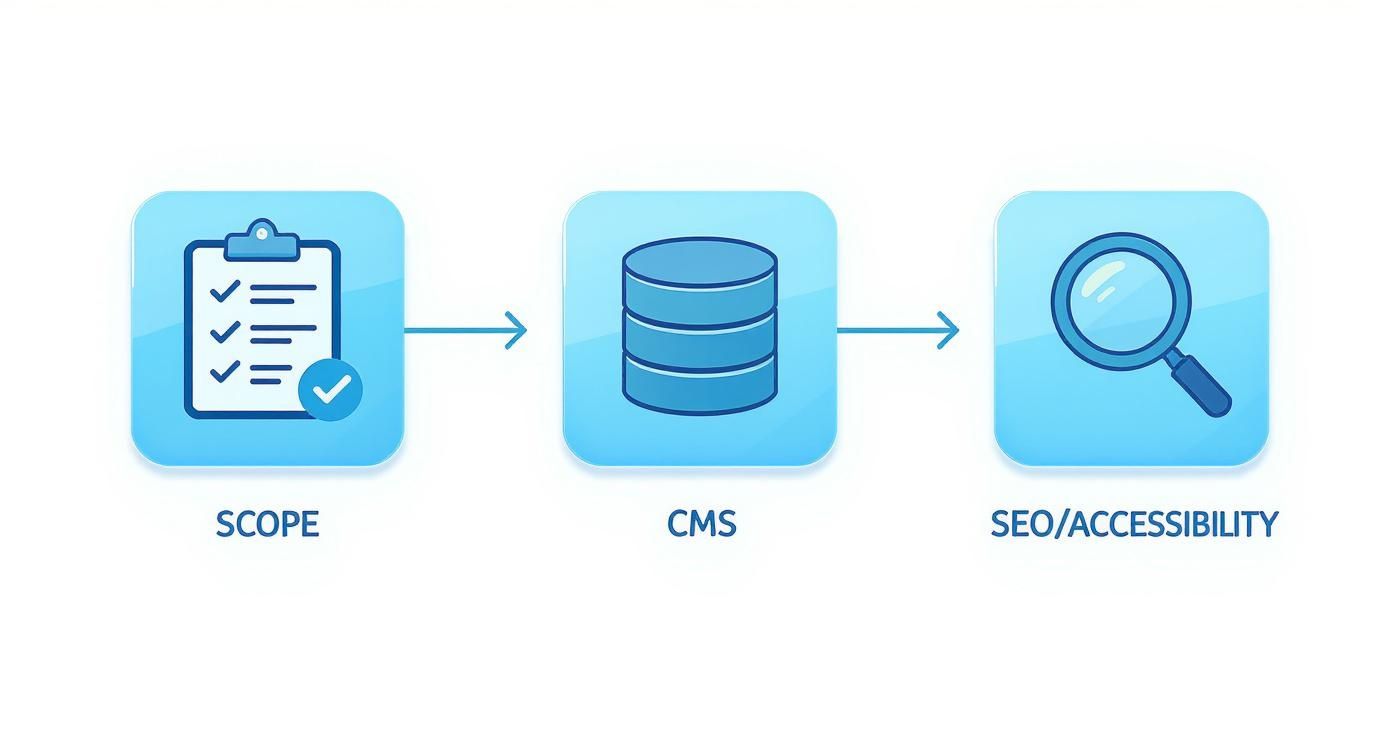
This visual really hammers home that a successful redesign is built on three pillars—a clear scope, the right CMS, and a solid commitment to SEO—all of which have to be factored into your timeline and budget.
Creating a Fair Evaluation System
Once proposals start rolling in, how are you going to compare them objectively? Relying on "gut feeling" or just picking the cheapest option is a recipe for disaster. The best move is to create a simple scoring matrix before you even send the RFP.
This makes sure every stakeholder on your team is judging proposals by the same standards. It keeps the process fair, transparent, and focused on what really matters to your business.
Your scoring matrix should weigh criteria based on what's most important to you. For instance:
| Evaluation Criteria | Weight | Description |
|---|---|---|
| Portfolio & Case Studies | 25% | Does their past work show expertise in our industry? Do their case studies prove they deliver measurable results? |
| Proposed Solution & Strategy | 30% | Did they really get our business goals? Is their proposal a strategic plan or just a list of features? |
| Technical Expertise & Process | 20% | Is their process for discovery, design, and development clear? Do they prioritize SEO from the start? |
| Team & Cultural Fit | 15% | Did we feel a good connection with the team? Is their communication style a good match for ours? |
| Budget & Value | 10% | Is the price fair for the value proposed? This isn't about being the cheapest; it's about the best return on investment. |
Using a system like this transforms a subjective decision into a structured, data-informed choice. It forces you to look past the slick presentations and evaluate which agency is truly the best long-term partner for your success.
How to Spot a Winning Proposal and the Right Partner

The proposals are in. Now for the hard part. It’s tempting to get wowed by slick mockups or jump at the lowest price, but that’s rarely where the best partnerships are found.
A winning proposal is more than a quote; it’s the first real glimpse into how an agency thinks and operates. The best ones show they didn’t just scan your request for proposal for a website redesign—they got it. You'll see them connect their solutions directly back to the business goals you laid out, proving they’re focused on your success, not just checking off a list of deliverables.
Reading Between the Lines
You can tell a lot about an agency by how they structure their proposal. A truly thoughtful one is personalized. It will reference specific pain points you mentioned and offer initial ideas on how to tackle them. If you get a generic, copy-paste response, that’s a huge red flag. It signals a one-size-fits-all approach that just doesn't work for custom projects.
Also, look for proposals that ask smart questions. Did they point out a potential roadblock you hadn't considered? Did they ask for more data to back up an assumption? That's a fantastic sign. It means they're already thinking like a partner, not just a vendor.
A winning proposal feels less like a sales pitch and more like the beginning of a strategic conversation. It should make you feel understood and confident that the agency is as invested in your business goals as you are.
Critical Red Flags to Watch For
On the flip side, some proposals should send you running. Spotting these early will save you from a world of headaches down the road.
Be on the lookout for these warning signs:
- A Lack of Questions: An agency that submits a proposal without a single clarifying question either didn't read your RFP carefully or isn't interested in a collaborative process. Both are bad news.
- Overemphasis on Vague Buzzwords: Be wary of proposals filled with jargon about "synergy" and "disruption" but light on actual details. You want to see their process, a realistic timeline, and clear deliverables—not fluff.
- An Unrealistic Price Tag: A bid that comes in dramatically lower than all the others isn't a bargain; it’s a warning. It often means they've misunderstood the scope or plan to cut corners on essentials like QA testing or proper SEO migration.
Interview Questions That Reveal the Truth
Once you’ve narrowed it down to your top two or three contenders, the interview is where you dig in. Your goal is to get a feel for their process, communication style, and how they handle the inevitable bumps in the road.
Go beyond their portfolio with questions that get to the heart of how they work:
- "Can you walk me through a time a project went off-track and how you got it back on course?" This tests their problem-solving chops and transparency.
- "Who from your team will be my day-to-day contact, and what does your communication cadence look like?" This sets clear expectations around project management and how responsive they’ll be.
- "How do you handle scope changes or new feature requests mid-project?" Their answer reveals how they manage scope creep and whether you’ll be blindsided by extra costs.
- "What CMS do you recommend for our project, and why is it the best fit for our team's technical skill level?" This ensures they've actually considered your internal resources. For many businesses, it's worth thinking about moving to WordPress or another platform, but a good partner will explain why it's the right choice for you.
Finally, always, always check their references. Ask past clients about the agency's communication, their ability to hit deadlines and stay on budget, and the ultimate question: would they hire them again? And as you weigh your options, don’t forget to consider different engagement models, like working with dedicated offshore developers, which can sometimes be the perfect fit for specific technical needs. This due diligence is the final step to confidently choosing a partner who will set you up for success.
Common Questions About Website Redesign RFPs
Even with a great plan, a few practical questions always pop up when you're putting the final touches on a website redesign RFP. Getting these details right from the start makes the whole process smoother for you and every agency you invite to bid.
Let's clear up the most common last-minute hurdles.
How Long Should Agencies Get to Respond?
This is a big one. It's tempting to rush things, but giving agencies enough time to put together a thoughtful proposal is the single best way to get high-quality responses. A tight deadline usually gets you one of two things: a generic, copy-paste proposal or radio silence from the best agencies, who are often busy with client work.
For a typical website redesign, 2-3 weeks is the professional standard.
That window gives a good agency the breathing room they need to:
- Really dig into your requirements and business goals.
- Hold internal brainstorming sessions to come up with creative solutions.
- Circle back with clarifying questions to fill in any gaps.
- Develop a customized, strategic proposal—not just a price list.
Anything less than two weeks can signal that you're prioritizing speed over quality, which might make some top-tier partners hesitate.
Should I Use a Generic RFP Template?
Go ahead and download a template, but please, don't just fill in the blanks. Online templates are a fantastic starting point for structure and can remind you of sections you might have overlooked. But they can’t possibly capture what makes your business unique.
Believe me, experienced agencies have seen hundreds of RFPs. They can spot a generic template from a mile away. A boilerplate document sends the message that you're not fully invested in the process, which can lead to equally uninspired proposals.
Use a template for inspiration, but make sure the final document is written in your company’s voice and tailored to your specific project goals, audience, and brand.
The biggest mistake I see in RFPs is a heavy focus on visual design and feature checklists while completely glossing over the business objectives. A great RFP connects every single requirement back to a measurable goal. That’s what empowers an agency to propose a real solution, not just check off a list.
Do I Have to Include a Budget?
While no one can force you, it’s highly recommended. I get it—disclosing your budget can feel like showing your hand in a poker game. But holding this card close to your chest almost always wastes time for everyone.
Without a budget, you’re flying blind. You’ll get proposals that are completely out of sync with what you can actually afford, forcing you to toss them out immediately. On the flip side, you might get low-ball offers from agencies that will have to cut corners on strategy, quality, or testing just to make the numbers work.
Providing a realistic budget range (like $25,000-$40,000) shows you're a serious, prepared client. It allows agencies to scope a solution that delivers the most value for your investment, ensuring the proposals you get are relevant and viable from day one.
A well-crafted RFP is your first step toward a website that actually drives growth. If you need a partner who knows how to turn a website into your best salesperson, Gidds Media is here to help. We combine expert WordPress design with data-driven SEO to build sites that don't just look great—they perform. Let's talk about your project today.


