

In a competitive local market, simply having an online presence is not enough. Potential customers are searching for services and products 'near me' every second, and if your business isn't a top result, you are losing valuable leads to competitors just down the street. The key to capturing this high-intent local traffic is a finely tuned SEO strategy, and the foundation of that strategy is a thorough audit. This is where a detailed local SEO audit checklist becomes your most powerful tool, moving your efforts from guesswork to a data-driven plan for growth.
This comprehensive guide is designed specifically for small and medium-sized businesses ready to take control of their online visibility. We will break down the ten most critical areas of local SEO into actionable, prioritized steps. Forget vague advice; this is a strategic roadmap to identify weaknesses, capitalize on hidden opportunities, and transform your website into a powerful, 24/7 lead-generating machine for your local service area. You will learn precisely what to check, why it matters, and how to fix it.
This process involves meticulously examining every signal your business sends to search engines like Google. From optimizing your Google Business Profile and ensuring NAP (Name, Address, Phone Number) consistency to building local backlinks and managing reviews, each element plays a crucial role in how you rank. For a comprehensive, step-by-step approach, refer to The Ultimate Local SEO Checklist to ensure no stone is left unturned. Following this structured audit will give you a clear picture of your current performance and a direct path to dominating local search results. Let's dive in.
1. Google Business Profile Optimization
Your Google Business Profile (GBP), formerly Google My Business, is the single most critical element of your local SEO strategy. It's often the first impression a potential customer has of your business, acting as a digital storefront directly on Google Search and Maps. A complete and optimized profile doesn't just provide information; it builds trust and significantly boosts your visibility in the local pack, the block of three business listings that appear for local queries.
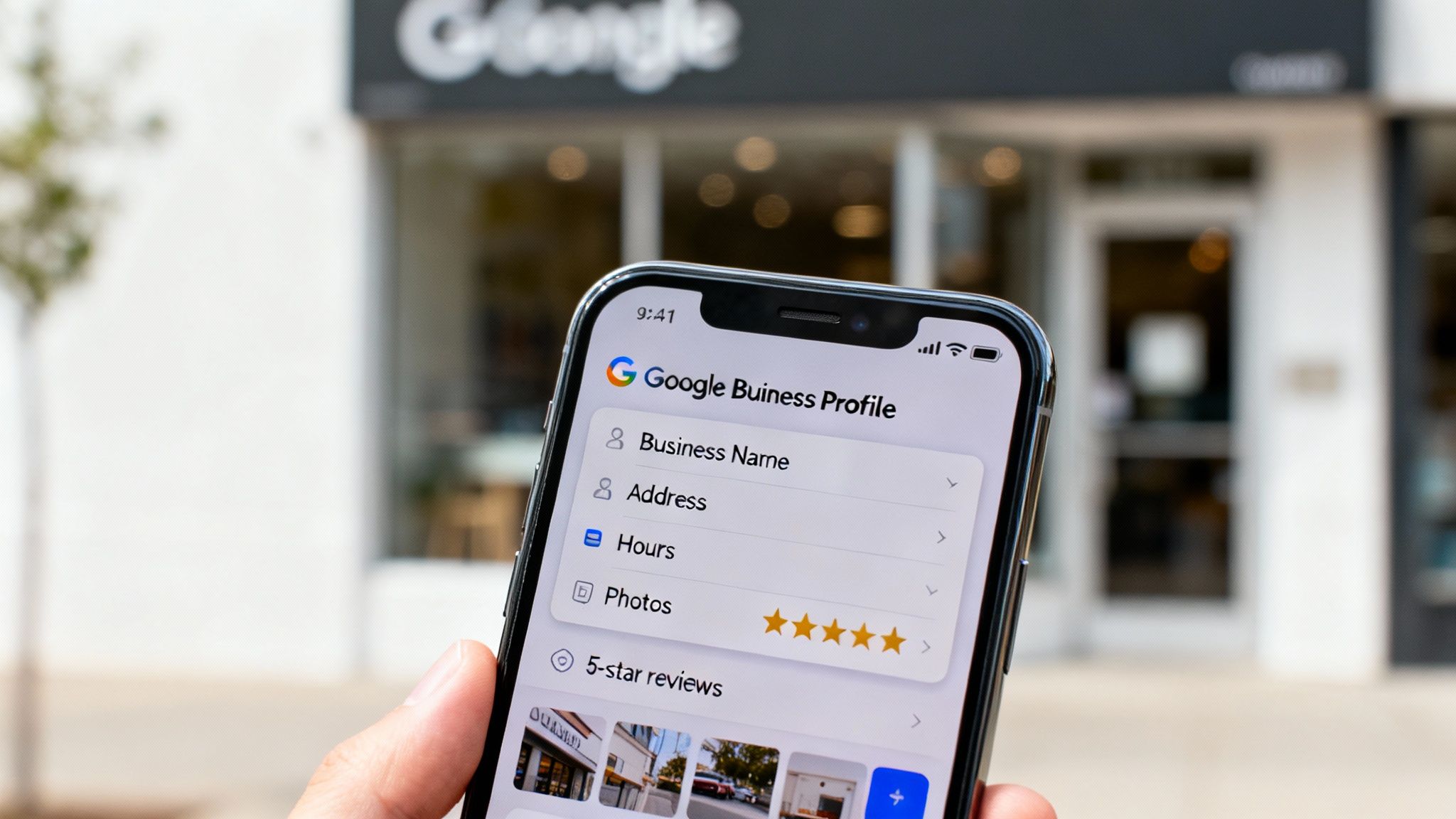
When conducting a local seo audit checklist, your GBP review should be the top priority. This involves verifying that every field is filled out accurately and strategically. Think of it from the customer's perspective: incomplete hours, a wrong phone number, or a lack of photos can be immediate red flags that send them to a competitor.
Key GBP Audit Actions
Here are the essential checks and optimizations for your profile:
- Core Information Accuracy: Double-check your business name, address, and phone number (NAP). Ensure they are identical across all online platforms.
- Categories: Select the most specific primary category for your business (e.g., "Plumbing Contractor" instead of just "Contractor"). Add relevant secondary categories to capture more specific searches.
- Business Hours: Keep hours updated, especially for holidays or special events. Use the "more hours" feature for specific services like delivery or senior hours.
- Photos and Videos: A robust visual portfolio is non-negotiable. Aim for at least 10-15 high-quality images covering your exterior, interior, team, and products or services in action.
- Products & Services: Detail your offerings directly in GBP. This helps Google understand your business and match you with relevant user queries.
- Reviews and Q&A: Actively manage this section. Respond to all reviews (positive and negative) promptly and pre-emptively answer common questions in the Q&A section.
Regularly updating your profile with posts, new photos, and responses signals to Google that your business is active and relevant, which can directly influence your local search ranking.
2. NAP Consistency Across Citations
After optimizing your Google Business Profile, the next pillar of your local foundation is NAP consistency. NAP stands for your business Name, Address, and Phone number. Ensuring this core information is identical across every online directory, social media profile, and citation site is a powerful trust signal for search engines like Google. Inconsistent information creates confusion, erodes trust, and can directly harm your local search rankings.

When executing your local seo audit checklist, verifying your digital footprint for NAP accuracy is non-negotiable. Search engines cross-reference this data from dozens of sources, from major platforms like Yelp and Apple Maps to niche industry directories. Every matching citation reinforces that you are a legitimate, established local business at a specific location, making Google more confident about showing your business in local pack results.
Key NAP Audit Actions
Here are the essential checks and optimizations for your citation profile:
- Establish a Master NAP: Create a single, definitive document with your official business name, address, and phone number. This becomes your source of truth for all future listings.
- Audit Existing Citations: Use tools like Semrush's Listing Management or BrightLocal's Citation Tracker to automatically scan the web for your business listings. These tools will flag inconsistencies, duplicates, and missing citations.
- Standardize Formatting: Pay close attention to small details. Decide whether to use "Street" or "St.", "Suite" or "Ste." and stick with it everywhere. Consistency is key.
- Prioritize High-Authority Sites: Begin your cleanup process with the most important platforms. Fix your website and GBP first, then move on to major data aggregators and top-tier directories like Facebook, Yelp, and Apple Maps.
- Address Inconsistencies Systematically: Once you identify errors, claim the listings and manually correct the information. This can be time-consuming but is crucial for building a clean citation profile.
- Build Relevant Citations: Beyond fixing errors, seek out new citation opportunities on reputable, industry-specific directories. A law firm should be listed on Avvo, while a restaurant should be on TripAdvisor.
A consistent NAP profile acts as a vote of confidence for your business in the eyes of search engines. Regularly auditing and cleaning up your citations is a fundamental practice that supports all other local SEO efforts and helps you outrank less diligent competitors.
3. Local Citations and Directory Listings
Beyond your Google Business Profile, your digital footprint across the web plays a crucial role in local search rankings. Local citations, which are online mentions of your business's name, address, and phone number (NAP), act as verification signals for search engines. When Google sees your business information listed consistently on reputable sites like Yelp, Apple Maps, and industry-specific directories, it reinforces the legitimacy and location of your business.
As part of your local seo audit checklist, evaluating citation health is essential for building local authority. Inconsistent or incorrect information across these platforms can confuse search engines and customers alike, directly harming your visibility. The goal is to create a consistent, widespread, and accurate network of citations that solidify your business's place in the local market.
Key Citation Audit Actions
Here are the essential checks and optimizations for your directory listings:
- NAP Consistency Audit: The cornerstone of citation management. Use a tool or manually check top directories to ensure your name, address, and phone number are absolutely identical everywhere.
- Directory Presence: Identify the most important directories for your industry. For example, a home services company must be on Angie's List and HomeAdvisor, while a restaurant should prioritize TripAdvisor and OpenTable.
- Profile Completeness: A citation is more than just NAP. Audit your top listings to ensure they have complete descriptions, correct business hours, high-quality photos, and a link to your website.
- Duplicate Listing Check: Search for duplicate listings for your business on major platforms and take steps to merge or remove them. Duplicates dilute your authority and can split your customer reviews.
- Citation Velocity: Assess the rate at which you are acquiring new citations. A slow, steady acquisition looks more natural to search engines than a sudden, one-time blast.
- Review Management: Monitor reviews on key third-party sites like Yelp and Facebook. Responding to feedback on these platforms shows engagement and builds trust beyond just your GBP.
Building and cleaning up your citations is a foundational task. By ensuring accuracy and relevance across the web, you send strong trust signals to Google, which can significantly improve your chances of appearing in the coveted local pack.
4. On-Page Local SEO Elements
While your Google Business Profile acts as your digital storefront on Google, your website is your brand's home base. On-page local SEO involves optimizing your site's content and HTML source code to clearly signal your location, services, and relevance to search engines. It’s how you tell Google, "I am the best [service provider] in [city]," directly through your website's architecture and content.
When you're running through a local seo audit checklist, scrutinizing your on-page elements is crucial. This step bridges the gap between your off-site profiles (like GBP) and your owned digital property. Failing to optimize your site for local intent means you're leaving significant ranking potential on the table, as Google relies on this content to validate the information it finds elsewhere.
Key On-Page Audit Actions
Here are the essential checks and optimizations for your website's local SEO:
- Location-Specific Pages: If you serve multiple areas or have several physical branches, create a unique, dedicated page for each one. A plumbing company, for instance, should have separate pages for "Emergency Plumber in Austin" and "Plumber in Round Rock" rather than one generic page.
- Keyword-Optimized Title Tags & Headers: Your title tags and H1 headers must include your primary keyword and location. For example, a title tag could be "Expert Dental Implants in Austin, TX | Downtown Smile Clinic".
- NAP in Footer/Header: Ensure your Name, Address, and Phone number (NAP) are consistently present in your website's footer or header, matching your GBP exactly.
- LocalBusiness Schema Markup: Implement LocalBusiness schema on your location pages. This structured data gives search engines precise details like your address, hours, and service area in a language they can easily process.
- Embed a Google Map: On your contact or location pages, embed a Google Map of your business address. This provides a strong, user-friendly local signal.
- Location-Rich Content: Write unique content for each location page. Mention local landmarks, discuss community involvement, or feature testimonials from local customers to demonstrate authentic local ties.
Properly optimizing your online presence with these on-page elements helps Google confidently connect your business to specific geographic searches, boosting your authority and visibility in your target service areas.
5. Review Management and Monitoring
In today's digital landscape, your online reputation is synonymous with customer reviews. Review management involves the strategic process of monitoring, encouraging, and responding to customer feedback across platforms like Google, Yelp, and industry-specific sites. These reviews are a powerful local ranking signal and one of the most significant factors influencing a potential customer's decision to choose your business over a competitor.

As part of any comprehensive local seo audit checklist, evaluating your review strategy is essential. A passive approach is no longer sufficient; you must actively cultivate a positive reputation. This means not only celebrating praise but also professionally handling criticism, turning potentially negative experiences into demonstrations of excellent customer service. Both Google and your customers want to see that you are engaged and value feedback.
Key Review Audit Actions
Here are the crucial checks and strategies for managing your online reputation:
- Response Time and Rate: Audit your recent reviews. Are you responding to both positive and negative feedback? Aim to respond to all new reviews within 24-48 hours to show you're attentive.
- Review Generation Strategy: Do you have a system for encouraging happy customers to leave reviews? Implement a follow-up process via email, SMS, or in-person requests. To streamline the process for customers and boost your review count, you might also consider learning how to create a Google Review QR code.
- Sentiment Analysis: Analyze the content of your reviews. Are there recurring complaints or common praises? Use this feedback to improve your operations and services.
- Platform Coverage: Check your presence on key review platforms beyond Google. Are you monitoring industry-specific sites (e.g., TripAdvisor for hotels, Avvo for lawyers) where your customers are active?
- Professionalism in Responses: Review your past responses. Ensure they are always professional, personalized, and helpful. For negative reviews, address the specific issue calmly and offer a path to resolution offline.
A proactive review management system builds social proof, improves customer relationships, and provides invaluable feedback, all of which directly contribute to stronger local search visibility and higher conversion rates.
6. Local Link Building and Local Backlinks
While broad, national backlinks build domain authority, local links are what tell Google you're a trusted and relevant player in a specific geographic area. These hyperlinks from other local websites act as endorsements, signaling to search engines that your business is an integral part of the local community. For instance, a link from a well-known Austin news blog to your local restaurant carries immense weight for "best tacos in Austin" searches.
As part of your local seo audit checklist, evaluating your backlink profile for local relevance is crucial. It's not just about the quantity of links but the quality and local context. A handful of high-authority links from local sources is far more valuable than dozens of generic, non-regional links. These local signals directly impact your visibility in location-specific search results and the local pack.
Key Local Link Building Audit Actions
Here are the essential checks and strategies for your local backlink profile:
- Analyze Existing Links: Use a tool like Ahrefs or Moz to see who currently links to you. Are they local? Are they relevant to your industry? Identify opportunities and gaps.
- Sponsor Local Events: Sponsoring a community fun run or a local charity event often results in a link from their website's sponsors page. This is a powerful and authentic local signal.
- Join Local Organizations: Become a member of your local Chamber of Commerce, Better Business Bureau, or industry-specific associations. These memberships almost always include a link from their directory.
- Build Local Partnerships: Partner with complementary, non-competing businesses. For example, a wedding planner could get a link from a local florist's "recommended vendors" page.
- Create Local Content: Develop a resource like "The Ultimate Guide to Dog-Friendly Parks in Austin." This type of content naturally attracts links from local bloggers, news outlets, and community forums.
- Pursue Local Press: Reach out to local journalists or bloggers about a newsworthy event, a unique company story, or local data you've compiled. A feature in a local publication provides a high-authority backlink.
Consistently building a portfolio of geographically relevant links is a long-term strategy that solidifies your business's digital footprint within your service area, making you the go-to choice for local customers and for Google.
7. Mobile Optimization and Mobile-First Indexing
Mobile optimization is no longer a recommendation; it's a requirement for local SEO success. With the majority of local searches happening on smartphones, your website must provide a seamless, fast, and intuitive experience on smaller screens. Google's mobile-first indexing policy means it primarily uses the mobile version of your site for indexing and ranking, making mobile performance a direct ranking factor.
When you're running through a local seo audit checklist, analyzing your site's mobile usability is non-negotiable. A poor mobile experience, characterized by slow load times, hard-to-read text, or difficult navigation, will lead to high bounce rates and lost customers. This signals to Google that your site offers a poor user experience, negatively impacting your rankings.
Key Mobile Audit Actions
Here are the essential checks and optimizations for your mobile site:
- Responsive Design: Ensure your website automatically adjusts its layout to fit any screen size, from a small smartphone to a large desktop monitor.
- Tap Target Size: All buttons, links, and navigation elements must be large enough to be easily tapped with a thumb (at least 48×48 pixels) to prevent user frustration.
- Click-to-Call Functionality: Convert every instance of your phone number into a clickable link. This allows mobile users to call you directly from your site with a single tap, a crucial feature for local service businesses.
- Page Speed: Mobile users expect speed. Your mobile pages should load in under three seconds. Compress images, leverage browser caching, and minimize code to achieve this. You can learn more about the importance of speed performance for your website on giddsmedia.com.
- Core Web Vitals: Use Google Search Console to monitor your Core Web Vitals (LCP, INP, CLS). These metrics measure real-world user experience and are a confirmed ranking signal.
- Testing: Regularly use Google's Mobile-Friendly Test tool to identify and fix any usability issues that could be hindering your performance on mobile devices.
A fast, user-friendly mobile site not only satisfies Google but also directly converts local searchers into paying customers by making it effortless for them to take action.
8. Local Schema Markup Implementation
Local schema markup, also known as structured data, is a powerful vocabulary you add to your website's code to help search engines understand your business information more clearly. It's like translating your key business details into a language Google can read instantly. By explicitly defining your name, address, phone number, hours, and services, you remove any guesswork for search engine crawlers, which can lead to better visibility and the display of rich snippets in search results.
When working through your local seo audit checklist, verifying your schema implementation is a crucial technical step. Proper structured data helps Google connect your website to your Google Business Profile and other local listings, reinforcing the consistency of your business information. This can result in enhanced search listings, such as star ratings appearing directly in the results, which significantly boosts click-through rates. For example, a restaurant can use schema to show its opening hours, menu, and ratings, making it more appealing to a user searching for a place to eat.
Key Schema Audit Actions
Here are the essential checks and optimizations for your website's structured data:
- Validate Existing Markup: Use Google's Rich Results Test tool to check your current pages for any existing schema. This will identify errors, warnings, and opportunities for improvement.
- Implement
LocalBusinessSchema: Ensure your homepage and primary location page have the coreLocalBusinessschema. This should include your exact name, address, phone number, opening hours, and a link to your logo. - Use Specific Schema Types: Go beyond the general
LocalBusinesstype. If you're a restaurant, useRestaurantschema. If you're a lawyer, useLegalService. The more specific you are, the better Google understands your services. - Format with JSON-LD: Implement your schema using the JSON-LD format. This is Google's recommended method as it's easier to implement and manage without mixing it directly into your HTML code.
- Enrich with Details: Add relevant properties like
geocoordinates (latitude and longitude),hasMap,servesCuisine(for restaurants), orpriceRangeto provide a more complete picture of your business. - Check for Consistency: Cross-reference the information in your schema (NAP, hours) with your Google Business Profile and other key citations. Any discrepancy can cause confusion for search engines.
9. Google Maps Optimization and Local Pack Ranking
Securing a spot in the Google Local Pack, the prominent block of three business listings shown above organic results, is a primary goal of local SEO. This coveted placement is driven by Google Maps optimization. It goes beyond just having a profile; it's about signaling to Google that your business is the most relevant, prominent, and trustworthy answer for a user's local search query, from "coffee shop near me" to "emergency plumber in Austin."
As part of your local seo audit checklist, analyzing your performance in the Local Pack is crucial. If competitors consistently outrank you, it indicates a gap in your optimization efforts. Dominating Maps and the Local Pack can drive a significant volume of calls, direction requests, and website clicks directly from the search results page.
Key Google Maps Audit Actions
Here are the essential checks and optimizations to improve your Local Pack ranking:
- Proximity and Relevance: While you can't change your physical address, you can enhance relevance. Ensure your GBP categories, services, and business description are filled with location-specific keywords.
- Review Velocity and Quality: Google favors businesses with a steady stream of positive reviews. Aim for a consistent flow of new, authentic reviews and respond to every single one.
- NAP Consistency: Any inconsistencies in your Name, Address, and Phone number across online directories can confuse Google. Use a tool to audit and clean up your citations.
- Photo and Post Activity: Regularly upload high-quality photos (aim for 15+ covering all aspects of your business) and publish weekly GBP Posts to signal that your business is active and engaged.
- On-Page Location Signals: Your website must support your location. Include your address in the footer, create location-specific service pages, and embed a Google Map.
- Local Backlinks: Earn links from other local businesses, chambers of commerce, or local news sites. These act as powerful votes of confidence for your local authority.
By systematically auditing and improving these factors, you enhance the three core local ranking pillars: relevance, distance, and prominence. This comprehensive approach is your best strategy for climbing the ranks in the Google Maps Local Pack.
10. Website Speed and Technical SEO for Local Search
While local SEO often focuses on external signals like your GBP and citations, the technical health and speed of your website form the foundation upon which everything else is built. A slow, poorly structured site can negate all your other efforts, frustrating users and signaling to search engines that your site provides a poor experience. Technical SEO ensures search engines can crawl, index, and understand your content efficiently, which is a prerequisite for ranking in any search, including local.
As part of your local seo audit checklist, a technical review is non-negotiable. For local businesses, this is especially critical for mobile users who expect fast-loading pages when they're on the go. If a potential customer clicks on your site from the local pack and has to wait more than a few seconds for it to load, they will likely hit the back button and choose a competitor instead.
Key Technical & Speed Audit Actions
Here are the essential checks to ensure your website's technical foundation is solid:
- Mobile-First Performance: Use Google’s PageSpeed Insights to test your site’s speed, paying close attention to the mobile score. Address recommendations like compressing images and leveraging browser caching.
- Core Web Vitals: In Google Search Console, check your Core Web Vitals report. These metrics (LCP, INP, CLS) are direct ranking factors that measure user experience.
- Secure Connection (HTTPS): Ensure your entire website uses an SSL certificate (https://). This is a standard security protocol and a confirmed ranking signal.
- Crawlability and Indexability: Check your
robots.txtfile to ensure you aren't accidentally blocking important pages. Submit an XML sitemap via Google Search Console to help Google find all your important location and service pages. - Fix Crawl Errors: Regularly review the "Pages" report in Google Search Console for 404 errors (not found) or other server issues. Use 301 redirects for any pages that have been permanently moved.
- Structured Data (Schema): Implement LocalBusiness schema markup on your location pages. This code helps search engines understand your NAP, hours, and services, which can result in rich snippets in search results.
A fast, secure, and technically sound website provides a seamless experience for local customers and makes it easier for search engines to reward your visibility. For a deeper dive into these fundamentals, explore these technical SEO best practices to ensure your site is perfectly optimized.
10-Point Local SEO Audit Comparison
| Item | 🔄 Implementation Complexity | ⚡ Resource Requirements | 📊 Expected Outcomes & Quality ⭐ | 💡 Ideal Use Cases | Key Advantages |
|---|---|---|---|---|---|
| Google Business Profile Optimization | Medium — initial setup + ongoing upkeep | Low–Medium: time to verify, photos, basic tools | 📊 Strong local visibility & Map presence; ⭐⭐⭐⭐⭐ | Single-location retailers, restaurants, service shops | Prominent local pack placement; free; drives calls/foot traffic |
| NAP Consistency Across Citations | Medium–High — audit + fixes across platforms | Medium: tools (BrightLocal, Semrush) and manual updates | 📊 Improved trust and local rankings; ⭐⭐⭐⭐⭐ | Multi-listing businesses, franchises, any local biz | Reduces confusion; strengthens local ranking signals |
| Local Citations and Directory Listings | Medium — submission & monitoring ongoing | Medium: time to submit, possible paid listings | 📊 Better referral traffic & authority; ⭐⭐⭐⭐ | New businesses, niche industries, regional services | Broad visibility across directories; credibility boost |
| On-Page Local SEO Elements | Medium–High — content + schema work | Medium: content creators, dev for schema | 📊 Higher relevance for local queries; more clicks; ⭐⭐⭐⭐ | Service-area businesses, multi-location sites | Improves SERP relevance; supports rich snippets |
| Review Management and Monitoring | Medium — continuous monitoring & responses | Medium: review tools + staff time | 📊 Strong ranking impact and trust; ⭐⭐⭐⭐⭐ | Hospitality, medical, professional services | Builds reputation; influences conversions and rankings |
| Local Link Building and Local Backlinks | High — outreach and relationship building | Medium–High: outreach time, PR effort | 📊 Increases local authority and rankings; ⭐⭐⭐⭐ | Community-focused businesses, B2B local firms | Builds authority, referral traffic, community ties |
| Mobile Optimization & Mobile-First Indexing | High — design + performance optimization | High: dev resources, testing tools | 📊 Better mobile UX, conversions, ranking; ⭐⭐⭐⭐⭐ | Any business with high mobile search volume | Improves speed, engagement, click-to-call conversions |
| Local Schema Markup Implementation | Medium — technical markup and testing | Medium: dev or SEO tool support | 📊 Enables rich snippets; clearer business data; ⭐⭐⭐⭐ | Businesses needing rich results (events, services) | Increases CTR; aids voice and snippet visibility |
| Google Maps Optimization & Local Pack Ranking | High — multi-factor effort (profiles, reviews, links) | High: combined GBP, citations, reviews, links | 📊 Top-3 visibility with high conversion potential; ⭐⭐⭐⭐⭐ | Competitive local categories (cafes, clinics, salons) | Drives high-intent traffic; directly increases calls/visits |
| Website Speed & Technical SEO for Local Search | High — technical audits and fixes | High: developers, hosting/CDN, monitoring tools | 📊 Better crawlability, UX, and rankings; ⭐⭐⭐⭐ | Sites with heavy traffic or many location pages | Improves Core Web Vitals, indexability, and mobile performance |
From Audit to Action: Your Next Steps for Local SEO Success
Navigating the extensive local SEO audit checklist you've just worked through is a monumental achievement. You now possess a comprehensive snapshot of your business's digital health, from its Google Business Profile accuracy to the technical integrity of its website. This audit is not just a report card; it is a strategic roadmap. The real value lies in transforming these findings into a disciplined, ongoing action plan that builds momentum and drives tangible growth for your Austin-based business.
The journey from audit to action can feel overwhelming, but the key is prioritization. Not all fixes carry the same weight. By tackling the most critical issues first, you can generate the most significant impact with your initial efforts.
Prioritizing Your Action Plan
Start by segmenting your audit findings into tiers of urgency. This strategic approach ensures you address the foundational elements that Google's local algorithm values most.
-
Tier 1: The Non-Negotiables (Immediate Action Required)
These are the cornerstones of your local visibility. Neglecting them is like building a house on a shaky foundation. Your immediate focus should be on your Google Business Profile (GBP). Is every section complete and optimized? Are your services, products, and Q&A sections actively managed? Alongside GBP, NAP consistency and review management are paramount. Inconsistent business information confuses search engines and erodes trust, while a proactive review strategy directly influences customer decisions and rankings. Finally, ensure your mobile experience is flawless, as the majority of local searches happen on smartphones. -
Tier 2: The Growth Accelerators (High-Priority Next Steps)
Once your foundation is solid, turn your attention to the elements that accelerate growth. This includes a thorough review of your on-page local SEO. Are your title tags, meta descriptions, and header tags optimized with local keywords? Have you created specific service pages for each of your core offerings? This is also the time to focus on local link building. Earning backlinks from other reputable local businesses, community organizations, or Austin-based news sites sends powerful signals to Google about your local authority. -
Tier 3: The Technical Refinements (Long-Term Optimization)
Items in this tier, such as local schema markup and advanced technical SEO, can be complex but offer a significant competitive edge. Implementing schema helps search engines understand the context of your content, increasing your chances of appearing in rich results. Addressing technical issues like site speed and crawlability ensures both users and search engine bots have a seamless experience on your site.
The DIY Path vs. Professional Partnership
For many small business owners, the "non-negotiables" in Tier 1 are manageable in-house. You know your business best, and tasks like updating your GBP or responding to reviews are often straightforward. However, when you venture into the more technical aspects of Tier 2 and Tier 3, the learning curve can be steep.
Consider the complexity and your available resources. If tasks like schema implementation, technical site audits, or strategic link building feel daunting, it may be the most cost-effective and results-driven decision to partner with a specialist. An experienced agency can execute these technical fixes efficiently and build a sustainable, long-term strategy, freeing you to focus on running your business.
Ultimately, this local SEO audit checklist is a dynamic tool. Local SEO is not a one-time fix; it's a continuous cycle of auditing, implementing, and monitoring. Schedule a lighter version of this audit quarterly to track your progress, adapt to Google's algorithm updates, and stay ahead of your local competition. By consistently refining your online presence, you transform your website from a simple digital brochure into a powerful engine for attracting local customers and driving sustainable growth.
Ready to turn your audit into measurable results? Gidds Media specializes in executing comprehensive local SEO strategies for Austin businesses, translating checklist findings into a powerful action plan that drives leads and revenue. Contact Gidds Media today to see how we can build your local authority and achieve your growth goals.


