In a competitive digital marketplace, a well-managed Google Ads campaign is no longer a luxury, it's a necessity. This is especially true for local and small-to-medium businesses in cities like Austin, where connecting directly with customers actively searching for your products or services is critical. Running a successful campaign, however, is more than just picking keywords and setting a budget; it demands a strategic approach grounded in proven techniques. Simple missteps can lead to wasted ad spend and significant missed opportunities, turning a potential asset into a financial drain.
This guide cuts through the noise. We've compiled 10 essential Google Ads best practices designed to transform your campaigns from a cost center into a powerful, predictable growth engine. We will move beyond generic advice and provide specific, actionable steps tailored for immediate impact. You'll learn how to refine your keyword strategy, write compelling ad copy that converts, and optimize your landing pages for maximum performance.
From foundational account structure and mastering Quality Score to implementing advanced conversion tracking and strategic bid management, these insights will help you maximize your return on investment. The goal is to attract high-quality leads, improve campaign efficiency, and consistently turn clicks into loyal, paying customers. Each practice is a crucial component for building a robust advertising strategy that delivers measurable results and a distinct competitive advantage.
1. Implement Comprehensive Keyword Research and Organization
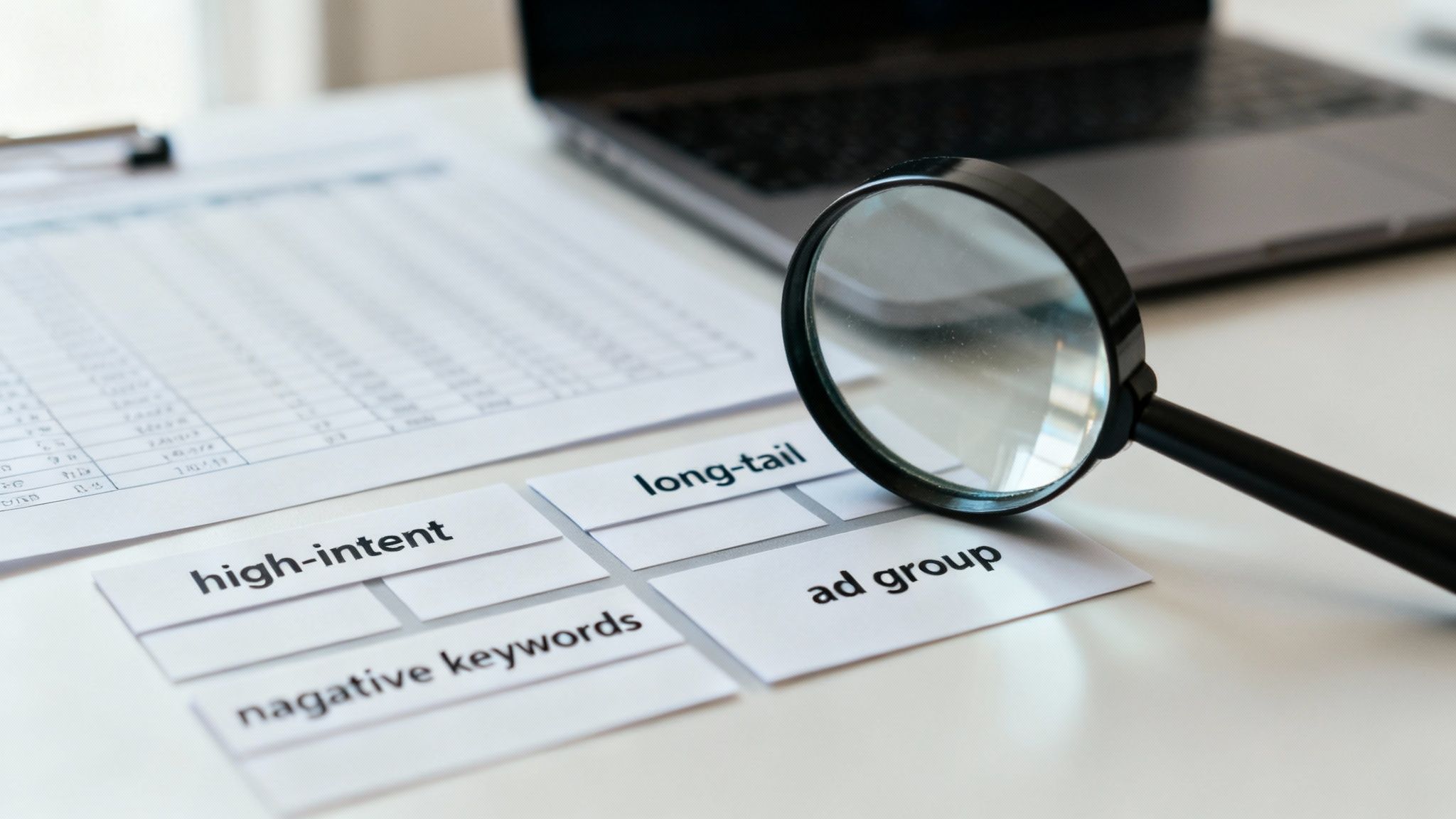
Effective Google Ads campaigns are built on a bedrock of meticulous keyword research. This foundational step involves more than just guessing what customers search for; it's about systematically identifying high-intent search terms, organizing them logically, and proactively filtering out irrelevant traffic. Neglecting this process is like building a house without a blueprint, it will almost certainly lead to wasted ad spend and poor performance. A solid keyword strategy ensures your ads appear in front of the right audience at the moment they are actively seeking your products or services.
Why Keyword Strategy is Crucial
The goal is to connect your ads with user intent. For instance, a user searching for “best running shoe reviews” is in a different stage of the buying cycle than someone searching for “buy blue Nike Pegasus online.” The first user is researching, while the second is ready to purchase. By separating these keywords into distinct ad groups, you can tailor your ad copy and landing pages to match their specific intent, dramatically increasing your conversion rates.
Key Insight: The success of your campaign hinges on matching your ad's message to the user's search intent. Granular keyword organization allows you to achieve this alignment, resulting in higher Quality Scores and lower costs per click.
Actionable Steps for Implementation:
- Utilize Professional Tools: Start with tools like Google Keyword Planner, Ahrefs, or SEMrush to discover keywords. Focus on search volume, competition level, and estimated cost-per-click (CPC) to find opportunities. This data-driven approach is a core element of many Google Ads best practices.
- Group by Intent: Create tightly-themed ad groups. For a local plumber, you might have one ad group for "emergency plumbing Austin" and another for "leak detection services." This allows for hyper-relevant ad copy.
- Embrace Long-Tail Keywords: Target longer, more specific phrases like "affordable wordpress web design austin." These keywords often have lower competition and higher conversion rates because the searcher's intent is very clear.
- Build a Negative Keyword List: From day one, add negative keywords to prevent your ads from showing on irrelevant searches. A roofer, for example, should add "-jobs" and "-training" to avoid clicks from job seekers. Regularly review your Search Terms Report to find new negatives.
Your keyword research for Google Ads often overlaps with and informs your broader digital marketing efforts. You can delve deeper into how these concepts connect by exploring this guide to deconstructing SEO on giddsmedia.com.
2. Craft High-Quality, Conversion-Focused Ad Copy
Once you have your keywords organized, your ad copy is the critical link between a user's search and your landing page. It's your first, and often only, chance to convince a potential customer to click. Effective ad copy goes beyond simply listing features; it communicates value, addresses the user's immediate need, and provides a clear reason to choose your business over competitors. This is a fundamental component of Google Ads best practices, directly influencing click-through rates (CTR) and Quality Score.
Why Ad Copy is Crucial
Your ad copy must resonate with the searcher's intent, which you identified during keyword research. For a user searching "emergency plumber Austin," an ad promising "24/7 Service & No Call-Out Fee" is far more compelling than a generic ad about plumbing services. High-quality copy grabs attention, builds trust, and pre-qualifies clicks, ensuring you attract visitors who are more likely to convert. It's the engine that drives qualified traffic to your website.
Key Insight: Your ad is a direct conversation with a potential customer. Speak to their pain point in the headlines, present your solution in the description, and tell them exactly what to do next with a strong call-to-action.
Actionable Steps for Implementation:
- Lead with Your Unique Value Proposition (UVP): Your first headline is the most important real estate. Immediately answer the user's question: "Why should I click this ad?" Highlight what makes you different, whether it's "Free Shipping Today," "Certified & Insured," or "Book Online in 60 Seconds."
- Mirror User Search Queries: Incorporate your target keywords naturally into your headlines and descriptions. This creates a strong sense of relevance for the user and can improve your ad's Quality Score.
- Leverage Numbers and Urgency: Specifics are more persuasive than generalities. Use "Save 40% Today" instead of "Big Savings." For promotions, implement countdown timers ("Sale Ends in 3 Hours") to create a sense of urgency and encourage immediate action.
- Test and Iterate with Responsive Search Ads: Create multiple headlines (at least 5-7) and descriptions (2-3) within a single Responsive Search Ad. Google's machine learning will test different combinations to find the highest-performing variations, continuously optimizing your campaign.
- Include a Clear Call-to-Action (CTA): Don't leave the user guessing. Use action-oriented language like "Shop Now," "Get a Free Quote," "Book Your Appointment," or "Download the Guide." The CTA should align perfectly with the offer on your landing page.
3. Optimize Landing Pages for Maximum Conversion Rate
Driving traffic to your website is only half the battle; the real victory is converting that traffic into customers. Your landing page is the critical final step in this process. A poorly designed page can negate even the most brilliantly executed ad campaign, causing visitors to leave without taking action. A great landing page experience is a core component of Google Ads best practices because it directly impacts your Quality Score, ad relevance, and, most importantly, your return on investment.

Why Landing Page Experience is Crucial
Google's algorithm prioritizes user experience, and your landing page is a major part of that. A page that is relevant, easy to navigate, and trustworthy earns a higher "Landing Page Experience" score, which contributes to a better overall Quality Score. For example, if your ad promises a "50% Off Emergency Plumbing Service," the landing page must prominently feature that same offer. This consistency reassures the user they are in the right place and guides them seamlessly toward the conversion goal.
Key Insight: Your ad makes a promise, and your landing page must fulfill it. A dedicated, high-converting landing page improves user trust, boosts your Quality Score, and directly increases your conversion rate, making every click more valuable.
Actionable Steps for Implementation:
- Create Dedicated Pages: Avoid sending paid traffic to your generic homepage. Instead, create dedicated landing pages for each ad group that mirrors the specific ad copy and keywords.
- Match the Message: Ensure the headline on your landing page directly reflects the headline in your ad. This "message match" is vital for reassuring visitors and improving relevance.
- Prioritize Page Speed: Use tools like Google PageSpeed Insights to diagnose and fix speed issues. Compress images, leverage browser caching, and use a Content Delivery Network (CDN) to ensure your page loads in under three seconds.
- Design for Conversion: Feature a clear, compelling call-to-action (CTA) with a contrasting button color. Remove distracting navigation menus and focus the user's attention on the single desired action, whether it's filling out a form or making a purchase.
- Build Trust and Authority: Incorporate social proof like customer testimonials, reviews, trust badges (e.g., BBB, security seals), and case studies to build credibility and overcome user hesitation.
While these tips focus on pages for ad campaigns, many of the same principles apply to your main site. You can discover more about building a high-performing site by reading this guide on how to create an engaging and converting homepage on giddsmedia.com.
4. Leverage Ad Extensions to Maximize Ad Real Estate
Think of ad extensions as a free upgrade for your Google Ads. They expand your standard text ad with additional, valuable information, effectively making your ad larger and more prominent on the search results page. This extra real estate not only increases visibility but also provides users with more reasons and ways to click, directly impacting your ad's performance. Implementing extensions is a fundamental Google Ads best practice that can immediately boost engagement without increasing your bid.
Why Ad Extensions are Crucial
Ad extensions work by providing context and convenience. For example, a local plumber can add a call extension, allowing mobile users to dial their number with a single tap. An e-commerce store can use sitelinks to direct users to specific product categories like "Men's," "Women's," or "Sale." These additions improve the user experience, which Google rewards with a higher Ad Rank, often leading to better ad positions and lower costs per click.
Key Insight: Ad extensions significantly increase an ad's click-through rate (CTR) by making it more informative and interactive. Using a variety of relevant extensions signals to Google that your ad is high-quality, which can improve your overall Ad Rank.
Actionable Steps for Implementation:
- Implement a Wide Variety: Activate all extension types relevant to your business goals. Common choices include Sitelinks (for key site pages), Callouts (for unique selling points like "Free Shipping"), and Structured Snippets (to list services or brands).
- Use Call and Location Extensions: For service-based or local businesses, call and location extensions are non-negotiable. They make it incredibly easy for customers to contact you or find your physical storefront directly from the search results.
- Highlight Key Pages with Sitelinks: Create sitelink extensions that point to your most important landing pages, such as your "About Us," "Contact," or specific service category pages. This helps users navigate your site more efficiently.
- Keep Promotions Current: Use promotion extensions to advertise special offers or sales. Remember to keep these updated to reflect current deals, preventing user frustration and ensuring your ad copy remains fresh and relevant.
By strategically using extensions, you can convey more information and dominate more space on the SERP, making your ads more compelling and effective. This is a core tactic for anyone serious about optimizing their Google Ads performance.
5. Master Quality Score and Its Impact on Campaign Performance
Quality Score is Google's diagnostic tool, a 1-to-10 rating that estimates the quality of your ads, keywords, and landing pages. This score directly influences your ad rank and how much you pay per click. A higher Quality Score means Google sees your ad as highly relevant and useful to searchers, rewarding you with lower costs and better ad positions. Ignoring it is like willingly paying more for less visibility; it's a critical lever for campaign efficiency.
Why Quality Score is Crucial
The financial impact of Quality Score cannot be overstated. An advertiser with a Quality Score of 8 might pay 50% less per click than a competitor with a score of 4, even if they are bidding on the same keyword. This is because Google’s ad auction system prioritizes user experience. By improving the three core components of Quality Score – expected click-through rate (CTR), ad relevance, and landing page experience – you align your campaign with Google's objectives, which in turn reduces your advertising costs.
Key Insight: Quality Score is a direct reflection of relevance. By focusing on improving its components, you are fundamentally improving the user's journey from search query to conversion, making your entire campaign more effective and cost-efficient.
Actionable Steps for Implementation:
- Boost Expected CTR: Write compelling ad copy that includes a strong call-to-action and incorporates your target keyword. Utilize ad extensions like sitelinks and callouts to make your ad more prominent and clickable.
- Maximize Ad Relevance: Ensure your keywords are tightly themed within each ad group. The ad copy should directly address the keywords in that group, creating a seamless connection between the user's search and your ad's message.
- Enhance Landing Page Experience: Your landing page must be directly relevant to the ad's promise. It should load quickly, be mobile-friendly, and provide a clear path to conversion. High bounce rates will negatively impact your score.
- Monitor and Prioritize: Regularly check the Quality Score columns in your Google Ads dashboard. Identify keywords with scores below 5 and prioritize them for improvement, as this is where you'll see the most significant performance gains.
6. Implement Strategic Bid Management and Automated Bidding
Choosing the right bidding strategy is pivotal to campaign success and directly impacts your return on investment. Modern Google Ads offers powerful automated bidding strategies (Smart Bidding) that leverage machine learning to optimize for conversions or conversion value in every auction. This real-time approach allows the system to analyze hundreds of signals to predict conversion likelihood and set the appropriate bid, moving beyond simple keyword-based manual bidding. Effectively managing your bids is a core component of any list of Google Ads best practices.
Why Bid Strategy is Crucial
The goal of a bid strategy is to achieve your specific business objectives as efficiently as possible. A local service provider might prioritize generating a high volume of leads within a specific budget, while an e-commerce store needs to maximize revenue for every dollar spent. Automated bidding removes much of the guesswork and manual labor, adjusting bids based on factors like the user's device, location, time of day, and past browsing behavior. For instance, an e-commerce store using a Target ROAS (Return on Ad Spend) strategy saw a 25% improvement in ROAS by letting Google's algorithm find the most profitable customers.
Key Insight: Smart Bidding moves campaign optimization from manual adjustments to strategic oversight. Your job becomes setting the right goals and providing the algorithm with clean conversion data, not micromanaging individual keyword bids.
Actionable Steps for Implementation:
- Establish a Data Foundation: Before switching to automated strategies, it's often wise to start with Manual CPC or Enhanced CPC to gather sufficient conversion data. Google recommends at least 15-30 conversions in the last 30 days before enabling strategies like Target CPA or Target ROAS.
- Select the Right Strategy: Match the strategy to your goal. Use Maximize Conversions to get the most leads within your budget, Target CPA (Cost Per Acquisition) to acquire leads at a specific cost, or Target ROAS for e-commerce with clear profit margins.
- Set Realistic Targets: When setting a Target CPA or ROAS, base your initial goal on your historical performance from the last 30 days. Setting an overly aggressive target from the start can stifle the learning algorithm and limit your campaign's volume.
- Respect the Learning Period: After implementing a new bid strategy, allow the system a "learning period" of 7-14 days to collect data and optimize. Avoid making significant changes during this time, as it can reset the learning process.
Properly implementing and managing these bidding strategies can be complex, but getting it right unlocks significant performance gains. You can explore professional management options and learn more about how expert-led Google Ads services on giddsmedia.com can optimize your campaign bidding.
7. Use Audience Targeting and Remarketing Effectively
Showing the right ad to the right person is fundamental, but showing it at the right time is what truly drives conversions. Audience targeting and remarketing allow you to go beyond keywords and connect with users based on their past behaviors, interests, and relationship with your business. This strategy re-engages potential customers who have already shown interest, making it one of the most cost-effective methods for increasing return on investment (ROI). It transforms your advertising from a one-time interaction into an ongoing conversation.
Why Audience Strategy is Crucial
Not all website visitors convert on their first visit. Remarketing keeps your brand top-of-mind by showing targeted ads to users as they browse other websites, watch YouTube videos, or use apps. For example, an e-commerce store can show the exact products a user added to their cart but didn't purchase, often leading to a significant recovery in sales. Similarly, you can target "in-market" audiences, reaching users Google has identified as actively shopping for your products or services, even if they haven't visited your site yet.
Key Insight: Your most valuable audience is often the one that already knows you. Remarketing bridges the gap between initial interest and final purchase, dramatically improving conversion rates by reminding engaged users why they visited in the first place.
Actionable Steps for Implementation:
- Build Your Remarketing Lists: Use your Google Ads tag or Google Analytics to create audience lists. Segment users based on their behavior, such as "all visitors," "cart abandoners," "product page viewers," or "past converters."
- Implement Dynamic Remarketing: For businesses with multiple products or services, dynamic remarketing is a must. It automatically creates ads that show users the specific items they viewed on your website, providing a highly personalized experience.
- Leverage Similar Audiences: Once your remarketing lists are large enough, Google can create "Similar Audiences" (lookalike audiences). This finds new users who share characteristics with your best customers, expanding your reach to a highly relevant new audience.
- Combine Audiences with Search Campaigns: Apply audience lists to your search campaigns with a "Targeting" or "Observation" setting. You can bid higher for past visitors or customers searching for your keywords, as they are more likely to convert. This is a core tenet of advanced Google Ads best practices.
8. Conduct Continuous A/B Testing and Experimentation
Static campaigns become stagnant campaigns. The key to long-term success with Google Ads is embracing a mindset of continuous improvement through methodical testing. A/B testing, also known as split testing, involves running two or more variations of an ad, landing page, or campaign setting simultaneously to determine which one performs better. This data-driven approach removes guesswork, allowing you to systematically refine every component of your strategy for optimal performance.
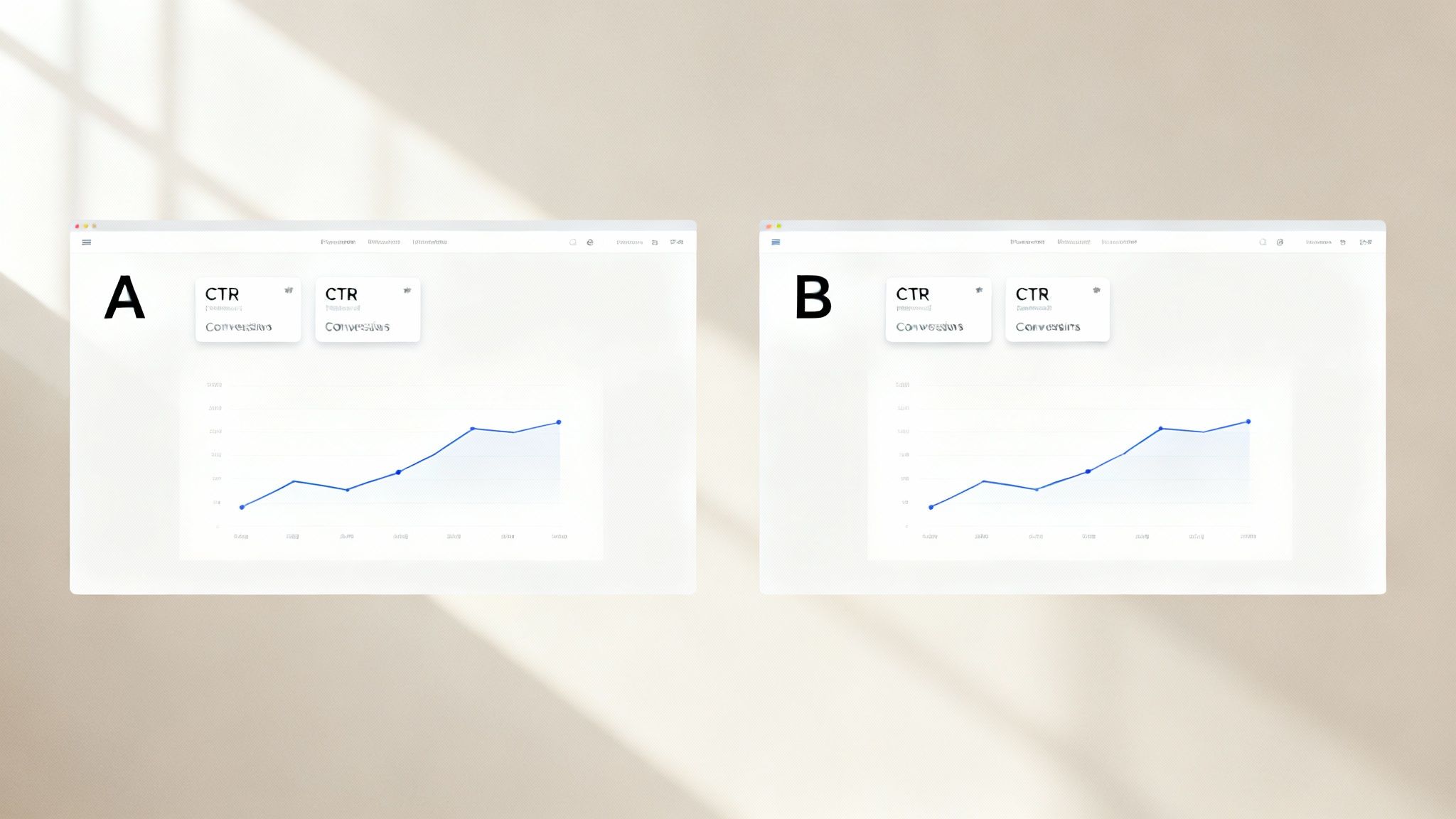
Why A/B Testing is Crucial
Even small changes can lead to significant impacts on your key metrics. For instance, testing a headline like "Buy Now" against "Get a Free Quote" could reveal a 25% difference in click-through rate (CTR) because it better aligns with user intent at a specific stage. Similarly, changing a call-to-action button color from blue to orange might increase conversions by 10%. Without testing, you're leaving potential revenue on the table and making decisions based on assumptions rather than concrete data.
Key Insight: Consistent experimentation is a non-negotiable for anyone serious about Google Ads best practices. It transforms your campaigns from a fixed expense into an evolving, high-performing asset that continually improves its return on investment.
Actionable Steps for Implementation:
- Isolate a Single Variable: To get clean, reliable data, test only one element at a time. Change a headline, a line of description, a landing page image, or a bidding strategy, but not all at once. This ensures you can attribute performance changes to a specific factor.
- Utilize Google's Experiments Tool: For campaign-wide changes like testing Smart Bidding vs. Manual CPC, use the built-in "Experiments" feature. This tool allows you to run a true split test by allocating a portion of your budget to the variant, providing statistically significant results.
- Test Both Big and Small Changes: Don't be afraid to test radical new landing page designs or entirely different value propositions. At the same time, consistently test smaller elements like calls-to-action (CTAs), headlines, and display URLs.
- Document and Learn: Keep a log of every test you run, including your hypothesis, the results, and your key takeaways. This creates a valuable knowledge base that will inform future campaign strategies and prevent you from repeating past mistakes.
9. Monitor, Analyze, and Optimize Campaigns Systematically
Launching a Google Ads campaign is just the beginning, not the end. The most successful advertisers treat their campaigns as living entities that require consistent attention and data-driven adjustments. Systematic monitoring and optimization is the process of regularly reviewing performance data, identifying trends, and making informed changes to improve results. This iterative cycle is what separates campaigns that generate a true return on investment from those that simply burn through a budget.
Why Systematic Optimization is Crucial
The digital advertising landscape is never static. Competitor strategies evolve, consumer behavior shifts, and Google's algorithm is constantly updated. Without a routine for analysis, your once-profitable campaign can quickly become inefficient. For example, a monthly performance review might reveal that your cost-per-acquisition has steadily increased. By digging into the data, you might discover a new competitor has driven up bids on your top keywords, requiring a strategic pivot in your bidding strategy or ad copy to remain competitive.
Key Insight: Consistent optimization is non-negotiable for long-term success. Making small, data-backed adjustments on a regular schedule prevents minor issues from spiraling into costly problems and ensures your campaigns continuously adapt to the market.
Actionable Steps for Implementation:
- Establish a Review Cadence: Schedule time for campaign analysis. A good starting point is a weekly check-in to review the Search Terms Report and ad performance, a monthly review for budget allocation and KPI trends, and a quarterly review for broader strategic planning.
- Define and Track Key KPIs: Before you optimize, know what you're optimizing for. Focus on core metrics like Click-Through Rate (CTR), Cost-Per-Click (CPC), Conversion Rate, and Return On Ad Spend (ROAS). Create a simple dashboard to monitor these weekly.
- Identify Winners and Losers: Each week, identify your top and bottom-performing keywords, ad groups, and individual ads. Pause the underperformers that are draining your budget and reallocate those funds to the proven winners.
- Set Up Performance Alerts: Use Google Ads' automated rules or third-party tools to create alerts for significant performance anomalies. Get notified if your CPC suddenly spikes by 20% or if a campaign's CTR drops below a certain threshold, allowing for a rapid response.
10. Align Google Ads with Business Goals and Attribution Modeling
An effective Google Ads campaign is more than just a source of clicks; it's a direct engine for achieving core business objectives. Simply running ads without a clear connection to your company's goals can lead to ambiguous results and wasted budget. By defining what success looks like for your business and implementing attribution models that accurately measure progress, you transform your ad spend from an expense into a strategic investment with a clear, demonstrable impact. This alignment ensures every dollar spent is accountable and works toward a meaningful outcome.
Why Aligning Ads with Goals is Crucial
The ultimate purpose of your ad campaign is not to generate impressions or clicks, but to drive tangible business results like sales, qualified leads, or new subscribers. For example, a B2B SaaS company might track both free trial sign-ups and eventual paid conversions separately to understand the full customer journey. Without a proper attribution model, they might undervalue top-of-funnel keywords that introduce users who convert weeks later. Aligning your campaigns with these deeper goals allows you to measure and optimize for what truly matters to your bottom line.
Key Insight: Moving beyond last-click attribution is essential for understanding the true value of your campaigns. A data-driven attribution model helps you credit touchpoints across the entire customer journey, preventing premature optimization and revealing the real drivers of growth.
Actionable Steps for Implementation:
- Define Clear Business Objectives: Before launching, define your primary goals. Are you aiming for a specific revenue target, a set number of qualified leads, or increased brand awareness? These goals will dictate your campaign structure, bidding strategy, and KPIs.
- Map Campaigns to Specific Goals: Create separate campaigns for different objectives. An awareness campaign targeting top-of-funnel keywords should be measured by reach and engagement, while a conversion-focused campaign for bottom-of-funnel keywords should be measured by cost-per-acquisition and ROAS.
- Implement Advanced Attribution: Move away from the default "Last Click" model in Google Ads. Explore models like "Data-Driven" or "Position-Based" to give credit to assists from keywords and ads earlier in the customer's journey.
- Track Offline and Lifetime Value: For businesses where conversions happen offline (like a phone call leading to a sale), implement offline conversion tracking. Assigning a value to conversions that reflects their actual business impact, including potential customer lifetime value, is a critical component of Google Ads best practices.
Google Ads Best Practices: 10-Point Comparison
| Strategy | Implementation Complexity 🔄 | Resource Requirements ⚡ | Expected Outcomes ⭐ | Ideal Use Cases 💡 | Key Advantages 📊 |
|---|---|---|---|---|---|
| Implement Comprehensive Keyword Research and Organization | Moderate → High; ongoing maintenance and updates | Time, keyword tools (Keyword Planner, SEMrush/Ahrefs), analyst | Higher CTR & Quality Score; lower CPC; more relevant traffic | Foundational for new search campaigns, e‑commerce, local targeting | Reduces wasted spend; improves targeting precision |
| Craft High-Quality, Conversion-Focused Ad Copy | Moderate; requires frequent testing and refreshes | Copywriters, creative time, A/B testing tools | Increased CTR and conversion rates; better ad relevance | Promotions, high-intent queries, responsive search ads | Boosts engagement, Quality Score, and ad efficiency |
| Optimize Landing Pages for Maximum Conversion Rate | High; design, development, and CRO testing required | Designers, developers, CRO tools, testing traffic | Higher conversion rate, lower bounce, improved Quality Score | Conversion-focused campaigns, product launches, high-traffic pages | Direct, significant uplift to conversions and ROI |
| Leverage Ad Extensions to Maximize Ad Real Estate | Low; simple setup and periodic updates | Minimal account management time; creative assets for extensions | Increased CTR and visibility; better SERP presence | All search campaigns; especially local businesses and promos | More clickable space with little added cost; better CTR |
| Master Quality Score and Its Impact on Campaign Performance | Moderate; continuous monitoring and adjustments | Analytics, testing, coordinated optimizations | Lower CPC, better ad position, improved ROI | Competitive markets and large accounts where CPC matters | Cost savings and more efficient ad delivery |
| Implement Strategic Bid Management and Automated Bidding | Moderate; strategy setup and monitoring during learning | Conversion data (volume), bidding strategy setup, analyst oversight | Improved ROI, scalable performance, real-time bid optimization | Accounts with steady conversion volume (e‑commerce, lead gen) | Saves time; optimizes bids for KPI goals at scale |
| Use Audience Targeting and Remarketing Effectively | Moderate; audience creation and segmentation effort | Tagging, CRM integration, audience data and lists | Higher conversion rates and ROAS from warm audiences | Cart abandoners, upsell campaigns, customer retention | Re-engages warm users; more efficient spend on high-value users |
| Conduct Continuous A/B Testing and Experimentation | High; needs disciplined framework and statistical rigor | Testing tools, sufficient traffic, analysts | Incremental, validated performance improvements over time | Optimization-focused accounts with adequate traffic | Produces data-driven winners; compounds long-term gains |
| Monitor, Analyze, and Optimize Campaigns Systematically | Moderate; ongoing processes and reporting cadence | Analytics stack, dashboards, regular analyst time | Early issue detection; better budget allocation and predictability | All accounts, especially multi-campaign or multi-channel setups | Enables data-driven decisions and clearer ROI visibility |
| Align Google Ads with Business Goals and Attribution Modeling | High; technical setup and cross-team alignment required | Analytics infrastructure, CRM/sales data, modeling expertise | Clearer connection between spend and revenue; better budget justification | B2B, multi-touch funnels, offline conversions, high-LTV products | Improves measurement accuracy and strategic budget allocation |
From Best Practices to Better Performance
Navigating the landscape of Google Ads can feel like mastering a complex instrument. It's not enough to simply know the notes; you must understand the rhythm, harmony, and timing to create a truly effective performance. Throughout this guide, we've dissected the ten core pillars that transform a basic ad campaign into a powerful, revenue-generating engine for your business. From the foundational necessity of meticulous keyword research and organization to the nuanced art of crafting high-quality, conversion-focused ad copy, each element plays a critical role in your overall success.
We've explored how a high Quality Score isn't just a metric but a direct lever for reducing costs and improving ad placement. We've seen how strategic bid management, whether manual or automated, allows you to allocate your budget with precision, ensuring every dollar works as hard as possible. The journey from a simple click to a loyal customer is paved with optimized landing pages, compelling ad extensions, and sophisticated audience targeting. By embracing these google ads best practices, you move beyond just "running ads" and start building a systematic, repeatable process for growth.
Synthesizing Strategy into Action
The true takeaway is that these practices are not isolated tactics to be checked off a list. They are interconnected components of a holistic strategy. For instance:
- Strong keyword research directly fuels your ad copy relevance, which in turn boosts your Quality Score.
- A high Quality Score lowers your cost-per-click, making your bidding strategy more efficient and impactful.
- Compelling ad copy and strategic ad extensions are only effective if they lead to a seamless, high-converting landing page experience.
- Continuous A/B testing provides the data needed to refine all of the above, creating a powerful feedback loop of constant improvement.
This interconnectedness is what separates stagnant campaigns from those that achieve scalable, long-term success. Your goal should be to build a well-oiled machine where each part enhances the performance of the others. Ignoring one component, like landing page optimization, can create a bottleneck that renders your brilliant keyword strategy and ad copy far less effective.
Your Path to Mastery and Growth
Implementing these Google Ads best practices requires a commitment to continuous learning and adaptation. The platform itself is in a constant state of evolution, with new features, bidding algorithms, and targeting options emerging regularly. This dynamic environment rewards advertisers who are proactive, data-driven, and willing to experiment. For those looking to deepen their expertise and validate their skills in the ever-evolving field, exploring some of the Top Digital Marketing Certification Programs can be a valuable next step. This formal training can help solidify your understanding and keep you ahead of the curve.
Ultimately, mastering Google Ads is about turning your advertising budget from an expense into a strategic investment. It's about understanding your Austin-based audience, anticipating their needs, and meeting them at the exact moment of intent with a message that resonates. By systematically applying the principles of account structure, optimization, and analysis, you build more than just campaigns; you build a predictable pipeline of leads and customers that fuels the growth of your business. The journey from good to great is paved with diligence, data, and the consistent application of these proven best practices.
Ready to turn these best practices into real-world results without the steep learning curve? At Gidds Media, we specialize in building and managing high-performance Google Ads campaigns that drive measurable growth for Austin businesses. Let our team of experts handle the complexity of campaign optimization so you can focus on what you do best: running your business.