

A digital marketing strategy for a startup isn't about doing everything at once. It's your foundational game plan, outlining how you'll use online channels to hit your core goals. Think of it as making smart, focused choices to drive awareness, acquire customers, and build momentum—all while working with limited resources. This initial roadmap ensures every marketing dollar gets spent strategically, not just hopefully.
Building Your Startup's Marketing Foundation
Every killer marketing campaign starts with a solid foundation of research and planning. It's incredibly tempting for founders to jump straight into building social media profiles or running ads, but that's a fast track to wasted time and money. Before you spend a single cent, you need to understand the field you're playing on and the people you're trying to reach.
Think of this foundational work as your strategic compass. It guides your messaging, your channel selection, and your content creation, making sure every move is deliberate and tied to your business goals. Without it, your marketing efforts are just shots in the dark.
Define Your Goals with the SMART Framework
Vague goals like "increase brand awareness" don't cut it for a startup. You need specific, measurable objectives that directly fuel growth. This is where the SMART framework (Specific, Measurable, Achievable, Relevant, Time-bound) is non-negotiable.
Instead of a fuzzy goal like "get more website traffic," a SMART goal sounds like this: "Increase organic website traffic by 20% over the next quarter by publishing four targeted blog posts per month and acquiring three high-quality backlinks." This gives you a clear target and a defined path to get there.
- Specific: Who, what, where, why? Pinpoint exactly what you want to achieve.
- Measurable: How will you track progress? Define clear metrics like conversion rates or lead numbers.
- Achievable: Is the goal realistic with your current resources and timeframe?
- Relevant: Does this goal actually align with your bigger business objectives, like revenue growth?
- Time-bound: When will you hit this goal? Set a hard deadline.
A strategy without measurable goals is just a dream. And for a startup, dreams don't pay the bills—data-driven actions do. This first step is what separates the startups that grow from those that stagnate.
Craft Detailed Buyer Personas
You can't sell effectively if you don't know who you're selling to. A buyer persona is a semi-fictional deep dive into your ideal customer, built from market research and real data. It goes way beyond simple demographics.
For instance, meet "SaaS Sally." She's a 32-year-old product manager at a mid-sized tech company. What are her biggest professional frustrations? What blogs does she read? Which social media platforms is she scrolling through to find solutions? Answering these questions helps you create content and messaging that genuinely connects with her. For startups, understanding these deep-seated motivations is everything. As you lay this groundwork, you'll find many powerful small business marketing strategies to complement your plan.
This visual shows how the foundational pieces fit together, from competitive analysis to channel selection.
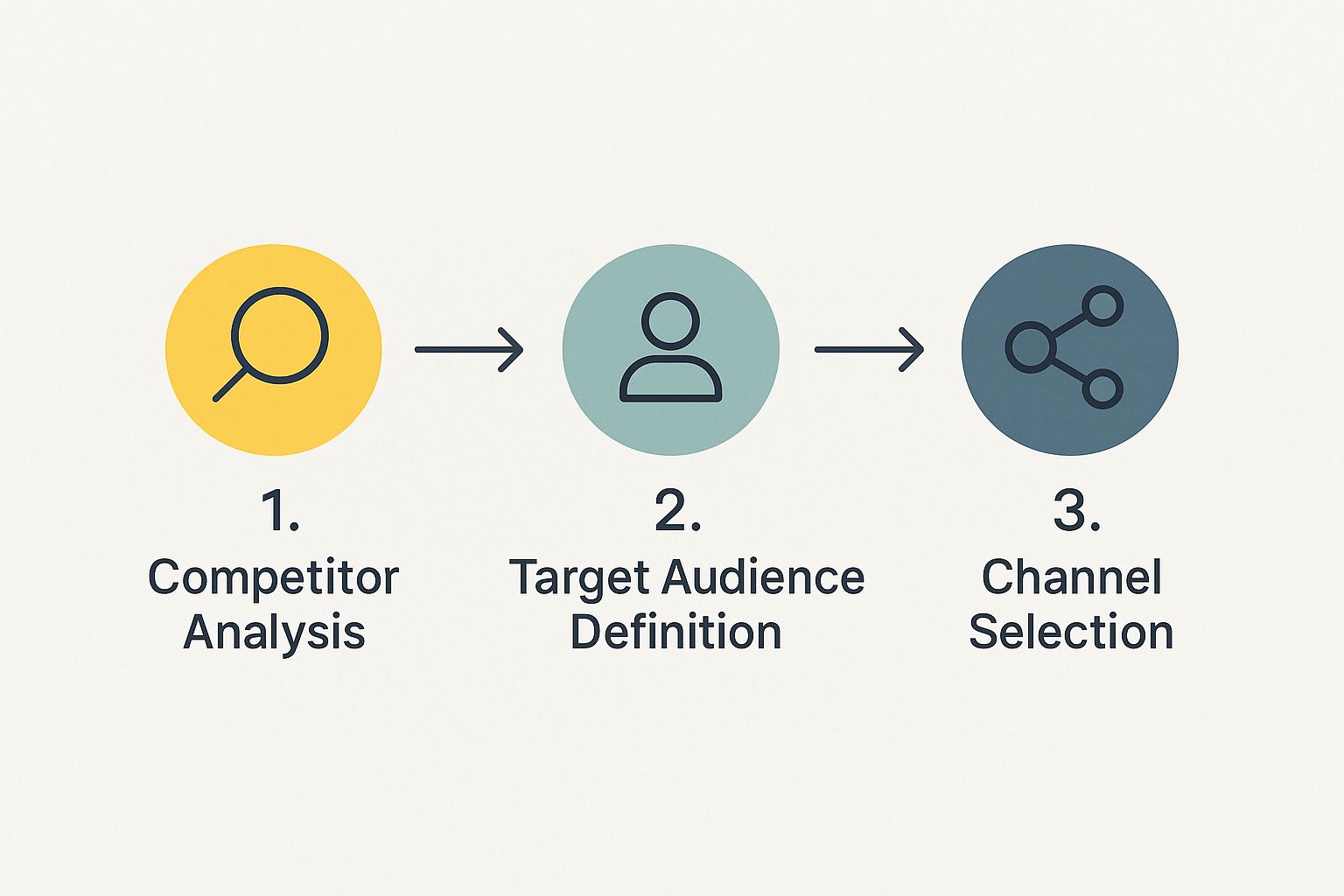
The key takeaway here is that understanding your market and audience has to happen before you decide where to put your marketing budget.
Conduct a Practical Competitive Analysis
Finally, you need to know who you're up against. A solid competitive analysis isn't about spying; it's about identifying your competitors' strengths and weaknesses so you can find gaps in the market.
Look at their messaging, their content strategy, and their social media presence. What keywords are they ranking for? Where are they getting backlinks? Tools like Ahrefs or Semrush can hand you this data on a silver platter.
The goal isn't to copy them. It's about finding the opportunities they've missed. For example, if your competitors all have a generic, uninspired homepage, you can learn https://giddsmedia.com/how-to-create-an-engaging-and-converting-homepage/ to immediately stand out. This intelligence is crucial for carving out your unique spot in the market.
To wrap this all up, I've put together a quick checklist to help you keep these foundational elements straight. Think of it as your quick-start guide to building a marketing strategy that actually works.
Startup Marketing Foundation Checklist
| Core Component | Why It's Critical for Startups | Key Action Item |
|---|---|---|
| SMART Goals | Provides clear, measurable targets to prevent wasted effort and money. | Set a specific, time-bound goal, like "Increase qualified leads by 15% in Q3." |
| Buyer Personas | Ensures your messaging and content resonate with your ideal customer. | Create 1-2 detailed personas with pain points, goals, and preferred channels. |
| Competitive Analysis | Identifies market gaps and opportunities your competitors have overlooked. | Use a tool like Semrush to analyze a top competitor’s keywords and backlinks. |
| Unique Value Proposition (UVP) | Clearly articulates why a customer should choose you over anyone else. | Draft a single sentence that explains what makes your solution different and better. |
Getting these four pillars right from the start saves you countless hours and dollars down the road. It turns marketing from a guessing game into a repeatable, scalable engine for growth.
Choosing Your High-Impact Marketing Channels

Alright, you've done the foundational work. Now it’s time to decide where to spend your most precious resources: time and cash. Here's a hard truth for startups: trying to be everywhere at once is a surefire way to fail. The goal isn't breadth; it's depth. You need to pick the right battlegrounds where your ideal customers are already hanging out.
Spreading a small budget across a dozen platforms will dilute your message and leave you with muddy, inconclusive data. A focused approach lets you actually master a couple of high-impact channels, figure out what really works, and then scale your success. It also saves you from burnout and ensures every dollar is pulling its weight.
Balancing Long-Term Assets and Quick Wins
Think of your channel mix like an investment portfolio. You need a blend of stable, long-term growth stocks and some aggressive plays that give you immediate feedback.
- Long-Term Assets (The Marathon): This is your SEO and content marketing. It’s a slower burn, no doubt about it, but the compounding returns are huge. Ranking for one high-intent keyword can bring in qualified leads for years without you spending another dime on ads. It's about building a valuable, lasting presence.
- Quick Wins (The Sprint): Paid social and search ads deliver instant results. You get traffic today, and more importantly, you get fast data on what messaging, offers, and audiences actually convert. That feedback is priceless for refining your entire strategy on the fly.
A classic startup mistake is going all-in on one or the other. Relying only on paid ads is expensive and unsustainable. But waiting for SEO to kick in can feel agonizingly slow when you need to make payroll. The smart play? Use paid ads to get initial traction and validate ideas while your organic SEO engine is warming up in the background.
The goal isn't just to find customers today; it's to build a system that attracts customers tomorrow, next month, and next year. Your channel selection is the first step in building that system.
Aligning Channels With Your Business Model
The right channels for your startup depend almost entirely on who you’re selling to. A B2B SaaS company and a direct-to-consumer (D2C) e-commerce brand live in completely different online worlds.
For instance, a B2B startup selling project management software will almost certainly find its audience on LinkedIn. It’s the perfect place for targeting professionals by job title, industry, and company size. In-depth articles, case studies, and webinars are the kind of content that will resonate with an audience looking to solve a business problem.
On the flip side, a D2C brand selling sustainable activewear is going to thrive on visual platforms like Instagram and TikTok. These channels are built for showing off products with killer images, video, and influencer collaborations. You have to go where your audience is, and that means adapting to their behavior. For many brands right now, that means understanding Gen Z's search behavior on TikTok, which has become a primary engine for discovery.
The Rise of Influencer and Social Commerce
Social media is no longer just a place for brand awareness—it’s a powerful sales channel. Influencer marketing is the perfect example of this shift. This sector exploded from $1.7 billion in 2016 to a projected $32–33 billion by 2025. Why? Because marketers finally recognized that authentic partnerships build trust and drive sales directly within social apps.
This methodical, data-backed approach removes the guesswork and makes sure your limited resources have the biggest possible impact.
- Identify Your Top 2-3 Channels: Based on your buyer personas, where do your customers live online? Don't overthink it. Start there.
- Set a Test Budget: Allocate a small, fixed budget to run some experiments with paid ads on your chosen platforms.
- Define Success Metrics: What does a "win" look like? Is it clicks, email sign-ups, or demo requests? Be specific.
- Analyze and Double Down: After 30-60 days, look at the data. Cut what's not working and pour more fuel on the fire that’s delivering the best return.
Executing Your Content and SEO Game Plan
Alright, you've done the foundational research and picked your high-impact channels. Now it's time to build the engine that will drive your startup’s long-term growth: content and SEO.
These two are joined at the hip. Incredible content is worthless if no one finds it, and top-tier SEO is just spinning its wheels without quality content to rank. For a startup, this combination is the single most sustainable way to build authority and pull in qualified leads over the long haul.
This isn't about mindlessly churning out blog posts, either. A smart startup digital marketing strategy runs on a "Minimum Viable Content" approach. Every single piece you create needs a clear purpose, has to solve a specific audience problem, and must be optimized for search from the get-go.
Uncovering High-Intent Keywords
Keyword research is your content creation map. It shows you what your audience is actually searching for, the exact words they use, and how tough it'll be to show up for those terms. As a startup, trying to rank for a massive, broad keyword like "project management software" is a fast way to lose against the big, established players.
Instead, you need to get laser-focused on long-tail keywords. These are longer, more specific phrases that tell you a user is much closer to making a decision. Think "best project management software for small creative teams" instead of the generic term.
- Brainstorm "seed" keywords: Just start with the basics. What are the core terms that describe what you sell?
- Use keyword tools: Fire up tools like Ahrefs, Semrush, or even the free Google Keyword Planner to expand your seed list into hundreds of long-tail opportunities.
- Analyze search intent: Figure out why they're searching. Are they looking for information ("how to…"), a specific brand, or are they ready to buy ("best," "alternative," "pricing")? Your priority should be keywords with commercial and transactional intent.
- Focus on low difficulty: Look for keywords with a lower "keyword difficulty" score. These are your openings to gain early traction and start ranking.
Winning at SEO as a startup isn’t about outspending your competitors; it’s about outsmarting them. Find the specific, high-intent questions they’re ignoring and become the best answer on the internet for those queries.
Building a Content Calendar That Converts
A content calendar is way more than just a schedule—it’s a strategic plan that maps your content directly to the buyer’s journey. This ensures you're creating the right piece at the right time to guide a prospect from "just browsing" to "take my money."
Keep it simple. Your calendar can be a basic spreadsheet or a board in a project management tool. Just make sure it tracks the topic, target keyword, content type, and funnel stage for every piece.
- Top of Funnel (Awareness): This is where you create educational blog posts, guides, and infographics that answer broad industry questions. A fintech startup might publish something like, "A Founder’s Guide to Understanding Venture Debt."
- Middle of Funnel (Consideration): Now you develop content that helps people compare solutions. This means case studies, product comparison pages, and detailed "how-to" articles that show your product's features in action.
- Bottom of Funnel (Decision): This content is all about closing the deal. We're talking pricing pages, powerful customer testimonials, and landing pages for free demos.
This structured approach gives you a balanced mix of content that nurtures leads at every stage, effectively turning casual readers into paying customers.
Mastering On-Page SEO Essentials
Once you’ve created a killer piece of content, you need to give it the best possible shot at ranking. On-page SEO is all about optimizing individual web pages to make them more visible in search results. The good news? Even non-technical founders can get these basics right.
If you want a deeper dive, you can learn more by deconstructing SEO and how to optimize your online presence.
Here’s a quick checklist to run through for every single piece of content you publish:
| SEO Element | Action Item | Why It Matters |
|---|---|---|
| Title Tag | Put your primary keyword near the beginning of the title. Keep it under 60 characters. | This is the most important on-page ranking signal and what people see in the search results. |
| Meta Description | Write a compelling, 155-character summary that includes your keyword and makes people want to click. | It's not a direct ranking factor, but a great meta description skyrockets your click-through rate. |
| URL Slug | Keep the URL short, descriptive, and include your target keyword (e.g., /startup-marketing-strategy). |
A clean URL is easy for users and helps search engines understand what the page is about. |
| Internal Linking | Link to at least 2-3 other relevant pages or posts on your own site within the content. | This helps search engines find your other content and spreads authority throughout your website. |
By consistently nailing these on-page SEO best practices, you're sending strong signals to Google that your content is high-quality, relevant, and deserves a top spot. This is the execution phase—where your strategy stops being a document and starts becoming a real asset that grows your startup.
Hitting the Accelerator with Strategic Paid Ads

While content and SEO are your long-game—building a sustainable engine for growth—sometimes a startup just needs to step on the gas. Paid advertising on platforms like Google Ads and social media is that gas pedal. It gets you in front of your target audience today, not months from now.
I like to think of organic marketing as planting a tree. It takes time to grow and bear fruit, but it eventually becomes a lasting asset. Paid ads? That’s like buying fruit from the store. You get what you need instantly, and you also learn which types of fruit people actually want to buy.
For a startup, that rapid learning is just as valuable as the immediate traffic.
How to Set a Realistic Starting Budget
Founders often get hung up on the budget, assuming they need a massive war chest to compete. That’s a myth. A winning paid ad strategy isn’t about outspending everyone; it’s about out-thinking them. Start small, get smart.
A budget of $500 to $1,500 per month is a solid starting point for most early-stage startups. This is enough to gather meaningful data on one or two channels without lighting your runway on fire. The goal here isn't immediate profitability; it's data acquisition.
You're paying to learn:
- Which ad copy actually resonates with your audience?
- What visuals make them stop scrolling and click?
- Which audience segments have the highest conversion rates?
Treat your initial ad spend like an investment in market research. Every click, impression, and conversion is a data point that sharpens your buyer personas and informs your entire marketing strategy—including your organic efforts.
This approach is crucial in a market that's only getting bigger. The global digital ad market is on track to hit $1.16 trillion by 2030, with digital channels gobbling up 72.7% of all ad investment in 2024. That shift tells you everything you need to know about where your audience is.
Crafting Hyper-Targeted Campaigns
The single biggest mistake I see startups make with paid ads is casting too wide a net. Your budget is limited, so your targeting has to be ruthless. Platforms like Facebook, Instagram, and LinkedIn offer incredibly granular targeting options that let you speak directly to the buyer personas you've already built.
Let's say you're a B2B SaaS startup selling a project management tool for remote software teams. A generic campaign targeting "software developers" is just a donation to Google.
A hyper-targeted campaign, on the other hand, would look something like this:
- Platform: LinkedIn Ads
- Targeting: Job Title ("Engineering Manager," "Head of Product"), Company Size (10-50 employees), Industry (Computer Software).
- Ad Copy: "Tired of chasing status updates? Our PM tool integrates with Slack & GitHub to give remote engineering leads a single source of truth. Try it free."
This level of precision ensures every dollar is spent reaching someone who can actually buy your product. Getting this right is a specialized skill, which is why many startups find it's worth partnering with an agency. If you need expert guidance, a professional PPC management service in Houston can help you maximize every dollar from day one.
Using Ads as a Rapid Learning Tool
Beyond just generating leads, paid ads are your fastest path to validating assumptions. Before you invest months creating a huge content library around a specific feature, you can test its appeal with a simple ad campaign.
Run two different ads with the same visual but different headlines, each highlighting a unique benefit of your product.
- Ad A (Benefit-focused): "Ship Code 30% Faster"
- Ad B (Pain-point-focused): "Eliminate Missed Deadlines"
After spending just $100, you’ll have hard data on which message drives more clicks. This feedback loop is priceless. It lets you iterate on your value proposition in days, not months, making sure your marketing is always dialed into what your audience actually cares about. This is how you build a smarter, more agile marketing machine.
Measuring What Matters and Scaling with AI
A brilliant marketing strategy is just a collection of good ideas until you can prove it's working. For a startup, tracking performance isn't just a best practice—it's a survival mechanism. This is where you separate the moves that actually fuel growth from the ones that just drain your budget.
You have to get laser-focused on metrics that directly reflect the health of your business, not just online popularity. Likes and shares feel good, but they don't pay the bills. The real story is told by the numbers that connect your marketing dollars to actual revenue.
Focusing on Actionable Startup KPIs
The key is to ignore the vanity metrics—things like page views or follower counts—and zero in on the Key Performance Indicators (KPIs) that really move the needle. These are the numbers that tell you if you're acquiring customers in a way that can actually sustain the business.
- Customer Acquisition Cost (CAC): This is your all-in cost to get a single new customer. If your CAC is too high, it can sink your startup before you even get off the ground. Tracking this relentlessly is non-negotiable.
- Lifetime Value (LTV): This metric forecasts the total revenue you can expect from a single customer over their entire relationship with your company.
- CAC to LTV Ratio: This is the magic number. A healthy ratio (ideally 3:1 or better) means for every dollar you spend to get a customer, you’re getting at least three dollars back over time.
If you only have time to track one thing, make it the CAC to LTV ratio. It’s the ultimate pulse check for a sustainable business model. This number tells you if you have a real business or just an expensive hobby.
Tools like Google Analytics are essential here. They give you the raw data needed to understand user behavior from the first click all the way to the final conversion, letting you connect the dots between your actions and these crucial KPIs.
Here’s a look at a standard Google Analytics dashboard, which is ground zero for tracking how users find you and what they do once they arrive.
This dashboard gives you a clean snapshot of where your traffic is coming from, how many people are visiting, and which channels are actually driving conversions. It’s your first step to identifying what’s working and what isn’t.
The Rise of AI in Startup Marketing
Once you have a handle on your core metrics, the next challenge is to scale your efforts without having to scale your team. This is where Artificial Intelligence (AI) comes into play. AI is no longer some futuristic concept; it's a practical toolkit that gives lean startup teams a fighting chance against established giants.
We're seeing a massive shift in the industry. By 2025, 71% of marketers are planning to invest at least $10 million in AI over the next three years. That stat, highlighted in a recent Marketing Dive report, shows just how critical this technology is becoming. For startups, this isn’t about replacing marketers; it’s about giving them superpowers.
Practical AI Applications for Lean Teams
AI can feel intimidating, but you don't need a data science degree to start using it. Some of its most powerful applications for startups are surprisingly accessible and can make your marketing smarter, faster, and way more efficient—starting today.
- Scale Your Content Creation: Tools like Jasper or ChatGPT can be incredible partners for brainstorming blog topics, drafting social media updates, or whipping up initial ad copy. This cuts down the time it takes to produce quality content, allowing a tiny team to maintain a consistent presence.
- Personalize the User Experience: AI can analyze what a visitor does on your site and change the content they see in real-time. Imagine it recommending blog posts based on their reading history or showing them testimonials from customers in their industry. It makes the whole experience feel more relevant and custom-tailored.
- Automate Your Campaign Analysis: Instead of spending hours buried in spreadsheets, AI-powered analytics tools can spot trends, identify your most valuable customer segments, and even predict which leads are most likely to convert. This frees you up to think about strategy instead of getting bogged down in data entry.
By pairing sharp KPI tracking with the smart automation AI offers, your startup can build a marketing engine that not only performs but also learns and gets better over time. This is how you turn a good strategy into an unstoppable one.
Startup Digital Marketing Questions Answered

Even with a perfect plan on paper, founders always bump into the same practical, nagging questions. Moving from a strategic document to the day-to-day grind can feel like a huge leap, so let’s tackle the most common hurdles you'll face when you actually start spending time and money.
Getting clear on these points is huge. It helps you manage expectations (yours and your investors'), put your limited resources where they'll do the most good, and keep everyone aligned as you start trying to build some real momentum.
How Much Should a Startup Budget for Marketing?
This is the million-dollar question, isn't it? But the answer isn't a magic number. It's all about percentages and what stage you're at. For very early-stage startups, especially if you're pre-revenue, it's common to allocate 20-30% of your total operating budget to marketing. You have to spend to build that initial flicker of brand awareness and get your first users in the door.
Once you have a product in the market and you're actually generating revenue, a good benchmark is 10-20% of your annual revenue. This gives you a scalable model that grows as your business grows. The trick is to start with a test budget, prove you can get a positive return on ad spend (ROAS), and then confidently pour more fuel on the fire.
Your first marketing budget isn't about massive spending; it's about buying data. Every dollar should be treated as an investment in learning what works, so you can scale the winners and cut the losers quickly.
What Are the Essential Marketing Tools for a Lean Startup?
Tool subscriptions can bleed a startup dry if you're not careful. You absolutely do not need a dozen different platforms to get off the ground. The key is to build a lean, effective tech stack that covers the basics without the fluff.
Focus on a few core categories that deliver the most bang for your buck:
- Analytics: Google Analytics is completely non-negotiable and it's free. It’s the bedrock for understanding who is coming to your site and what they're doing.
- SEO: You don't need to pay for the top-tier plans right away. Start with the free versions of powerful tools like Ahrefs' Webmaster Tools or Semrush for basic keyword research and site health checks.
- Social Media Management: A platform like Sprout Social or Buffer saves you from the soul-crushing task of posting manually everywhere. Schedule your content and see what's working in one place.
This simple set gives you everything you need to execute and measure your strategy without destroying your runway.
SEO vs. Paid Ads: Which Comes First?
In a perfect world with unlimited resources, you'd do both from day one. But this is the startup world, and choices have to be made. The right one for you boils down to a classic trade-off: speed vs. sustainability.
| Channel | Time to See Results | Long-Term Value |
|---|---|---|
| Paid Ads (PPC) | Immediate (Days) | Low (Stops when you stop paying) |
| SEO | Slow (3-9 Months) | High (Compounding, lasting asset) |
Here’s the smartest approach I’ve seen work time and again: use paid ads for quick wins and rapid learning. You can test your messaging, validate your offer, and see what converts in a matter of weeks, not months.
At the same time, you start consistently investing in SEO and content. Think of it as your long-term engine for sustainable, low-cost growth. The best part? The data you get from your paid campaigns—the keywords that convert, the ad copy that resonates—can directly inform your SEO strategy, making both channels smarter.
This hybrid model gives you the immediate traffic and data you need to survive, all while you're building a valuable asset that will pay dividends for years to come.
At Gidds Media, we specialize in transforming your startup's passion into measurable growth. We build conversion-focused WordPress websites and manage targeted SEO and Google Ads campaigns that deliver real results. Ready to turn your website into your best salesperson? Get your free, no-pressure SEO audit today.
Article created using Outrank


