

Think of your content marketing strategy as a business asset. One that works for you 24/7, building trust and bringing in leads long after you hit publish. This isn't about expensive, short-lived ads. It's about creating genuinely valuable and helpful content that solves your ideal customer's problems and quietly positions you as the go-to expert in your field.
Why Content Is Your Small Business Growth Engine
Let's get one thing straight: content isn't some fluffy add-on to your marketing plan. For a small business, it's the most sustainable growth engine you can build.
Unlike a paid ad that disappears the second your budget runs out, a well-crafted blog post or a truly helpful video keeps working for you. It becomes a long-term asset, pulling in customers for months—sometimes even years.
This whole approach flips traditional marketing on its head. Instead of shouting at potential customers and interrupting their day, you’re inviting them in by offering real value first. That simple shift builds a foundation of trust, making them far more likely to choose you when they’re actually ready to buy. It's how you can compete with the big players, even on a shoestring budget.
From Trust to Authority
The journey your content creates is a powerful one. It starts by building a little bit of trust. Then it turns that trust into qualified leads. Eventually, it cements your business as a recognized authority. Each stage builds on the last.
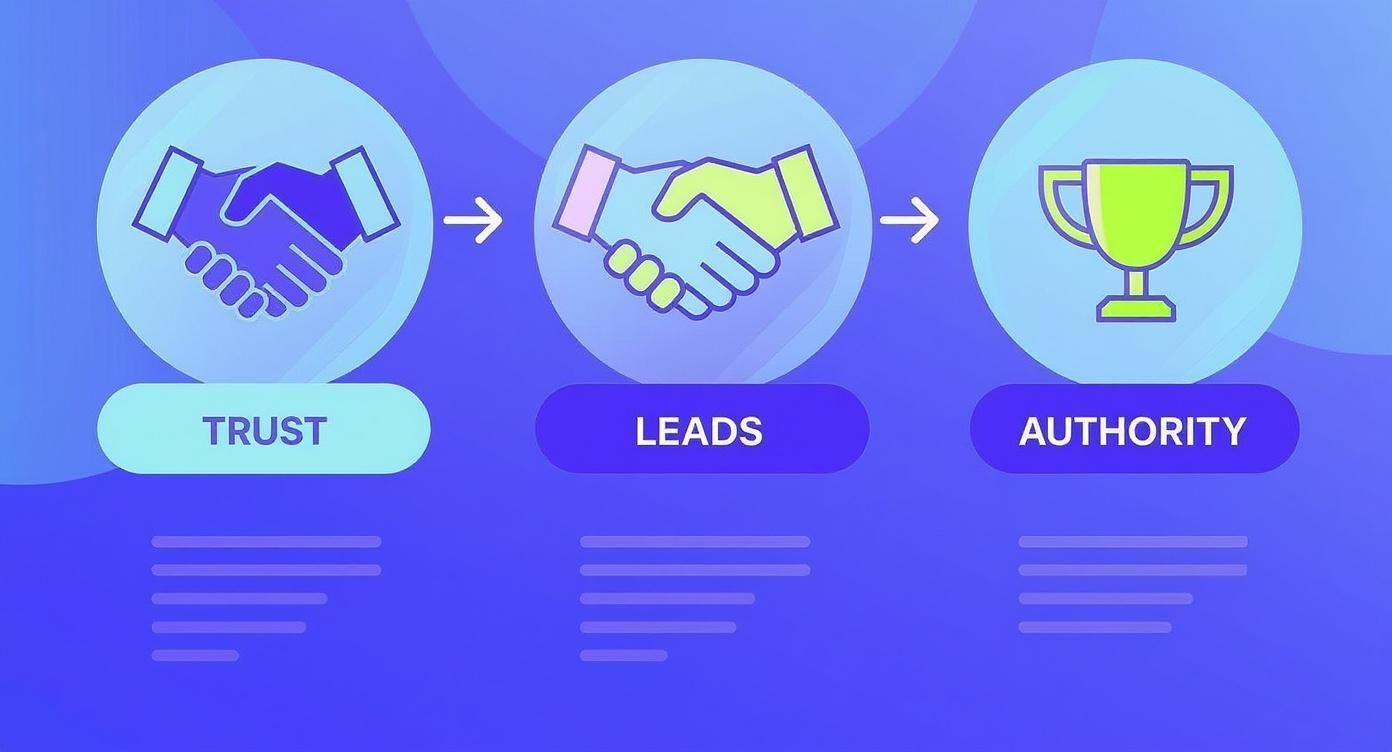
This shows that content isn't just about writing articles. It’s a deliberate process of guiding potential customers from simply being aware of you to becoming loyal advocates.
Before we dive into the nitty-gritty of building your strategy, let's get a high-level view of the core components we'll be covering.
The Pillars of a Small Business Content Strategy
| Pillar | Your Goal | Key Action Item |
|---|---|---|
| Audience & Keywords | Know exactly who you're talking to and what they're searching for. | Develop detailed customer personas and map out their buying journey. |
| Content Pillars | Create focused topic areas that align with your expertise and audience needs. | Define 3-5 core themes that will guide all your content creation. |
| Distribution & SEO | Make sure your content gets found by the right people at the right time. | Build a multi-channel plan for organic search, social media, and email. |
| Measurement & KPIs | Track what's working so you can double down on your successes. | Set up a simple dashboard to monitor traffic, leads, and conversions. |
Think of these as the foundation of your entire content operation. Get them right, and everything else becomes much, much easier.
Investing in Your Growth
The money flowing into content marketing tells its own story. The global market was valued at a massive $413.2 billion in 2022 and is on a trajectory to hit an eye-watering $2 trillion by 2032.
Here's the critical part for small businesses: analysis shows that companies that fail often underinvest in content. A staggering 31% of them spend less than 5% of their marketing budget on it, compared to just 9% of highly successful businesses. The proof is in the pudding.
Of course, content is just one piece of the puzzle. To see how it fits into the bigger picture, it's worth exploring these 10 potent small business growth strategies.
Key Takeaway: A smart content strategy isn't an expense. It's an investment in a durable asset that delivers compounding returns in trust, leads, and authority.
By focusing on creating resources that genuinely help people, you build a marketing machine that works tirelessly to grow your business from the ground up.
Finding Your People and the Words They Use
Before a single word of your content gets written, we need to get one thing straight: who are you actually writing for? A powerful content marketing plan isn't about shouting into the void with a megaphone. It's more like using a laser pointer to connect with the exact people already looking for what you do.
And the good news? You don't need fancy, expensive software to figure this out. The most valuable clues are usually hiding in plain sight.
Your job is to move past generic labels like "moms, age 30-45" and create a real, flesh-and-blood picture of your ideal customer. Think of it like a character sketch for the person who is going to absolutely love your business. It’s simpler than it sounds.
Digging for Customer Gold
The best insights always come straight from the source. The first step is to become a detective and hang out in the digital spaces where your customers are already talking about their problems. This is where you’ll find the exact language they use—which is pure gold for creating content that resonates and for finding keywords that actually work.
Here’s where to start digging, without spending a dime:
- Social Media Comments: Sift through the comments on your own posts, but don't forget to peek at your competitors' pages, too. What questions pop up again and again? What are people complaining about? This is unfiltered, honest feedback.
- Customer Emails & Inquiries: Your own inbox is a treasure trove. Look at the last 20 questions you got through your contact form. The repeating themes are basically a roadmap telling you what content to create next.
- Online Reviews: Spend an hour on Google, Yelp, or any industry-specific review sites. Pay just as much attention to the 1-star reviews as the 5-star ones, for both your business and the ones down the street. A competitor's failure is a content opportunity for you.
This recon work builds the foundation. It gives you a real feel for your customer's world, their frustrations, and what they truly value.
From Clues to Actionable Personas
Once you have all this raw intel, it's time to organize it into a simple, usable customer persona. A persona is just a semi-fictional snapshot of your ideal customer, pieced together from all the real data you just found. For most small businesses, one or two of these are all you need to get started.
Pro Tip: Don't get lost trying to write a novel-length biography. Just focus on the stuff that will actually shape your content: their main goal, their biggest roadblock, and the specific words they use to talk about it.
Let's imagine a local landscaping company here in Austin. After looking through their emails and social media DMs, they might sketch out a persona they call "Busy Professional Patty."
- Her Goal: Wants a gorgeous, low-maintenance yard but has zero time to garden.
- Her Roadblock: Is totally overwhelmed by all the options and terrified of picking expensive plants that will just die in the Texas heat.
- Language She Uses: "drought-tolerant," "curb appeal," "easy to care for," "native plants for Austin."
Boom. This simple profile gives the company instant clarity. They know Patty isn't typing "advanced botany techniques" into Google. She’s searching for things like "best low-maintenance plants for Austin sun." That insight is the critical bridge connecting who your customer is to what you should write about.
Finding Keywords That Actually Drive Business
With a clear picture of Patty and the words she uses, you can finally start finding keywords that will bring her to your website. For a small business, the strategy is to completely sidestep the hyper-competitive, generic terms and focus on two secret weapons: long-tail keywords and local keywords.
Long-tail keywords are just longer, more specific phrases. They signal that someone is much further along in their buying journey. Instead of the massive, impossibly competitive term "coffee beans," a long-tail keyword like "how to choose the right coffee beans for cold brew" attracts someone who knows what they want.
Local keywords are how you win your neighborhood. These are simply search terms with a geographic tag, like a city or even a specific area. A plumber has almost no chance of ranking for the word "plumber." But ranking for "emergency plumber in South Austin"? That’s not only achievable, but it also attracts a customer with a wallet in their hand.
You can uncover these gems for free using Google itself. Just type in one of your core services and scroll down. The "People also ask" and "Related searches" sections are Google telling you exactly what real people are looking for. It's a ready-made list of content ideas that you already know people want.
Laying the Foundation: Your Content Pillars and Formats

Alright, you know who you're talking to. Now for the big question: what on earth do you actually talk about? The sheer number of options can feel paralyzing.
The trick is to stop chasing individual topic ideas and start thinking in terms of content pillars.
Think of content pillars as the 3-5 core subjects your business will absolutely own. These are the big, foundational themes tied directly to what you do best and the problems your customers are desperate to solve. They’re your strategic filter, making sure every single thing you create is relevant and cements you as the go-to expert.
For instance, a local landscaping company here in Austin wouldn't just write about "gardening." Their pillars would be much sharper:
- Seasonal Garden Care: This bucket holds everything from spring planting checklists to prepping flower beds for a mild Texas winter.
- Drought-Resistant Plants: A massive pain point for any local homeowner. This pillar speaks directly to a real, urgent need.
- DIY Patio & Hardscape Design: This taps into the aspirational side of homeownership, helping customers envision their dream outdoor space.
Pillars give you structure. They eliminate that "what should I post today?" panic because every piece of content you create will sprout from one of these core themes.
How to Brainstorm Your Core Pillars
To find your pillars, you need to look at the sweet spot where your audience's needs and your business expertise overlap. Go back to your customer personas. What are their biggest headaches? What questions do they ask over and over?
Your pillars should be broad enough to spawn dozens of smaller ideas but specific enough to stake your claim. If you're a financial advisor for young families, a pillar like "Financial Planning" is way too generic. A much stronger one would be "Saving for College and First Homes." See the difference? It’s focused, relevant, and immediately signals your niche.
Key Takeaway: Your content pillars aren’t just topics. They are the strategic themes that position your small business as the undisputed expert in a very specific arena.
Once you nail these down, they become the wellspring for everything you create, from blog posts to social media clips.
Turning Pillars into Real, Actionable Content
This is where the magic happens. You take a single pillar and slice it into a ton of different content formats and specific angles. This is how you build a sustainable content machine without constantly trying to reinvent the wheel.
Let’s stick with our landscaping company's "Drought-Resistant Plants" pillar. From that one theme, they could easily create:
- A "How-To" Blog Post: "Top 10 Drought-Tolerant Flowers That Actually Thrive in Austin Heat"
- An Instagram Reel: A quick, satisfying time-lapse of planting a beautiful succulent garden.
- A Checklist PDF: "Your Ultimate Checklist for a Water-Wise Texas Garden" (perfect for capturing email addresses).
- A Customer Story: A short video case study featuring a happy client whose water bill plummeted after a garden redesign.
This "pillar and cluster" model creates a steady stream of consistent, interconnected content. Each piece reinforces the others, building a web of expertise that both Google and your future customers will love.
Choosing the Right Content Format for the Job
Not every idea should be a 3,000-word blog post, and not every tip needs a professionally shot video. Picking the right format is all about meeting your audience where they are and matching the container to the content. A good content mix keeps things interesting for them and manageable for you.
Blog Posts and Articles
These are the absolute workhorses of any small business content plan. They are fantastic for SEO, letting you go deep on a topic to prove your expertise and answer complex customer questions. Long-form content is still a powerhouse for driving high-quality traffic. In fact, articles over 2,500 words attract 77.2% more backlinks. Blogging is a proven way to build authority, which is why we dig into the top benefits of blogging for small businesses in another one of our guides.
Short-Form Video (Reels, TikToks, Shorts)
This is your go-to for grabbing attention and showing off your brand's personality. Use it for quick tips, behind-the-scenes moments, or highlighting a single amazing customer review. Video is also perfect for demonstrating something that’s tough to explain with just words.
Email Newsletters
Email is your direct line to your most loyal audience—the people who actually asked to hear from you. Use your newsletter to share your best content, announce special offers, or give exclusive advice you don't post anywhere else. It’s an incredibly powerful tool for nurturing leads and driving repeat business.
Creating and Optimizing Content That Connects

Okay, you've got your pillars and a game plan for formats. Now for the fun part: actually rolling up your sleeves and creating the content. This is where your strategy becomes something real—assets that will pull in the right people, keep them engaged, and ultimately, grow your business.
Don't get hung up on perfection. The goal is clarity and genuine helpfulness. You want to build a real connection, not win a Pulitzer.
Great content is as much about its structure as the words themselves. Let's be honest, people don't read websites word-for-word. They scan. They’re looking for a quick answer to their problem. Your job is to make that answer as easy as possible to find.
Think of your blog post like a well-organized shop. Your headings (H2s and H3s) are the aisles, guiding readers right to what they need. Short paragraphs—sticking to 2-3 sentences—and bullet points are like neatly stacked products, easy to grab and understand at a glance. This keeps people from getting overwhelmed and clicking away.
Making Friends with Google
You’re writing for people first, always. But you also need to give search engines a clear roadmap so they can understand and rank your content. That’s all on-page SEO really is—adding simple signals that tell Google what your page is about. It's not about stuffing keywords or trying to trick the system.
If you’re on WordPress, this is incredibly easy. Tools like Yoast SEO or Rank Math give you a simple checklist right inside your editor, walking you through the most important parts.
For every piece you publish, dial in these key elements:
- SEO Title: This is your headline in the search results. It needs to be compelling and include your main keyword, ideally near the front.
- Meta Description: The little blurb under the title in search results. It doesn't directly affect rankings, but a good one makes people want to click. Think of it as a mini-advertisement for your content.
- Image Alt Text: This is just a quick, descriptive text for your images. It helps visually impaired users and tells Google what your visuals are about, which can even help you rank in image searches.
Key Takeaway: On-page SEO isn’t about cheating the system. It’s about being clear for both humans and search engine bots, making sure your amazing content actually gets seen.
If you want to dig a little deeper, understanding how your site structure works is a game-changer. You can learn more about these fundamentals by reviewing some technical SEO best practices that will only strengthen your content efforts.
Creating High-Quality Video on a Budget
The word "video" makes a lot of small business owners sweat. We immediately picture expensive cameras, fancy lights, and complicated editing software. Forget all that. The truth is, you already have a powerful video studio right in your pocket: your smartphone.
Today, high-quality video is less about cinematic polish and more about being authentic and valuable. People connect with real, helpful content. In fact, a slick, corporate-style video can sometimes feel less trustworthy than a genuine clip shot on a phone.
You can make your videos look and sound professional by focusing on just two things: lighting and audio.
- Find Good Light: Natural light is your best friend. Stand facing a window so the light hits your face. Never have a bright window behind you—you'll end up looking like a silhouette.
- Get Clear Audio: Your phone's mic is okay, but a cheap lavalier mic that clips to your shirt will make a world of difference. Clear audio is non-negotiable. People will forgive a slightly shaky video, but they won't stick around if they can't understand what you're saying.
With just those two simple tweaks, your smartphone videos will instantly look and sound 10x better. It’s the perfect setup for quick tips, behind-the-scenes tours, or customer testimonials that create a powerful, human connection with your audience.
Getting Your Content in Front of the Right People

Let's be honest: creating great content is only half the job. If nobody ever sees that brilliant blog post or helpful video you poured hours into, it might as well not exist. This is where a smart distribution plan comes in, turning your valuable content into a real audience-building machine.
Think of it this way: you just baked a fantastic cake. Distribution is making sure everyone at the party gets a slice.
This doesn’t mean you have to be everywhere at once. The real key is to be strategic and focus your energy on the channels where your ideal customers are already hanging out.
Tailoring Your Message for Social Media
Sharing your new blog post on social media isn't just about dropping a link and hoping for the best. Each platform has its own vibe and audience expectations, and a one-size-fits-all approach will fall flat. Fast.
Instead, think like a content chameleon, adapting your message to fit the environment:
- LinkedIn: This is your professional stage. Frame your content around business insights, industry trends, or career advice. A post could start with something like, "We analyzed the top 5 challenges facing local retailers this quarter. Here’s what our latest article uncovered…"
- Instagram: It's all about visuals and storytelling here. Pull a punchy quote from your article and turn it into a sharp graphic using a tool like Canva. Even better, create a short Reel summarizing the top three tips from your post.
- Facebook: Use this channel to spark a real conversation. Pose a question related to your content to get comments and engagement from your local community. For example, "What's the #1 thing you struggle with when it comes to XYZ? We tackle it in our new guide."
By tailoring the hook for each platform, you dramatically increase the chances that people will actually stop scrolling and click. This simple shift is a core part of building a strong local business digital marketing presence that truly connects.
Building Your Direct Line with Email
An email list is one of the most valuable assets you can own as a small business. It’s a direct, personal line to people who have explicitly raised their hand and said they want to hear from you.
Start simple. Your goal is to deliver genuine value, not just clutter up inboxes. Send a monthly newsletter that rounds up your best content, shares an exclusive tip, or offers a special promotion just for your subscribers.
Key Takeaway: Social media platforms can change their algorithms overnight, but your email list is yours. It's a stable, reliable channel for nurturing relationships and driving repeat business.
As your list grows, you might want to look into platforms with advanced email marketing features like segmentation and automation. This lets you send more targeted, relevant messages that people actually appreciate.
Boost Your Best Content with a Small Ad Budget
Paid advertising can feel like a big, scary leap, but you don't need a massive budget to make a real impact. A small, targeted spend can give your best-performing content the push it needs to reach a much wider—yet still relevant—audience.
Here’s the trick: wait until a piece of content has proven itself organically. If a blog post is already getting good traffic or a video is getting lots of shares, that’s your green light. Invest just $5 or $10 a day to "boost" that post on Facebook or Instagram, targeting an audience that mirrors your ideal customer persona.
This approach ensures you’re putting money behind a proven winner, getting the most bang for your buck without breaking the bank. It's a smart, efficient tactic, especially when you consider that a solid content strategy already cuts marketing costs by an average of 62% compared to traditional methods.
How to Measure Your Content Marketing Success
Look, creating great content is a fantastic start. But if you’re not tracking what happens next, you’re basically flying blind. For any small business, a successful content strategy hinges on one simple thing: knowing what’s actually working. That’s how you double down on your wins and stop wasting time and money on what isn't.
You don't need to get lost in a sea of confusing analytics. Seriously. For most small businesses, just a handful of key performance indicators (KPIs) can tell you pretty much everything you need to know about your return on investment.
Focusing on Metrics That Matter
Your goal isn't just to get clicks—it's to get customers. Plain and simple. That's why your measurement has to focus on metrics that tie directly to business growth. You don't even need expensive software to pull this off. Free tools like Google Analytics and Google Search Console are more than powerful enough to get the job done.
Here are the essential KPIs you should be watching:
- Organic Traffic Growth: Is your overall website traffic from search engines going up month over month? This is the clearest sign your content and SEO efforts are actually paying off.
- Keyword Rankings: Are you climbing the search results for your target keywords? Tracking your position for a term like "Austin landscaping services" shows if you're gaining visibility where it truly counts.
- Conversion Rate: This is the big one. How many visitors are taking the action you want them to? This could be filling out a contact form, signing up for your newsletter, or picking up the phone to call your business. A strong conversion rate means your content is genuinely persuading people to act.
Key Takeaway: The ultimate goal is to draw a straight line from a blog post to a new lead. If your content is attracting the right audience and convincing them to take that next step, you know your strategy is working.
Building a Simple Performance Dashboard
You can whip up a straightforward dashboard using Google's free tools to keep these numbers front and center. This isn't about getting bogged down in complex spreadsheets; it's about having a quick, at-a-glance view of your content's health.
Inside Google Analytics (GA4), you can easily track traffic sources to see how many people are finding you through organic search versus social media. You can also set up conversion events to automatically log every time someone fills out your contact form—no manual counting needed.
Meanwhile, Google Search Console is your go-to for all things SEO data. It will show you exactly which search queries people are using to find your site and what your average ranking position is for those terms.
Checking this just once a week will give you a clear picture of which content pieces are gaining the most traction with search engines. By keeping an eye on these simple metrics, you can make informed decisions, justify your budget, and strategically invest in what truly drives results for your small business.
Answering Your Content Marketing Questions
Jumping into content marketing for your small business always brings up a few practical questions. Let's tackle the ones I hear most often so you can move forward with a clear plan.
How Much Should We Really Be Spending on Content Marketing?
There's no magic number, but a solid starting point is to earmark 5-15% of your total revenue for all your marketing efforts, with a healthy chunk of that going toward content.
Here's a more practical way to think about it: start small and scale smart.
Figure out your most urgent needs first. Is it foundational blog posts that answer your customers' biggest questions? Or maybe it's nailing the copy on your key service pages. Budget for those initial wins. Once you start seeing some traction—more traffic, a few leads coming in—you can reinvest a piece of that new revenue right back into creating more content. The goal here is consistency, not a huge one-time splash.
How Long Until We Actually See Results?
I get this one a lot. Content marketing is a long game, not a quick fix. While you might get some early traffic bumps, it generally takes a good 6 to 12 months of consistent effort to see significant results in organic traffic, lead generation, and your search rankings.
Consistency is everything.
Every time you publish a high-quality piece of content, you're sending positive signals to Google and, more importantly, building real trust with your audience. Don't just watch for sales in the first few months. Instead, keep an eye on the early indicators of success, like seeing your keyword rankings start to climb, getting more engagement on social media, or watching your email subscriber list grow.
My Takeaway: Think of your content like planting a tree, not starting a fire. It needs steady attention and time to grow strong, but the payoff is a sustainable source of leads and authority for years to come.
Can I Do This Myself, or Do I Need to Hire Someone?
This really boils down to your time, your skills, and your budget. Plenty of small business owners successfully run their own content marketing by keeping their focus tight—maybe just on a blog and an email newsletter to start.
If you go the DIY route, block out a few hours every single week dedicated only to content. Protect that time. But if you find yourself staring at a blank page or consistently pushing content to the bottom of your to-do list, it might be time to get help. Hiring a freelance writer or a part-time marketing assistant can be a game-changer. It frees you up to do what you do best—run your business—while making sure your content engine keeps running and doesn't lose momentum.
At Gidds Media, we build and execute powerful content strategies that help small businesses in Austin see real, measurable growth. If you'd rather have a partner handle your content, SEO, and website so you can focus on your customers, let's talk. Learn more about how we can grow your business.


