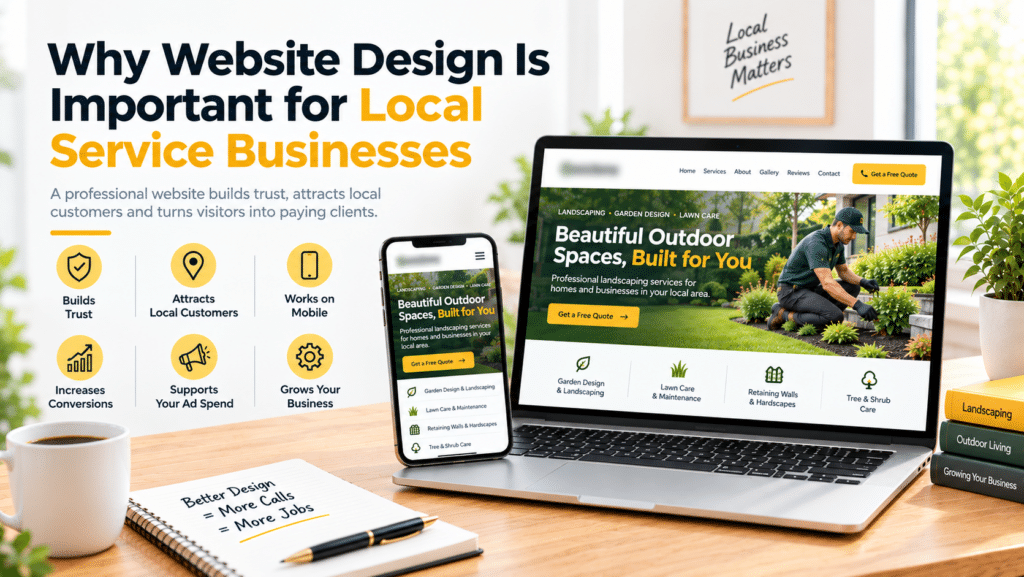
Your website is the first place a potential customer forms an opinion about your business, and that opinion forms fast. Research from Stanford’s Web Credibility Project consistently shows that visual design is the single largest factor people cite when judging whether a business website is credible or not.
For local service businesses, a plumber, HVAC company, landscaper, or electrician working a defined geographic area, the stakes are even higher. You are not competing globally. You are competing against three or four other local names, and the person comparing you on a smartphone at 9 PM will decide based on what they see before they read a single word of copy.
Who this is for: This article is written for local service business owners and their marketing managers who are actively deciding whether to invest in a professional website redesign or questioning why their current site is not converting traffic into calls and bookings.
Not for: Developers looking for technical build specifications or enterprise-level brands managing multi-regional web properties.
Key Takeaways
- First impressions on a website happen in under a second, and visual design carries the most weight in credibility judgments for service businesses.
- A poorly designed site actively costs you customers, even if your ads and SEO are driving traffic to it.
- Mobile performance is not optional. Most local service searches happen on phones, and slow or broken mobile layouts lose jobs to competitors.
- Trust signals (license numbers, reviews, photos of your real team) reduce friction and increase contact form submissions and phone calls.
- Design and advertising work together. A high-converting site dramatically improves the return on any paid traffic you send to it.
- Redesigning does not have to mean a six-figure project. Knowing how much does it cost to build a website for your specific scope helps you budget realistically.
First Impressions Are Faster Than You Think
Visitors form a visual impression of your site in roughly 50 milliseconds, according to published attention research from Carleton University. That is before they have read your business name. Before they have seen your phone number. Design is doing the persuading at that moment, not your words.
For a local HVAC company or a residential cleaning service, the practical implication is straightforward. A site that looks dated, loads slowly, or presents a wall of text signals to the visitor that the business itself may be disorganized or unreliable. That is not a fair judgment, but it is the one being made.
The trade-off worth naming here is cost. Polished design is not free. If budget is a real constraint right now, even a streamlined single-page site with a professional photo of your crew, a clear service area, and a click-to-call button will outperform a cluttered five-page site built on a free template from 2019. Do not let perfect become the enemy of functional.
What usually trips people up here is assuming the copy is carrying the weight when, in reality, users are bouncing before they read the first paragraph. If your site has high traffic but low contact rates, design is the first variable to examine, not the content.
How Design Directly Affects Your Conversion Rate
A website that looks good but does not convert is not doing its job. For local service businesses, conversion almost always means a phone call, a contact form submission, or a booking. Design decisions control how easily a visitor can take that action.
Specific design elements that affect conversion rates for service businesses include button placement, mobile tap target size, the presence of a phone number above the fold, and load time on cellular connections. Google’s Core Web Vitals documentation outlines the technical thresholds that correlate with user retention. A page that takes longer than 3 seconds to load on a 4G connection loses a measurable share of visitors before it finishes loading.
| Design Element | What It Does | Common Mistake |
|---|---|---|
| Click-to-call button above the fold | Gives mobile visitors instant access to call you | Buried in footer or missing entirely |
| Real team photos | Builds personal trust for in-home services | Stock photos that feel impersonal |
| License and insurance badges | Reduces objection for regulated trades | Not displayed or hard to find |
| Review count and stars visible | Social proof before the visitor reads | Hidden on a separate testimonials page |
| Clear service area map or text | Confirms you work in their zip code | Forces visitors to guess or call to ask |
The pattern seen consistently across local service sites is that businesses invest in paid ads to drive traffic, then watch conversions stall because the landing experience is broken. Understanding how much do meta ads cost only matters if the destination page is ready to receive that traffic.
Mobile Performance Is the Real Battleground
More than 60 percent of local service searches happen on mobile devices, according to Google’s consumer insights data. A person whose furnace stopped working at midnight is not sitting at a desktop. They are on their phone, searching “emergency furnace repair near me,” and they will call the first site that loads cleanly and shows a phone number immediately.
Desktop design still matters, especially for higher-consideration services like remodeling projects where customers research at length. But if your site is not mobile-first in its structure and speed, you are conceding the highest-intent searches to competitors who made that investment.
The catch is that mobile optimization is not just about making text smaller on a phone screen. It means rethinking which elements load first, how forms behave on touch screens, and whether your navigation collapses cleanly. A developer who slaps a “responsive” tag on a site without testing it on actual Android and iOS devices at various connection speeds is giving you false confidence.
Trust Signals That Close the Gap Between Visitor and Customer
Local service businesses operate on trust in a way that e-commerce businesses do not. When you are inviting someone into your home to do electrical work or roofing, the question is not just “what does this cost?” It is “can I trust this person and this company?”
Design is the vehicle that delivers trust signals. Those signals include visible licensing information, a physical address (even a service area address rather than a P.O. box), photos of the actual crew rather than stock images, video testimonials, and a consistent color palette and typography that feels established rather than thrown together.
| Trust Signal | Why It Works | Where to Place It |
|---|---|---|
| State license number displayed | Proves legitimacy for regulated trades | Homepage header or footer |
| Real crew photos with names | Reduces anxiety about strangers entering the home | About page and homepage |
| Google review widget (live) | Continuously updated social proof | Homepage and service pages |
| BBB or contractor association badge | Third-party credibility endorsement | Footer and contact page |
| Service area map | Confirms relevance before the visitor calls | Homepage and contact page |
| Response time promise (“We call back in 2 hours”) | Reduces uncertainty about the sales process | Above the fold on homepage |
In practice, businesses that add a visible license number and a genuine team photo to their homepage see measurable increases in form completions within the first month. The design choice to surface that information (rather than bury it on an “About” page) is what drives the result.
The Connection Between Website Design and Your Ad Spend
This is where understanding why website design is important becomes financially concrete. Every dollar you spend on paid advertising, whether through Google Local Services Ads, Facebook, or Instagram campaigns, is landing somewhere. If that destination is a weak page, you are paying to generate impressions and clicks that evaporate at the moment of truth.
When you understand what are the 5 types of meta ads and start running campaigns for your service business, the ads drive intent. The website converts it. A weak site turns a well-targeted ad into wasted budget.
This relationship also works in reverse. A strong, fast, trust-building website raises your Quality Score in Google Ads, which directly lowers your cost-per-click. The design investment pays dividends on every future ad campaign.
If you are planning paid campaigns and are unsure how to approach the setup, reviewing guidance on how to run meta ads and when to hire an agency helps you understand when managing ads in-house makes sense versus when the complexity justifies professional help. Either way, the ads are only as effective as the page receiving the traffic.
What a Realistic Website Investment Looks Like for a Local Service Business
The honest conversation about website design includes cost. For a local plumber, electrician, or landscaping company, a professionally designed five to eight page website built on WordPress or a similar CMS typically runs between $2,500 and $8,000 for a U.S.-based agency or freelancer in 2026. Ongoing maintenance and hosting runs separately.
The reason why website design is important becomes clearest when you calculate it against customer acquisition cost. If your average job is worth $800 and you close one in four inquiries, each new contact form submission is worth $200 in expected revenue. A site redesign that doubles your monthly form submissions from 10 to 20 is generating $2,000 in additional expected monthly revenue. The payback period on a $5,000 redesign is less than three months.
Using a customer acquisition cost calculator makes this math concrete before you commit budget. It forces you to see design as a revenue lever, not a sunk cost.
A full picture of what local service marketing actually costs, including web and paid channels combined, is covered in detail in how much does advertising cost for a small business a 2026 breakdown. Use that context to decide where your next marketing dollar goes with real numbers rather than guesswork.
The trade-off: spending at the low end of the range ($1,500 to $2,500) often means a templated site that looks similar to competitors and lacks custom conversion optimization. Spending above $10,000 for a simple local service site is rarely justified unless you are running high-volume lead generation at scale. The $3,000 to $6,000 range is where most local service businesses get genuine value in 2026.
SEO and Design Are Not Separate Decisions
A common misunderstanding among local service business owners is treating SEO and design as two separate projects. They are not. Design decisions directly affect whether your site ranks at all.
Page speed, structured heading hierarchy, schema markup for local businesses, crawlable navigation, and image alt text are all design and build decisions that determine how Google indexes your pages. A beautiful site built in a way that blocks crawlers or loads in 6 seconds on mobile is invisible to the people searching for your services.
The structure matters too. A site that has one generic “Services” page instead of separate optimized pages for “Water Heater Repair in Austin, TX” and “Emergency Pipe Burst Service in Austin, TX” is leaving local search visibility on the table. That is a design and information architecture decision, not just a content decision.
Understanding why website design is important at this level means recognizing that design is strategy, not decoration. The choices made during the build phase determine the ceiling of your organic reach for the next three to five years.
Frequently Asked Questions
Q: How long does it take for a new website design to start showing results for a local service business?
Most local service businesses see measurable changes in contact rate and bounce rate within 30 to 60 days of launching a redesigned site.
The caveat is that SEO results take longer. Organic ranking improvements typically show up between 90 and 180 days after launch, depending on how well the new site is structured for local search and how competitive your market is. Paid traffic results are immediate, which is why running a small ad campaign right after a redesign is a practical way to get early conversion data.
Q: Can a badly designed website hurt my Google rankings?
Yes. Google measures user behavior signals like bounce rate, time on page, and Core Web Vitals scores, all of which are directly influenced by design quality.
A site that loads slowly, displays poorly on mobile, or confuses visitors into leaving quickly sends negative signals to Google’s ranking algorithm. Over time, this depresses your position in local search results even if your off-site SEO (citations, backlinks, Google Business Profile) is strong. Design and rankings are connected more tightly than most business owners realize.
Q: Do I need a custom-designed website or will a template work for my service business?
A well-chosen template, customized with your real photos, service area details, and trust signals, can absolutely perform well for a local service business.
The distinction that matters is not custom versus template. It is generic versus optimized. A template left at its defaults, using stock images and placeholder text, will not convert. A template that has been configured with a clear mobile layout, click-to-call functionality, and real business content can outperform a custom site that was built without conversion in mind. Budget constraints make templates a legitimate starting point for newer businesses.
Q: Should I redesign my website before or after I start running paid ads?
Redesign first, then run ads. Sending paid traffic to a weak site is the fastest way to waste your ad budget.
The math is straightforward. If your current site converts 1 in 50 visitors into a contact and a redesigned site converts 1 in 20, every dollar you spend on ads after the redesign works roughly two and a half times harder. Launching ads before fixing the destination page is a common sequencing mistake that local service businesses make, particularly when they feel pressure to generate leads quickly. A short delay to fix the site pays back within the first campaign month.
Q: What is the single most important design element for a local service business homepage?
A visible, clickable phone number above the fold on mobile is the single highest-impact element for a local service business homepage.
Everything else, reviews, photos, service descriptions, contributes to trust and conversion over time. But a visitor who cannot immediately see how to contact you will leave. On mobile, that means a tap-to-call button that requires zero scrolling. On desktop, it means the phone number is in the top right of the header in a size and color that stands out from the background. This one change alone, applied to sites where the number was previously buried, consistently produces measurable increases in inbound call volume within the first few weeks.
The Bottom Line on Why Website Design Is Important for Local Service Businesses
Your website is not a digital brochure that sits quietly in the background. For a local service business, it is the primary conversion tool in your entire marketing stack. Every ad you run, every referral you earn, and every Google search you rank for eventually lands a potential customer on that site. What happens next is entirely determined by design.
The decision framework is simple. Audit your current site against the trust signals and mobile performance benchmarks covered above. If your bounce rate is high, your phone is not ringing from web traffic, or your site looks dated compared to local competitors, a redesign is not an expense. It is the highest-ROI marketing investment available to you right now. Start by getting a realistic cost estimate, map it against your average job value using a customer acquisition model, and treat the redesign as infrastructure rather than cosmetics. Once the site is built to convert, everything else you spend on marketing works harder. If you want a second opinion on your current site, here is how we handle website design for local service businesses.