Knowing your Customer Acquisition Cost (CAC) is the difference between guessing and growing. It’s the total cash you spend to land a new customer, and getting this number right is the very first step toward building a business that actually makes money.
Without it, you’re just flying blind with your marketing budget.
Why Customer Acquisition Cost Is Your Most Important Metric
Let’s be real—winning new customers feels great, but it’s getting more expensive and competitive every single year. Relying on gut feelings to steer your marketing spend is a fast track to burning cash.
This is where your CAC becomes a critical health check for your entire business. It stops being a simple accounting task and turns into a strategic weapon.
When you have a firm grip on this number, you suddenly unlock the ability to make smarter decisions everywhere. It directly tells you how to set marketing budgets, how to price your products, and ultimately, how to build a sustainable path to profitability. Ignoring it means you could be pouring money into channels that don’t work or, even worse, acquiring customers who cost more than they'll ever be worth.
The Rising Tide of Acquisition Costs
The pressure to get customers efficiently has never been higher. Recent data shows that acquisition costs have absolutely skyrocketed. The average loss per new customer climbed from just $9 in 2013 to a projected $29 in 2025—that's a staggering 222% increase.
This jump is fueled by climbing digital ad prices and insane competition for people's attention.
This infographic really nails why CAC is such a fundamental business health indicator.
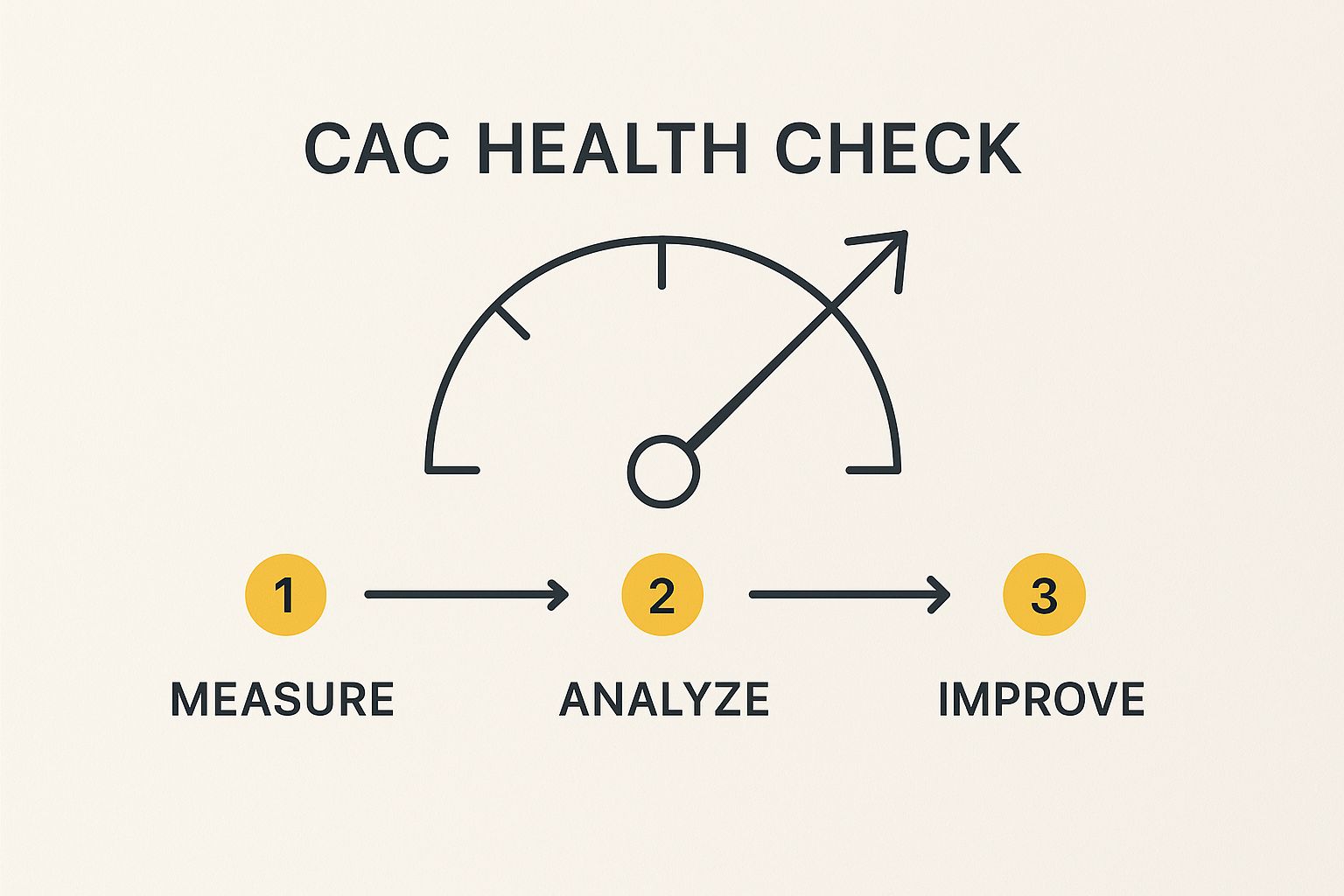
Just as the gauge suggests, a healthy CAC is tied directly to a healthy business. It's a metric you have to watch like a hawk and constantly work to improve.
Turning Insight into Action
Figuring out your CAC isn't just about landing on a number; it’s about what you do with that information. It’s the starting point for a much deeper analysis of your business.
By treating your Customer Acquisition Cost as a core business KPI, you shift from simply spending on marketing to strategically investing in growth. It’s the foundation for a scalable and resilient business model.
This one metric can guide your entire growth plan. For startups, especially, a well-managed CAC is non-negotiable for survival and growth. You can see how CAC fits into the bigger picture in our guide on creating a startup digital marketing strategy.
Understanding this cost is the first step toward building a business that doesn't just attract customers, but does so profitably.
Mastering the Customer Acquisition Cost Formula
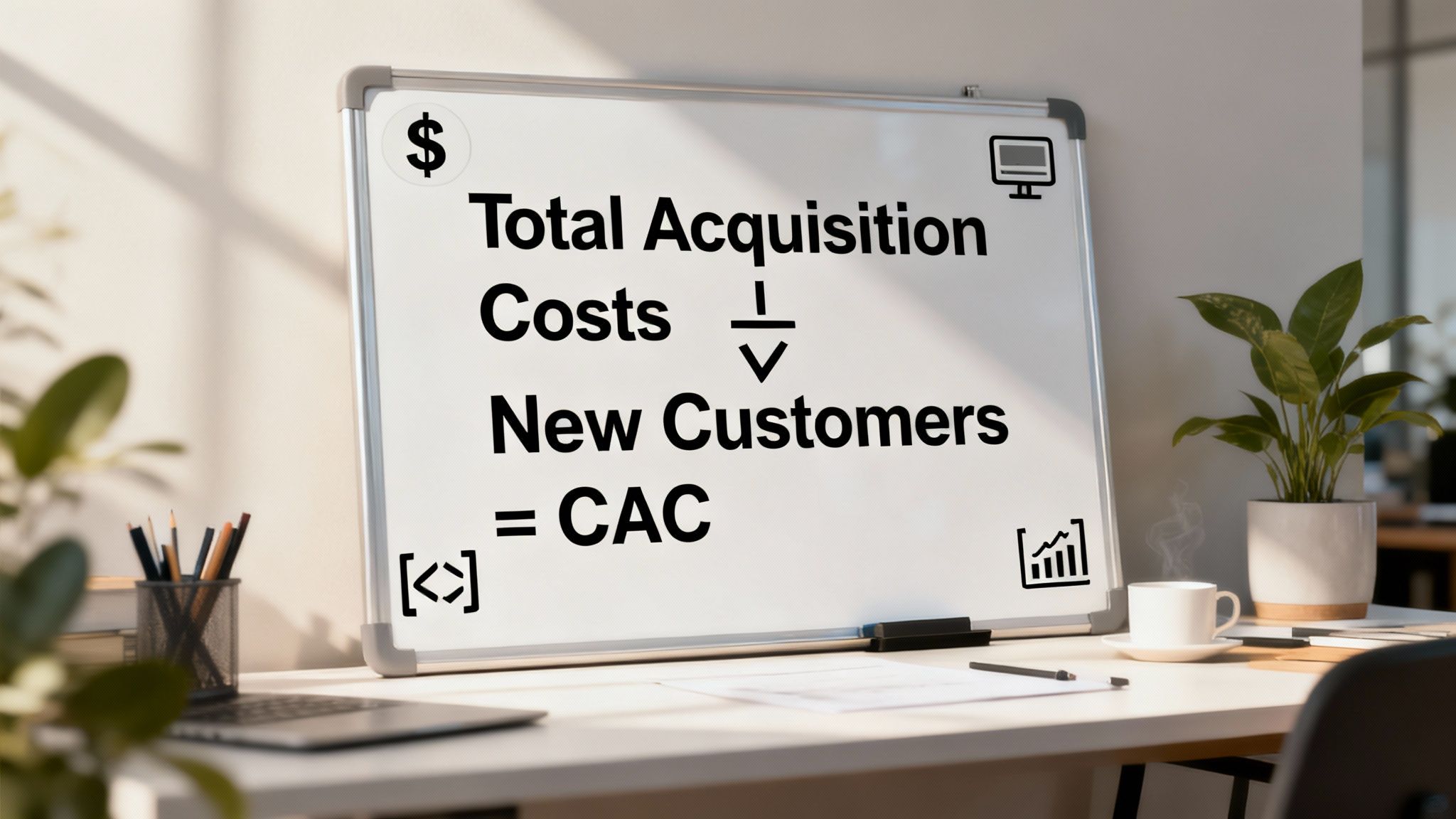
At first glance, the customer acquisition cost formula seems straightforward. You just divide your total sales and marketing costs by the number of new customers you brought in over a certain period. Simple, right?
But the real work—the part that separates a vanity metric from a genuinely useful one—is digging into what actually goes into your "total costs."
A surface-level calculation that only looks at ad spend will give you a dangerously misleading number. To really get a handle on your acquisition engine, you have to be honest and account for every single dollar spent to win a new customer. It’s a foundational metric, but the details matter.
So, if you spend $100,000 in a quarter and land 1,000 new customers, your CAC is $100. But let's break down what really goes into that $100,000. If you want to dig even deeper into this, Improvado.io offers some great insights on CAC.
What to Actually Include in Your Total Costs
To get this right, you need to be meticulous. It’s incredibly common for businesses to stop at their most obvious expenses, like their Google Ads budget, but this approach ignores a massive chunk of the real investment. It paints a rosier picture than reality.
Here’s a more complete checklist for an accurate customer acquisition cost calculator:
- Team Salaries: This isn't just base pay. You need the fully-loaded cost—including benefits and payroll taxes—for everyone on your sales and marketing teams.
- Software and Tools: Think about your whole tech stack. This includes subscriptions for your CRM, email marketing platform like Mailchimp, analytics software, and any other tools you use to attract and convert leads.
- Ad Spend: The total budget spent across all paid channels. We're talking social media ads, search ads, sponsored content—everything.
- Creative and Content Costs: Did you hire a freelance writer? A video editor? A graphic designer? Those expenses for content creation absolutely count.
- Agency or Contractor Fees: Don't forget the retainers or project fees you pay to marketing agencies, SEO consultants, or PPC specialists.
Getting all of this on paper ensures you're looking at the full picture, not just a convenient snapshot.
A Real-World SaaS Company Example
Let's make this tangible. Imagine a growing software company we'll call "SaaSCo." They want to calculate their CAC for the last quarter (Q3) and need to pull all their expenses from July, August, and September.
First, they start tallying up the costs. It looks something like this:
- Marketing Team Salaries (3 people): $45,000
- Sales Team Salaries (2 people): $35,000
- Google & LinkedIn Ad Spend: $20,000
- Marketing & Sales Software (HubSpot, SEMrush): $5,000
- Freelance Content Writer Fees: $3,000
Adding it all up, their total sales and marketing spend for Q3 comes to $108,000.
Next, they jump into their CRM and see they acquired 300 new paying customers during that same three-month window.
With these two numbers, the actual math is easy. You just divide the total costs by the number of new customers. This simple step turns a long list of expenses into a single, powerful metric you can act on.
Now, SaaSCo can plug their figures into the formula:
$108,000 (Total Costs) / 300 (New Customers) = $360 CAC
There it is. On average, SaaSCo spent $360 to acquire each new customer in the third quarter. This isn't just a number; it's a benchmark. They can now use it to measure future performance, evaluate which marketing channels are pulling their weight, and make much smarter decisions about where to put their budget next quarter.
How to Find the Right Data for Your Calculation
An accurate customer acquisition cost calculator is only as reliable as the data you feed it. Your final number is a direct reflection of your inputs, so garbage in, garbage out. This means you need a clear plan to hunt down the right numbers from the right places inside your business.
The goal here isn't just a one-off calculation. It's about creating a repeatable process for collecting this data. When you do that, every time you calculate CAC, you're comparing apples to apples. That's how you spot real trends over time.
Pinpointing Your True Acquisition Costs
One of the most common mistakes I see is people mixing up their acquisition marketing costs with their retention marketing costs. Your CAC calculation should only include expenses aimed at winning genuinely new customers.
For example, the budget for an email campaign targeting existing customers with an upsell offer? That's a retention cost, plain and simple. On the other hand, the ad spend for a Google Ads campaign targeting users who have never bought from you before is a clear acquisition cost. You'll need to work with your marketing team to neatly separate these expenses.
A clean CAC calculation requires discipline. You have to rigorously exclude all costs related to retaining, upselling, or re-engaging your existing customer base. This separation is non-negotiable if you want an accurate result.
To really get this right, robust advertising analytics for Google Ads are indispensable. They help you trace every dollar spent back to a specific outcome, making it much easier to isolate those pure acquisition efforts from the rest of the noise.
Your Data Collection Checklist
To build a complete picture of your spending, you'll need to pull information from a few different places. Don't just glance at your ad dashboards; you've got to dig deeper into your financial and operational tools.
Here’s where to look for the essential data points:
- Accounting Software (like QuickBooks or Xero): This is your source of truth for total expenses. It will house all the records for team salaries, benefits, agency retainers, and any software subscription fees.
- CRM (like HubSpot or Salesforce): Your CRM is the definitive source for customer counts. Make sure you are only counting new, paying customers acquired within your chosen time frame.
- Ad Platforms (Google Ads, Meta Ads, etc.): These platforms will give you the precise ad spend for your acquisition-focused campaigns. Startups, in particular, need to manage this closely, which you can learn more about in our guide to Google Ads for Austin startups.
Once you have all this info, get it organized in a simple spreadsheet. Create columns for each cost category and a separate entry for the total number of new customers you brought in. This simple habit will make your monthly or quarterly CAC calculation a much smoother process. It'll transform it from a dreaded task into a powerful strategic review.
What a Good Customer Acquisition Cost Actually Looks in the Real World
https://www.youtube.com/embed/FBPdVn53Btw
So, you’ve plugged your numbers into a customer acquisition cost calculator and now you're staring at a dollar amount. The big question is always the same: is that number good or bad?
The honest answer? It’s completely relative. There's no magic number that works for every single business. A $500 CAC could be a total disaster for a company selling $40 subscription boxes. But for a software firm landing enterprise contracts worth five figures? That $500 CAC would be an incredible win.
The LTV to CAC Ratio Is What Really Matters
Instead of getting hung up on the raw CAC figure, the real test of your acquisition strategy is how it stacks up against your Customer Lifetime Value (LTV). LTV is simply the total revenue you can reasonably expect to earn from a single customer over their entire time with your company.
When you compare these two, you get the LTV to CAC ratio—arguably the single most important metric for sustainable growth. It tells you if the customers you're paying to bring in will actually generate more money than they cost to acquire. Without that context, your CAC is just a number floating in a void.
The gold standard for a healthy LTV to CAC ratio is 3:1. In simple terms, for every dollar you spend to get a customer, you should expect to get three dollars back in lifetime value. If your ratio is dipping below that, you might be overspending.
A ratio of 1:1 means you’re just breaking even on each new customer, which is a fast track to nowhere once you account for all your other business costs. On the flip side, a ratio of 5:1 or higher might actually mean you’re underspending on marketing and could be growing a lot faster.
Benchmarking Against Industry Averages
While your LTV to CAC ratio should be your north star, it’s still useful to see how your spending compares to others in your industry. Acquisition costs can be wildly different from one sector to another, shaped by things like the length of the sales cycle, the level of competition, and how much a customer is typically worth.
Looking at industry benchmarks can give you a much-needed reality check. You can’t compare the acquisition costs of a B2B SaaS company to a direct-to-consumer eCommerce brand—it's like comparing apples and oranges.
Here’s a look at how different industries stack up, which helps illustrate how business models and sales cycles really shape acquisition spending.
Average Customer Acquisition Cost by Industry
| Industry | Average CAC |
|---|---|
| Fintech | $1,450 |
| Insurance | $1,280 |
| B2B SaaS | $395 |
| Retail | $165 |
| Travel | $80 |
Data from 2025 projections shows some huge variations. Fintech leads with a staggering average CAC of $1,450, a number driven by heavy compliance and high-touch sales processes. Insurance isn't far behind at $1,280 per customer, thanks to long decision-making cycles. You can discover more insights about these industry benchmarks on Usermaven.com.
Seeing these numbers provides crucial context. Use this kind of data as a directional guide to set realistic goals and better understand the competitive field you’re playing on.
Proven Strategies to Lower Your Customer Acquisition Cost
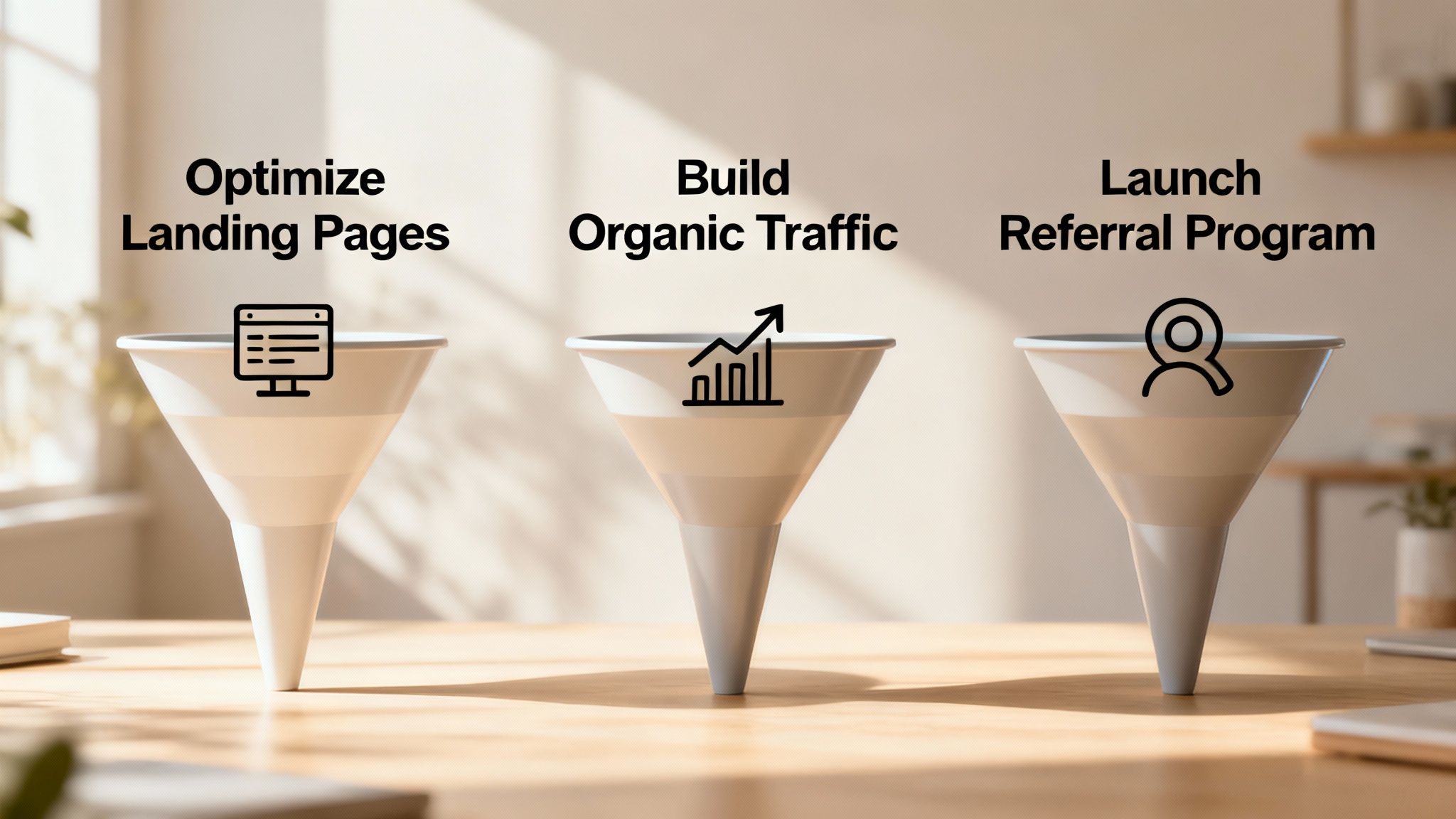
Knowing your Customer Acquisition Cost is just the starting line. The real work begins when you start actively driving that number down. Getting your CAC lower isn't about slashing your marketing budget; it’s about making every single dollar you spend work harder and smarter for you.
This means shifting your focus from just "spending to get customers" to building efficient, repeatable acquisition engines. By optimizing the channels you're already using and exploring new ones, you can pull in more customers for the same—or even less—investment.
Optimize Your Conversion Funnel
One of the fastest ways to slash your CAC is to get your conversion rate up. Think about it: if you can get more visitors to become paying customers without touching your ad spend, your acquisition cost automatically drops. The first place I always look is the landing page or homepage, since that's where most of the friction happens.
Start by making sure your message is crystal clear and speaks directly to what your visitor is struggling with. A tiny tweak to a headline or call-to-action can have a massive impact. I once worked with a SaaS company that saw a 15% lift in sign-ups just by changing their CTA from "Get Started" to "Start Your Free 14-Day Trial." That simple change removed all ambiguity and set a clear expectation. To really nail this, check out our guide on how to create an engaging and converting homepage.
Build an Organic Traffic Engine
Paid ads get you results right now, but they come with a constantly running price tag. Investing in Search Engine Optimization (SEO) and content marketing, on the other hand, is like building an asset. It takes time and effort upfront, but it pays dividends for years by bringing in "free" organic traffic.
Here are a couple of powerful strategies to get you started:
- Targeted Blog Content: Create genuinely helpful articles that answer your ideal customer's most pressing questions. A local plumbing company, for example, could write a killer post on "How to Fix a Leaky Faucet," attracting homeowners who are actively looking for that exact solution.
- Local SEO: If you're a service-based business, optimizing your Google Business Profile is non-negotiable. Earning positive reviews and keeping your information current helps you pop up in local search results right when customers are ready to pull out their wallets.
An effective content strategy attracts qualified leads who are already searching for what you offer. This high-intent traffic converts at a much higher rate than cold outreach, directly lowering your overall CAC.
Launch a Powerful Referral Program
Your happiest customers are your best marketers. Period. A well-designed referral program can turn your existing customer base into an incredibly low-cost acquisition channel. Instead of spending a ton on ads to find new people, you can incentivize your loyal fans to do the heavy lifting for you.
Dropbox is the textbook example of this done right. Their famous referral program offered both the referrer and the new user extra storage space. This simple, value-driven incentive was a key driver of their explosive early growth, dramatically reducing their reliance on expensive paid advertising. On a more modern note, exploring tactics like using AI to launch ads can also make your paid campaigns way more efficient and chip away at your CAC.
Common Questions About Calculating CAC
Once you start digging into your Customer Acquisition Cost, you’ll find a few questions always seem to surface. These aren't just minor details—getting them right can completely change how you see your business and the decisions you make.
Think of this as the go-to guide for those tricky "what if" scenarios. Nailing these nuances is what separates a surface-level understanding from the kind of confident, data-backed insight that actually drives growth.
How Often Should I Calculate My CAC?
When it comes to tracking metrics, consistency is king. For CAC, the sweet spot is calculating it on both a monthly and quarterly basis. This dual timeline gives you the perfect blend of short-term agility and long-term perspective.
- Monthly calculations are your early warning system. They’re fantastic for seeing the immediate ripple effects of a new ad campaign or a recent shift in your sales process.
- Quarterly calculations smooth out the bumps. A single bad month won't skew your perception, giving you a more stable, big-picture view of your acquisition engine's health.
While an annual CAC is great for high-level planning or investor reports, the real, actionable insights come from that monthly and quarterly rhythm.
Should I Include Marketing Team Salaries?
Yes. A thousand times, yes. To get a true, unfiltered picture of your customer acquisition cost, you must include the fully-loaded salaries of your sales and marketing teams. That means their paychecks, benefits, payroll taxes—the whole package.
The single biggest mistake I see companies make is leaving out salaries. It gives you a dangerously low and misleading CAC. Your team is a massive expense directly tied to bringing in customers, and ignoring that cost paints a financial picture that's pure fiction.
What Is the Difference Between CAC and CPA?
This is a classic point of confusion, but the distinction is critical. People often use CAC (Customer Acquisition Cost) and CPA (Cost Per Acquisition) as if they're the same thing, but they measure two very different outcomes.
CPA is a much broader term. It can track the cost of acquiring something other than a paying customer—like a lead, a free trial sign-up, or someone downloading your app.
CAC, on the other hand, is laser-focused. It only measures the total cost to acquire a new, paying customer.
Put simply: every CAC is a type of CPA, but not every CPA is a CAC. Knowing the difference ensures you’re tracking the metric that actually ties back to profitability.
Ready to stop guessing and start growing? At Gidds Media, we build data-driven marketing strategies that lower your CAC and maximize your ROI. Find out how we can help your business with a free, no-pressure consultation. Learn more about our services.