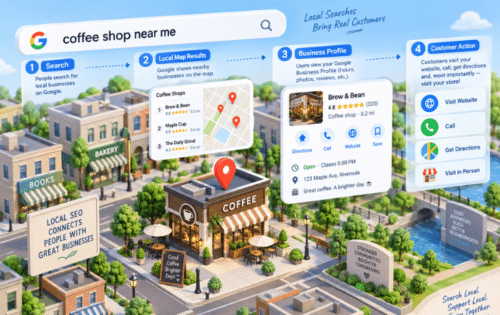
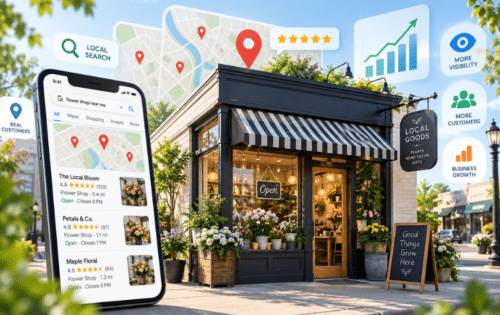
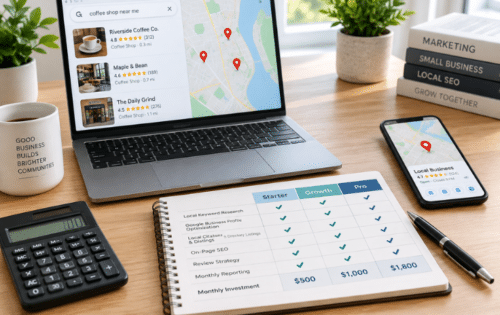
Organic search traffic is what happens when someone finds your website the old-fashioned way: by typing something they need into a search engine and clicking on a natural, unpaid result.
Think of it like this: your website is a shop. Paid traffic is like running a huge, flashy ad that screams, “Come visit!” Organic traffic, on the other hand, is when someone asks for the best shop to solve their problem, and a trusted local (like Google) points them directly to your door.
They didn't see an ad; they found you because you were genuinely the best answer to their question.
What Is Organic Search Traffic, Really?
At its heart, organic search traffic comes from earned visibility. It’s not bought, it’s built. When you type a question into Google, its complex algorithms sift through countless pages to serve up what it believes are the most helpful and authoritative answers. Landing a spot on that first page is Google’s way of giving your content a stamp of approval.
This makes it fundamentally different from visitors who arrive from paid ads, social media, or by typing your URL directly into their browser. The infographic below breaks down these pathways.
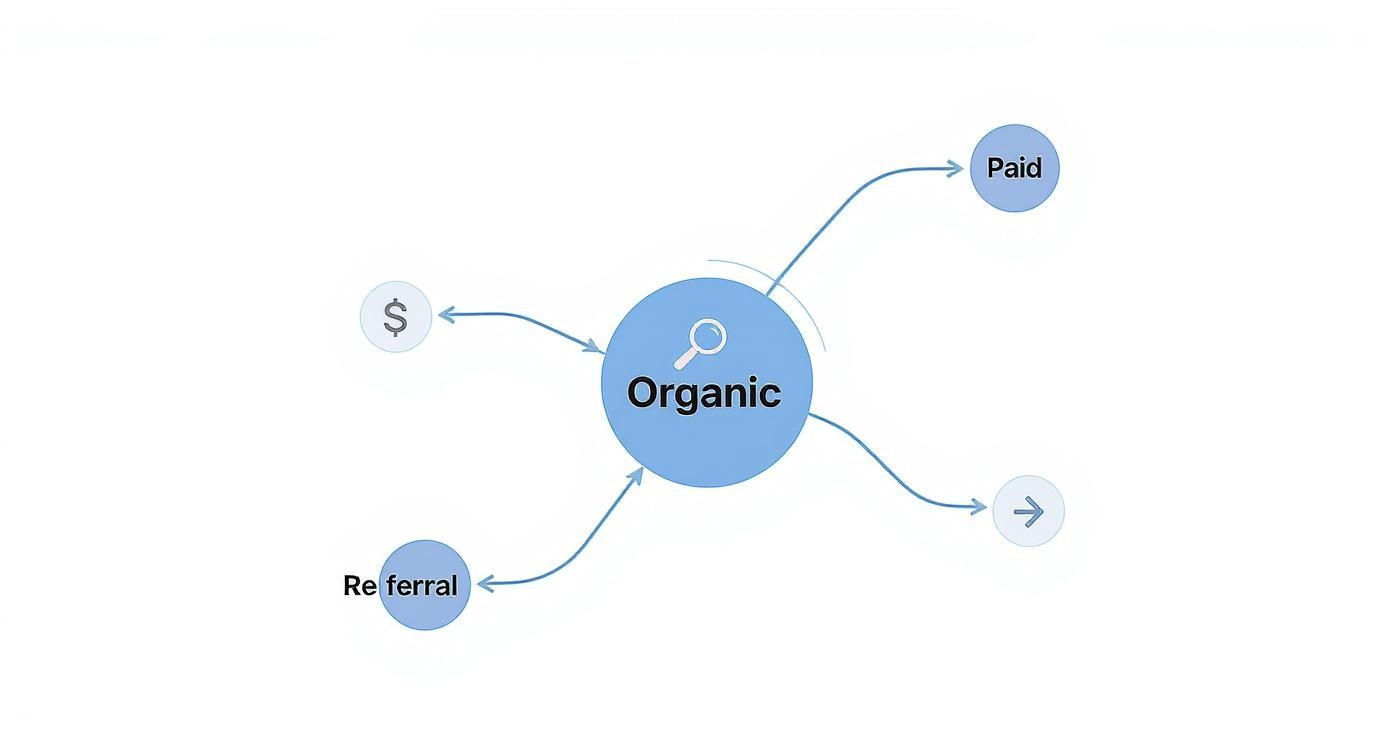
As you can see, each source is distinct. Organic traffic is the only one that stems directly from a user's unfiltered, intent-driven search.
To better understand how these channels stack up, let's compare them side-by-side.
Comparing Key Website Traffic Sources
| Traffic Source | How Visitors Arrive | Primary Benefit |
|---|---|---|
| Organic Search | Clicking on an unpaid result in a search engine like Google or Bing. | Builds long-term trust and authority. |
| Paid Search | Clicking on an advertisement (PPC ad) that appears at the top of search results. | Delivers immediate, targeted traffic. |
| Direct | Typing your website URL directly into the browser or using a bookmark. | Indicates strong brand recognition and loyalty. |
| Referral | Clicking a link from another website, like a blog or a partner site. | Borrows credibility from the referring site. |
| Social | Arriving from a link on a social media platform like LinkedIn, X, or Facebook. | Drives community engagement and brand awareness. |
Each source has its place, but organic traffic often stands out for its sustainability and credibility.
The Bedrock Of Digital Discovery
For most people, search engines are the default starting point for finding new information, products, or services. It’s no surprise, then, that organic search drives around 53% of all website traffic—making it the single largest channel for most businesses.
Even as technology evolves, this simple, powerful exchange remains: someone has a need, and your website provides the answer. This is the core principle you'll master when you start deconstructing SEO for your online presence.
The real magic is in the mix of trust and intent. When a user clicks an organic link, they’re placing more confidence in it than a paid ad. Why? Because it's seen as an impartial endorsement from the search engine itself.
This built-in trust is precisely why growing your organic traffic is a non-negotiable for long-term success. To really get a handle on it, you need to know how analytics platforms define and measure it. For a great breakdown, check out this guide on What Is Organic Traffic in Google Analytics.
The Core Benefits of Growing Organic Traffic
Investing in organic search is all about playing the long game for sustainable success. Unlike paid advertising, where your visibility evaporates the second you stop paying, SEO is an asset that builds on itself. Every piece of optimized content you create becomes a durable digital asset, pulling in visitors long after you hit "publish."
Think of it this way: paid ads are like renting a storefront. You pay month after month just for the space. Organic search, on the other hand, is like getting a mortgage—every payment builds equity until you own a valuable property that works for you 24/7.

This cumulative effect snowballs over time, leading to a much stronger and more cost-effective return. It creates a predictable stream of leads and sales, turning your website into a powerful, scalable engine for business growth.
Building Unshakeable Brand Credibility
On the internet, trust is everything. And organic rankings are a massive signal of credibility. When someone sees your website listed naturally in the search results—not in the sponsored section—it feels like an implicit endorsement from Google itself. People just perceive your content as more authentic and authoritative than a paid placement.
The data backs this up. An incredible 94% of clicks on Google go to organic results, with most users skipping right past the ads. The very top organic spot alone grabs an average click-through rate of 27.6%, proving just how much trust people put in non-paid content. You can review useful SEO findings on Keyword.com to see more stats like these.
By appearing consistently in search results for relevant queries, you're not just getting clicks; you're building a reputation. You become the go-to resource, the trusted expert in your field.
A Sustainable and Scalable Growth Engine
One of the best things about organic traffic is that it's inherently scalable. A paid ad budget always has a hard ceiling, but there’s practically no limit to the number of keywords you can rank for or the amount of traffic you can attract.
As you build authority with Google, it actually gets easier to rank for new, related topics. This creates a powerful feedback loop with a few key advantages:
- Reduced Acquisition Costs: Over time, your cost per lead from organic search plummets compared to what you’d spend on paid channels.
- Predictable Lead Flow: A strong organic presence generates a steady, reliable stream of visitors, which makes business forecasting a whole lot easier.
- Compound Growth: Each new article or blog post adds to your site's overall authority, making the next piece of content even more likely to succeed.
How to Measure Your Organic Performance
You can't improve what you don't measure. Diving into your website's data might sound intimidating, but it's the only way to make smart decisions that actually move the needle.
Luckily, Google gives us two powerful, free tools that work together to paint a complete picture of your organic traffic: Google Analytics 4 (GA4) and Google Search Console.
Think of it like this: Google Analytics 4 is the manager of your physical store. It tells you how many people walked through the door (Sessions), how many unique individuals they were (Users), and exactly what they did once they were inside. It’s all about on-site behavior.
Google Search Console, on the other hand, is your scout standing on the street corner. It reports on how people found your store in the first place, what signs they saw (Impressions), how many decided to walk in because of those signs (Clicks), and your store’s overall visibility on the street (Average Position). It tracks your performance in the search results themselves.
By combining insights from both, you get the full story—not just who is visiting your site, but how they found you and which search terms brought them to your digital doorstep.
Key Metrics You Need to Know
Turning all this data into something you can actually use starts with a few core metrics. These numbers are the vital signs of your content's health.
Here are the essentials you should be tracking:
- Organic Sessions: This is the total number of visits to your site that came from an unpaid search result. Seeing this number climb is a clear sign your SEO efforts are paying off and more people are discovering you through search.
- Click-Through Rate (CTR): Found in Google Search Console, CTR tells you the percentage of people who saw your website in the search results and actually clicked on it. A low CTR could mean your page titles or meta descriptions aren't compelling enough to grab attention.
- Keyword Rankings: This shows you where your pages rank for specific search queries. Keeping an eye on your position for target keywords helps you see if your content is gaining traction for the topics that matter most to your business.
Monitoring these key performance indicators (KPIs) is the first step toward building a data-informed strategy that consistently grows your organic reach.
The Core Strategies for Growing Your Organic Traffic

If you want to see consistent, long-term growth in your organic search traffic, you need a strategy that rests on three unshakable pillars: on-page SEO, technical SEO, and off-page SEO.
Think of it like building a high-performance car. On-page SEO is the powerful engine, technical SEO is the perfectly engineered chassis, and off-page SEO is the car’s reputation on the racetrack. All three have to work in sync to win the race.
Getting these areas right sends a clear message to search engines: your website is a valuable, trustworthy, and user-friendly resource that deserves a top spot in the search results.
On-Page SEO: Creating Content People Actually Want
On-page SEO is everything you can control directly on your web pages. The single most important part of this is creating high-quality, genuinely helpful content that answers the specific questions your ideal customers are typing into Google.
It's not about stuffing keywords into a page anymore. It’s about being the absolute best, most comprehensive answer to a person's problem.
A huge part of this is knowing who you're talking to. For example, using effective market segmentation lets you create content that speaks directly to a specific audience, making it far more likely to resonate and rank well.
Great on-page content is always:
- Comprehensive: It covers a topic so thoroughly that the user doesn’t need to go anywhere else.
- Well-structured: It’s easy to read, using clear headings (H1, H2, H3) and short paragraphs.
- Optimized: It naturally weaves in your target keywords in titles, headers, and throughout the text.
Technical SEO: Making Sure Your Site Is Easy for Google to Use
Technical SEO is all about your website's behind-the-scenes foundation. It’s the work that ensures search engines can crawl, understand, and index your content without any hiccups.
You could have the best content in the world, but if your site has technical problems, it might as well be invisible. A fast, secure, and mobile-friendly site isn’t just a nice-to-have; it's a requirement.
Your website's technical health is the foundation of your entire organic strategy. If search engines can't access your content efficiently, they can't rank it, and your efforts in creating valuable content are wasted.
Key elements of technical SEO include things like optimizing your site speed, being mobile-friendly, and having a clean, logical site structure. We cover a lot of these in our guide to technical SEO best practices. Getting this right makes a massive difference.
Off-Page SEO: Building Your Website’s Authority and Reputation
Finally, off-page SEO includes all the actions you take outside of your website to improve your rankings. This really boils down to building your site’s authority and credibility, primarily by earning backlinks from other high-quality, reputable websites.
Think of a backlink as a vote of confidence. When another site links to you, they're telling search engines that your content is worth paying attention to.
Search engines see these backlinks as a powerful signal that your content is trustworthy. The data backs this up—top-ranking websites have, on average, 3.8 times more backlinks than the sites ranking below them on the first page.
When you pair that with the fact that the average first-page result is roughly 1,447 words long, it’s clear that both in-depth content and a strong reputation are non-negotiable for success.
How the Future of Search Is Changing the Game

The ground is shifting in the world of SEO. Big changes like AI Overviews and the rise of voice search are completely rewriting the rules of how people find information online. For marketers, this isn't a threat—it's a massive opportunity.
These days, users often get their answers directly on the search results page without ever visiting a website. These "zero-click searches" are becoming more and more common, which forces us to rethink what "success" even means. It’s no longer just about clicks.
This shift gets to the heart of what organic search traffic is today: it’s about visibility. Being seen is the new currency.
Evolving for a Smarter Search Engine
To win in this new environment, your content has to do more than just exist. It needs to prove you're a legitimate expert and earn trust. This is exactly what Google is rewarding with its E-E-A-T guidelines (Experience, Expertise, Authoritativeness, and Trustworthiness). They want to show users content that’s genuinely helpful, reliable, and written by people who know their stuff.
So, where should you focus your energy?
- Go deep on specific, long-tail questions. These are the kinds of nuanced queries that AI summaries often miss.
- Build a brand that people actually search for by name. When people look for you directly, you've already won.
- Offer a unique point of view. Create content that can't be easily scraped or replicated by a machine.
In today's search landscape, being the most trustworthy source is your ultimate advantage. The goal is to be the definitive answer, whether that answer shows up in an AI summary, a voice assistant's response, or a traditional blue link.
This user-first mindset also lines up perfectly with how people actually search. An incredible 69-70% of all search traffic now comes from long-tail keywords, proving that users want specific, detailed answers to their problems. You can discover more insights about the future of organic search on Theedigital.com.
Ultimately, future-proofing your SEO strategy isn't about chasing the latest algorithm update. It's about delivering real value and making sure your site is fast and easy to use, which just reinforces the importance of speed and performance for your website.
Still Have Questions About Organic Search Traffic?
https://www.youtube.com/embed/Db-2WRx2sQw
Getting into the weeds of organic search traffic always brings up some practical questions. Let's tackle a few of the most common ones we hear from business owners trying to figure this all out.
How Long Does SEO Take to Work?
This is the big one, and the honest answer is: it’s a marathon, not a sprint. Unlike paid ads that get you seen instantly, SEO is all about building momentum that lasts.
You can generally expect to see the first signs of life within three to six months. This isn't a flood of leads, but it's progress—maybe you start ranking for a few less competitive keywords or see a small but steady climb in organic visitors.
But for the kind of traffic that really moves the needle, you should be thinking more in the six to twelve-month range. It takes time for Google to find your new content, understand its value, and grant you the authority to rank for the keywords that matter most.
Think of it like planting a tree. You don't get fruit in the first month. But with consistent watering and care, it grows into an asset that produces for years. SEO is the same—the value compounds over time, rewarding your patience.
What Is the Best First Step for a Beginner?
It’s easy to get overwhelmed when you're just starting. The single best thing you can do is a simple keyword research audit focused entirely on your ideal customer.
Forget the complicated tools for a minute. Just ask yourself: what problems do my customers have, and what would they type into Google to find a solution?
Once you've got a short list of these "problem-aware" phrases, your next steps are straightforward:
- Look at the pages already ranking on the first page for those terms.
- Figure out what they're doing well and, more importantly, where the gaps are.
- Create something better—a piece of content that's more helpful, more detailed, or offers a perspective that's missing.
This approach keeps you focused on creating content people actually need, which is the heart of any good organic traffic strategy.
Is SEO Still Worth It with AI Overviews?
Absolutely. While things like AI Overviews and "zero-click" searches are definitely changing the game, the core principles of SEO have never been more important.
Think about it: where does Google's AI get its answers? It relies on high-quality, authoritative content from websites just like yours.
By focusing on creating the best, most trustworthy content in your space, you're not just trying to get a click—you're positioning your brand to be the source for these AI-powered summaries. The goal is shifting from just ranking to becoming the definitive authority on a topic.
Ready to turn your website into a 24/7 salesperson? At Gidds Media, we build custom SEO and content strategies that drive real growth for Austin businesses. We focus on what matters—more traffic, better leads, and a clear return on your investment.