In a digital marketplace crowded with big players and even bigger budgets, small businesses often feel they are fighting an uphill battle. Generic SEO advice like 'create great content' or 'build links' falls flat without a clear, actionable roadmap. The reality is that the strategies that work for multinational corporations often do not translate to a local bakery or a boutique consulting firm in Austin.
The best small business SEO is not about outspending the competition; it's about outsmarting them with focused, high-impact tactics tailored to your unique strengths and local market. This guide cuts through the noise to deliver proven SEO strategies that are both effective and specifically designed for the resourcefulness and agility of a small business.
We will move beyond the basics, providing practical steps and real-world examples to turn your website into a powerful, 24/7 lead-generation machine. You will learn precisely how to implement:
- Local SEO Optimization: Dominating your service area.
- Content & Blogging Strategy: Attracting your ideal customer.
- Technical SEO: Ensuring your site is built for search engines.
- Link Building & Digital PR: Building authority and trust.
- On-Page SEO: Optimizing every page for maximum visibility.
- Voice Search & Snippets: Answering questions before they are fully asked.
- Google Business Profile: Your digital storefront.
- Competitive Analysis: Finding and filling market gaps.
Let's explore how to make your business the definitive answer to your customers' local searches.
1. Local SEO Optimization
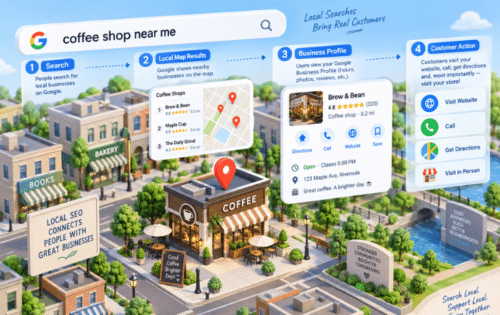
For brick-and-mortar businesses or companies serving a specific geographic area, Local SEO isn't just a strategy; it's a lifeline. This highly focused approach optimizes your online presence to capture customers searching for your services right in your neighborhood. It's the engine that powers your visibility in Google's Local Pack (the top three map listings) and on Google Maps, directly connecting you with high-intent local customers.
Why is this a cornerstone of the best small business seo? Because it levels the playing field. A local bakery in Austin can outrank a national chain for "custom birthday cakes Austin" by leveraging a perfectly optimized Google Business Profile (GBP), hundreds of positive reviews, and location-specific content. This strategy transforms your website and GBP into a magnet for local traffic, both online and through your front door.
How to Implement Local SEO
Getting started involves a few critical, non-negotiable steps. These actions send strong local signals to search engines, telling them exactly where you are and what you do.
- Claim and Optimize Google Business Profile: Your GBP is your digital storefront. Fill out every single section: services, products, accurate hours, high-quality photos, attributes (like "woman-owned"), and Q&As.
- Build Local Citations: Ensure your business Name, Address, and Phone number (NAP) are 100% consistent across all online directories like Yelp, Angie's List, and industry-specific sites.
- Encourage and Manage Reviews: Actively ask satisfied customers for reviews. Respond professionally to all feedback, positive and negative, to build trust and show you're engaged.
- Create Hyper-Local Content: Write blog posts about local events, create neighborhood guides, or highlight customer stories from your community. Use local keywords naturally, such as "emergency plumber in downtown Seattle" instead of just "emergency plumber."
The infographic below highlights the key benefits of committing to a robust local strategy.
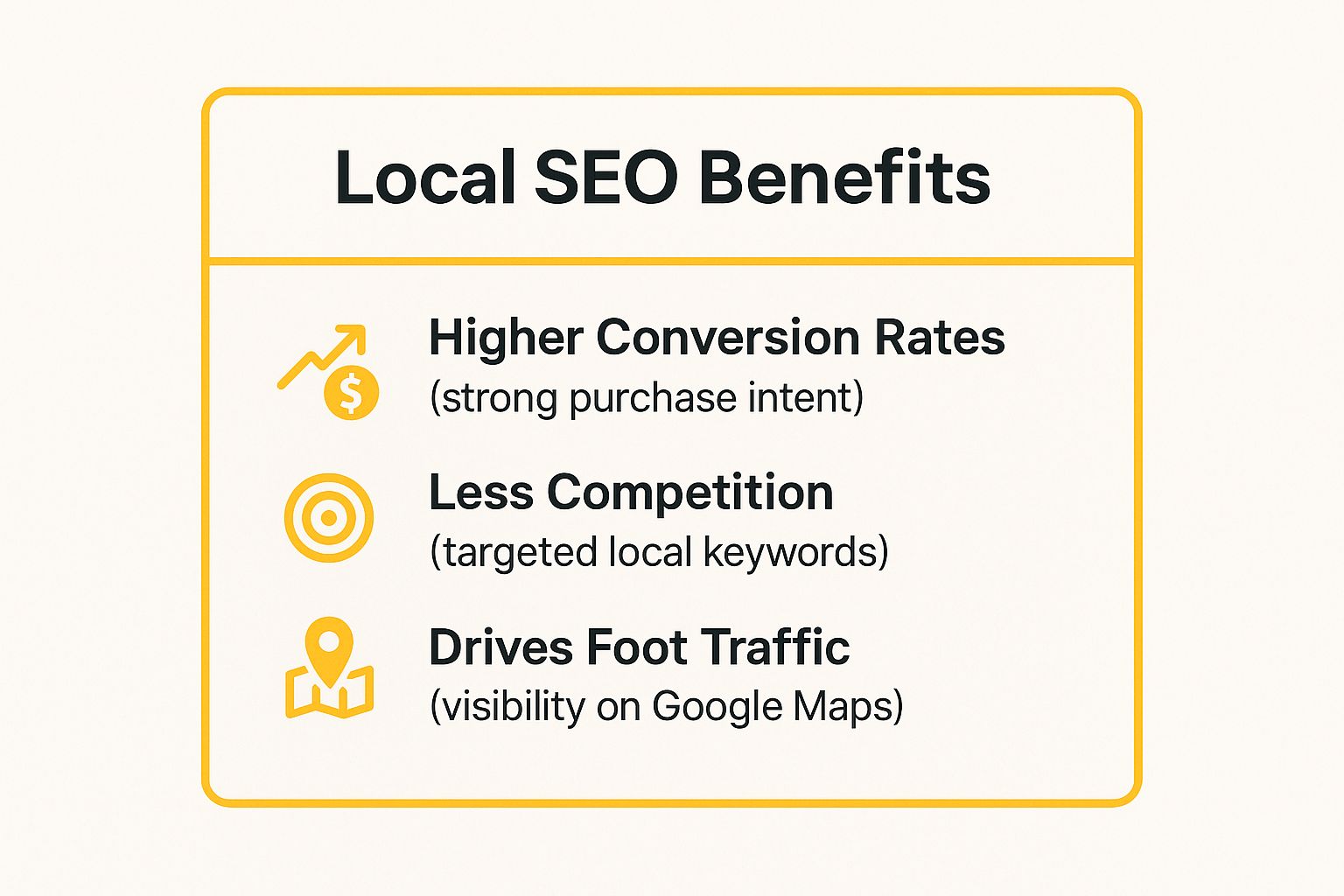
As the data shows, the primary advantages are higher conversion rates and the ability to drive real foot traffic, making it an incredibly efficient marketing investment. For a deeper dive into how these strategies can be applied, you can explore more about local business digital marketing.
2. Content Marketing & Blogging Strategy
Content marketing is the practice of creating and distributing valuable, relevant, and consistent content to attract and retain a clearly defined audience. For small businesses, this means publishing blog posts, guides, and articles that solve your customers' problems. This approach builds topical authority, generates organic traffic, and positions your business as a trusted expert in your industry.
Why is this a key part of the best small business seo? Because it answers the questions your potential customers are typing into Google. A local HVAC company can dominate search results for hundreds of queries by publishing seasonal maintenance guides and troubleshooting articles. This strategy, famously used by companies like River Pools and Spas to increase traffic by 1,000%, transforms your website into a powerful resource that naturally attracts qualified leads.
How to Implement a Content & Blogging Strategy
A successful content strategy is built on understanding user intent and providing comprehensive answers. These steps are fundamental to creating content that ranks and converts.
- Start with Keyword Research: Use tools to find the topics and questions your target audience is actively searching for. Focus on their pain points.
- Create Comprehensive, High-Value Content: Go beyond surface-level posts. Create in-depth pillar pages on broad topics (e.g., "The Ultimate Guide to Home Air Conditioning") and support them with detailed cluster articles on specific subtopics (e.g., "How to Fix a Leaking AC Unit").
- Focus on Search Intent: Understand what the user wants to accomplish. Are they looking for information ("how to…"), comparing options ("best…"), or ready to buy ("…near me")? Tailor your content to match.
- Optimize On-Page Elements: Ensure your target keyword is in your title (H1), subheadings (H2s), and introduction. Weave it naturally throughout the content. Add internal links to related articles to guide visitors through your site.
- Promote and Refresh: Share new posts via your email newsletter and social media channels to gain initial traction. Annually review and update older content to keep it accurate and maintain its rankings.
For tailored advice on leveraging content, explore these practical approaches for content marketing for small business.
By consistently publishing helpful content, you build a sustainable source of organic traffic that grows over time. To better understand the direct impact this can have, you can learn more about the benefits of blogging for small businesses.
3. Technical SEO Optimization
If content is the engine and links are the fuel, technical SEO is the chassis and transmission that holds everything together. This foundational layer focuses on optimizing your website’s backend structure to ensure search engines can crawl, understand, and index your pages without any issues. It’s the behind-the-scenes work that makes all your other marketing efforts possible.
Why is this a key component of the best small business seo? Because without a technically sound website, even the best content can go unnoticed. A small e-commerce site, for instance, could reduce its page load time from 7 to 2 seconds and see a 35% jump in organic traffic. This strategy removes technical roadblocks, improves user experience, and gives your content the best possible chance to rank by creating a fast, secure, and easily crawlable site.

How to Implement Technical SEO
Getting your technical house in order involves a systematic audit and a series of targeted fixes. These actions directly impact how search engines perceive your site's quality and authority.
- Audit Your Site's Health: Use tools like Google Search Console or the SEMrush Site Audit to identify crawl errors, broken links, security issues, and other technical problems.
- Prioritize Site Speed and Core Web Vitals: A fast website is crucial for both SEO and user experience. Compress images, enable browser caching, and use a Content Delivery Network (CDN) to boost loading speeds.
- Ensure Mobile-Friendliness: With most searches happening on mobile devices, your site must be responsive. Use Google's Mobile-Friendly Test to confirm your design works flawlessly on all screen sizes.
- Implement Schema Markup: Add structured data (schema) to your code to help search engines understand the context of your content, such as your business hours, address, reviews, and services.
Mastering these elements ensures your website is a strong contender in search results. For a comprehensive guide to these foundational elements, you can explore more about technical SEO optimization.
4. Link Building & Digital PR
Link building is the process of acquiring hyperlinks from other websites to your own. Think of these links as votes of confidence; the more high-quality, relevant websites that "vote" for you by linking to your content, the more trustworthy and authoritative Google perceives your site to be. This directly translates to higher search engine rankings and increased referral traffic.
Why is this a cornerstone of the best small business seo? Because it's how you build authority online. A B2B consultant in Austin can significantly boost their credibility by earning a single backlink from Forbes or Entrepreneur, which is far more powerful than dozens of low-quality links. This strategy positions your brand as a respected voice in your industry, driving not just traffic, but qualified leads.

How to Implement Link Building & Digital PR
Effective link building for small businesses is about earning links, not just building them. It requires a strategic and relationship-focused approach.
- Create "Linkable Assets": Develop content that others will naturally want to link to. This includes original research, comprehensive guides, free industry-specific tools, or compelling infographics that provide immense value.
- Leverage Digital PR: Use services like Help a Reporter Out (HARO) to provide expert quotes to journalists. This is a highly effective way to earn links from authoritative news and publication websites.
- Analyze Competitor Backlinks: Use tools like Ahrefs or Semrush to see who is linking to your competitors. This can reveal partnership opportunities and publications that are already interested in your niche.
- Use Broken Link Building: Find relevant websites in your industry, identify their broken (dead) outbound links, and reach out to the site owner. Politely offer your own relevant content as a replacement for the dead link.
5. On-Page SEO Optimization
On-page SEO is the art and science of optimizing individual web pages to rank higher in search results. This fundamental strategy involves refining elements you directly control, from the content your audience reads to the HTML source code that search engines crawl. It's about making every page on your website a perfectly tuned engine for attracting relevant traffic.
Why is this essential for the best small business seo? Because it empowers you to directly influence your rankings without relying on external factors. A small e-commerce store can outrank a retail giant for a niche product by creating a perfectly optimized product page that answers every customer question, includes high-quality images, and has flawless technical elements. Mastering on-page SEO ensures your website communicates clearly and effectively with both users and search engines.
How to Implement On-Page SEO
Effective on-page optimization requires a methodical, page-by-page approach. These actions are critical for building a strong foundation and maximizing your content's potential.
- Refine Titles and Meta Descriptions: Write a unique, compelling title tag (under 60 characters) with your primary keyword near the front. Craft a meta description (around 155 characters) that acts as a mini-advertisement, encouraging users to click.
- Structure Content Logically: Use one H1 tag per page for your main title. Break up content with H2 and H3 subheadings that include variations of your target keywords, making the text scannable and easy to understand.
- Optimize for User Intent: Write for humans first. Your primary goal should be to thoroughly answer the user's search query. Focus on creating high-quality, in-depth content that is more valuable than what your competitors offer.
- Strengthen Internal Linking: Add relevant internal links to other pages on your site using descriptive anchor text. This helps distribute page authority and guides users and search engines to important content.
- Enhance Readability and Media: Use short paragraphs, bullet points, and images with descriptive alt text. This improves user experience and provides search engines with more context about your page. A blog post that jumps from page three to the top positions often does so by adding more depth, better structure, and relevant media.
6. Voice Search & Featured Snippet Optimization
As customers increasingly use voice assistants like Alexa and Google Assistant, optimizing for how people speak is no longer a futuristic concept; it's a present-day necessity. Voice search optimization is the process of tailoring your content to answer conversational queries, which directly aligns with earning "position zero" or featured snippets in Google's search results. These snippets are the direct answers Google reads aloud, making them prime real estate.
Why is this a key component of the best small business seo? Because it bypasses traditional rankings. A local home services company can leapfrog competitors for a query like "how much does it cost to fix a leaky faucet" by providing a clear, concise answer that Google can easily pull for a featured snippet. This strategy positions your business as an authoritative, helpful resource, capturing high-intent users at the exact moment they need a solution.
How to Implement Voice Search & Featured Snippet Optimization
The goal is to make your content the easiest and most direct answer for search engines to find and present. This requires a shift from keyword stuffing to providing genuine, well-structured solutions.
- Structure Content for Questions: Use headings (H2s, H3s) that are phrased as common questions, like "What Causes Tooth Sensitivity?" or "How Often Should I Service My AC Unit?"
- Provide Concise, Direct Answers: Immediately following the question-based heading, write a direct, 40-60 word paragraph that succinctly answers the query. You can elaborate further down the page.
- Use Formatted Lists and Tables: Google loves pulling answers from bullet points, numbered lists (like for recipes or step-by-step guides), and tables (like for pricing).
- Target Conversational Keywords: Think about how people actually talk. Instead of just "HVAC repair," target long-tail phrases like "what's the best way to know if my heater is broken?"
- Implement Schema Markup: Use FAQPage schema to explicitly tell Google that a section of your page is a question-and-answer format, making it easier for them to parse and feature.
7. Google Business Profile & Review Management
For any small business with a physical location or service area, your Google Business Profile (GBP) is your most powerful local SEO asset. This isn't just an online directory listing; it's a dynamic, interactive storefront on Google Search and Maps. Optimizing your GBP is a highly specialized strategy that directly impacts your visibility in the coveted Local Pack, where the majority of local clicks happen.
Why is this a cornerstone of the best small business seo? Because a meticulously managed GBP can outperform websites with far greater domain authority in local searches. A local salon in Austin that uses Google Posts for weekly promotions, responds to every review within hours, and has a complete, photo-rich profile can easily outrank a national chain for "balayage highlights Austin." This strategy turns searchers into customers by providing immediate social proof, essential business information, and direct engagement opportunities.
How to Implement Google Business Profile & Review Management
Success with GBP requires active, consistent management, not a "set it and forget it" approach. These steps are crucial for signaling to Google that your business is active, relevant, and trustworthy.
- Complete Your Profile to 100%: Fill out every single field. This includes primary and secondary categories, service areas, detailed service/product descriptions, accessibility attributes, and accurate hours.
- Maintain a Flow of High-Quality Photos: Regularly upload new, high-resolution images of your storefront, team, products, and services in action. Aim for at least 10 to start and add more quarterly.
- Actively Manage Reviews: Create a simple process to ask every satisfied customer for a review. Crucially, respond professionally to all reviews, both positive and negative, to show you are engaged and value customer feedback.
- Utilize Posts and Q&A: Publish Google Posts at least once a week to share updates, offers, or events. Proactively use the Q&A section to answer common customer questions before they have to ask.
8. Competitive Analysis & Gap Strategy
Instead of starting from scratch, a powerful SEO approach involves looking at what already works for your competition. Competitive analysis is the process of systematically researching top-ranking competitors to understand their strengths and weaknesses. This intelligence mission uncovers the keywords they rank for, the websites that link to them, and the content strategies that drive their success, allowing you to find exploitable gaps.
Why does this belong in a list of the best small business seo strategies? Because it provides a data-driven roadmap. A B2B company can analyze a competitor's backlinks, replicate their outreach strategy, and acquire dozens of high-quality links. This approach saves immense time and resources by focusing your efforts on proven tactics, rather than guessing what might work. It's about working smarter, not just harder.
How to Implement Competitive Analysis
Getting started requires a systematic approach and the right tools. These steps help you deconstruct competitor success and build a superior strategy of your own.
- Identify True Competitors: Pinpoint 3-5 direct competitors who consistently appear in search results for your most important keywords. Use tools like Ahrefs or SEMrush to find SERP competitors you may not even know about.
- Conduct a Keyword Gap Analysis: Use an SEO tool to find valuable keywords your competitors rank for, but you don't. Focus on terms with manageable difficulty scores where you can realistically compete.
- Analyze Top-Performing Content: Examine the structure, depth, and format of competitor pages that rank well. Look for opportunities where their content is thin, outdated, or poorly presented, and create something demonstrably better.
- Deconstruct Backlink Profiles: Investigate which websites link to your competitors. This reveals potential link-building opportunities and partnerships you can pursue for your own business. For example, if they are featured on a local business blog, that blog might be interested in your story too.
8-Key Small Business SEO Strategies Comparison
| Strategy | Implementation Complexity 🔄 | Resource Requirements ⚡ | Expected Outcomes 📊 | Ideal Use Cases 💡 | Key Advantages ⭐ |
|---|---|---|---|---|---|
| Local SEO Optimization | Medium – ongoing management needed | Low to Medium – directory listings, reviews | Improved local visibility, higher local conversions (3-6 months) | Restaurants, retail, services with local presence | High purchase intent, less competition, drives foot traffic |
| Content Marketing & Blogging | High – consistent, quality content | Medium to High – content creation, SEO skills | Long-term organic traffic and authority (6-12 months) | B2B, consultants, e-commerce, SaaS | Builds authority, generates backlinks, supports full customer journey |
| Technical SEO Optimization | High – technical skills required | Medium to High – tools, developer support | Improved crawlability, site speed, better indexing (1-3 months) | All websites, especially e-commerce, large or old sites | Foundation for SEO, improves UX, competitive edge |
| Link Building & Digital PR | High – time and relationship intensive | Medium to High – outreach, content assets | Better domain authority, referral traffic, higher rankings (3-6 months) | Competitive niches, B2B, online retailers | Builds authority, long-term SEO value, brand awareness |
| On-Page SEO Optimization | Low to Medium – page-level changes | Low – mostly in-house optimization | Quick ranking improvements, better user experience (2-8 weeks) | All businesses with websites, product/service pages | Direct control, cost-effective, measurable impact |
| Voice Search & Featured Snippet | Medium – content and schema focus | Low to Medium – content updates, schema markup | Increased visibility in voice and snippet results (3-6 months) | Local businesses, FAQ-heavy, how-to sites | Captures voice search, high CTR snippets, competitive edge |
| Google Business Profile & Review | Low to Medium – profile & review management | Low – profile setup and response efforts | Enhanced local pack presence, customer interaction (1-3 months) | Businesses with physical location/service areas | Free platform, direct customer interaction, trust building |
| Competitive Analysis & Gap Strategy | Medium – tool use and analysis | Medium – SEO tools subscription, time | Data-driven strategy, identify quick wins (actionable early) | All small businesses, especially competitive niches | Focused efforts, realistic goals, uncovers opportunities |
Putting Your SEO Blueprint into Action
Navigating the world of search engine optimization can feel like trying to solve a complex puzzle with constantly changing pieces. However, by breaking it down into the eight core pillars we've explored, you can transform this challenge into a structured, manageable process for sustainable growth. The journey to achieving the best small business SEO results isn't about mastering every single algorithm update overnight; it's about consistently executing the fundamentals.
From claiming and meticulously optimizing your Google Business Profile to diving deep into a competitive gap analysis, each strategy builds upon the last. A technically sound website (Technical SEO) ensures search engines can crawl and index your pages, while a robust content marketing plan gives them something valuable to rank. Similarly, on-page optimizations make your content relevant, and strategic link building provides the authority needed to climb the search engine results pages (SERPs).
Your Actionable SEO Roadmap
The key is to move from knowledge to action. Don't let the scope of these strategies lead to paralysis. Instead, focus on a phased approach that delivers compounding returns over time.
- Start with Your Foundation (Weeks 1-4): Begin with the highest-impact, lowest-effort tasks. Fully optimize your Google Business Profile and conduct a thorough technical SEO audit. Fixing broken links, improving site speed, and ensuring mobile-friendliness are critical first steps.
- Build Content & Authority (Months 2-6): With a solid foundation, shift your focus to creating valuable, keyword-targeted blog posts and core service pages. Simultaneously, begin your outreach for quality backlinks to build your site's credibility.
- Refine and Dominate (Ongoing): SEO is a continuous process of improvement. Regularly analyze your competitors, monitor your keyword rankings, and actively manage your online reviews. As your strategy matures, explore advanced tactics like optimizing for voice search and featured snippets. To continually refine your approach, explore additional Top SEO Strategies for Small Business that can provide fresh perspectives.
Ultimately, a successful SEO strategy does more than just drive traffic; it connects you with the right customers who are actively searching for your solutions. It builds brand trust, establishes your authority, and creates a predictable engine for lead generation and revenue. By implementing this blueprint, you are not just "doing SEO" – you are making a strategic investment in the long-term visibility and profitability of your business.
Ready to turn this blueprint into measurable results but need an expert partner to lead the way? Gidds Media specializes in creating and executing custom SEO strategies that drive meaningful growth for small businesses in Austin and beyond. Visit Gidds Media to schedule a free, no-pressure SEO audit and discover your biggest opportunities today.