Let's be clear on the fundamental difference between paid and natural search, because it's simpler than you might think. Paid search is about buying visibility through ads to get immediate traffic. Natural search is about earning that visibility by creating quality content and optimizing your site over time.
One builds a lasting brand asset, while the other delivers speed, control, and surgical precision.
Defining the Two Pillars of Search Marketing
To build a smart digital strategy, you have to stop thinking of paid and natural search as rivals. They're complementary forces. One is a long-term investment in your brand’s digital real estate, and the other is a tool for making an immediate impact. The real question isn't "which one is better?" but rather, "how do I blend them to hit my specific business goals?"
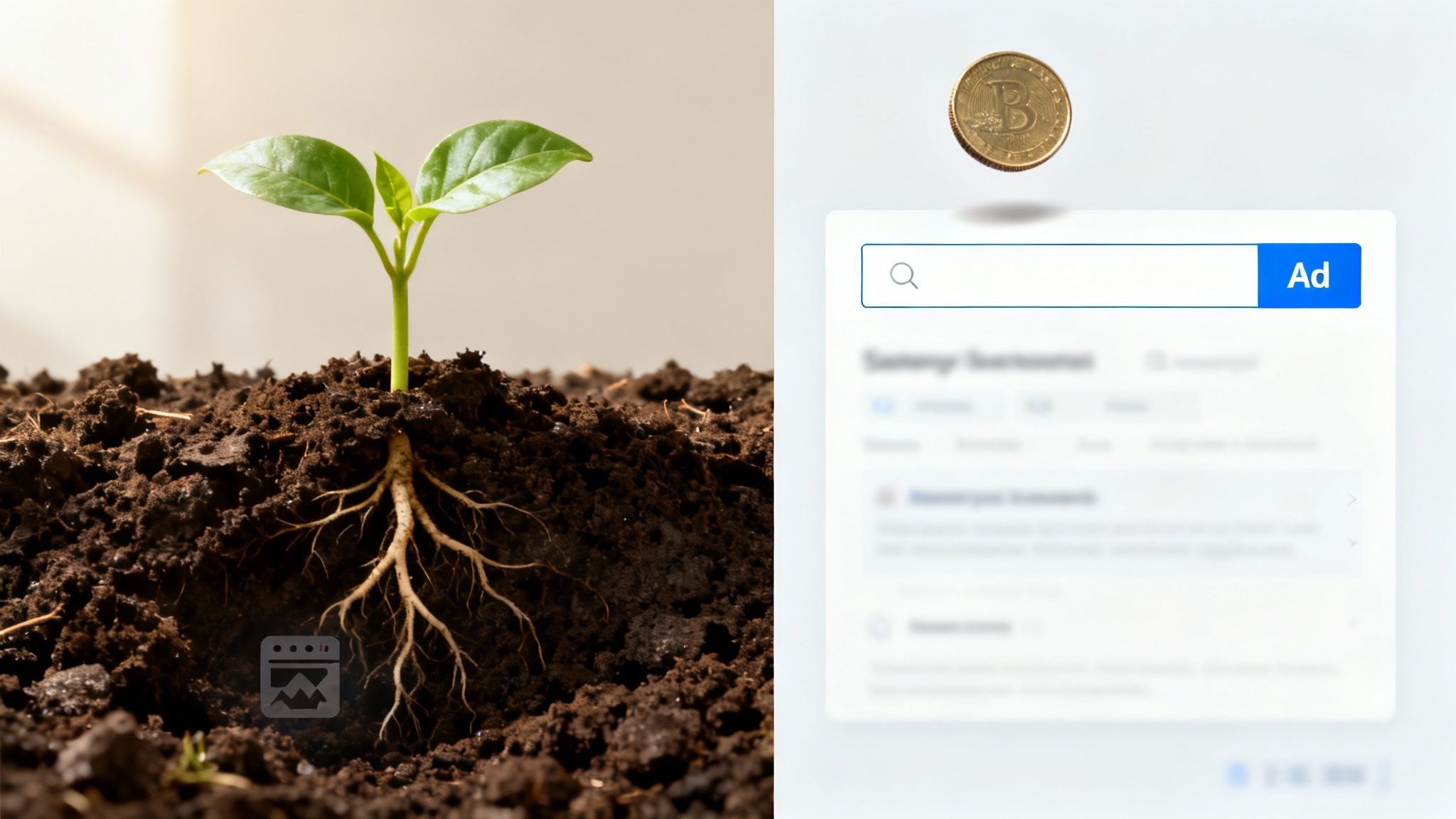
What is Natural Search?
Natural search, which most people know as Search Engine Optimization (SEO), is all about improving your website's visibility in the non-paid search results. The goal is to create high-quality, genuinely helpful content and make sure your site is technically solid so search engines can easily find, crawl, and understand it.
Think of it like building a great reputation in a bustling city. Over time, that reputation earns you a prime spot on Main Street where everyone can see you. To get a handle on how search engines are evolving, it helps to understand concepts like Natural Language Processing (NLP) basics. This is the tech that helps Google interpret what users really want, making organic results more relevant than ever.
What is Paid Search?
Paid search, or Pay-Per-Click (PPC), lets you place ads directly on the search engine results pages (SERPs). You bid on keywords relevant to your business, and every time someone clicks your ad, you pay a fee. It’s a direct transaction.
This approach gives you instant visibility and incredible control over your targeting, messaging, and budget. It’s like renting a billboard on the busiest highway in town—you get guaranteed exposure for as long as you’re willing to pay for the space.
The data shows a clear difference in where traffic comes from. Industry analysis reveals that organic search drives roughly 53% of all website traffic, while paid search brings in around 27%. Even more telling, the top organic result on Google gets a click-through rate (CTR) somewhere between 27.6% and 39.8%. The top paid ad? Its CTR is just 1.63% to 2.1%.
The core distinction is ownership versus rental. Natural search builds a digital asset you own, delivering compounding value over time. Paid search rents visibility, providing traffic that stops the moment you stop paying.
To make things even clearer, I've put together a quick table that breaks down the key differences between these two powerful channels.
Paid vs Natural Search At a Glance
This table gives you a high-level summary of how paid and natural search stack up across the dimensions that matter most to a business. Use it as a quick reference to see where each channel shines.
| Dimension | Natural Search (SEO) | Paid Search (PPC) |
|---|---|---|
| Primary Goal | Build long-term authority and trust. | Drive immediate, targeted traffic and leads. |
| Cost Model | Investment in resources (time, content, expertise). | Direct payment for clicks (ad spend). |
| Speed to Results | Slower; typically takes months to see significant results. | Fast; results can be seen almost instantly. |
| Sustainability | High; traffic continues after active investment stops. | Low; traffic stops when ad spend is paused. |
| Control Level | Less direct control over rankings and placement. | High control over targeting, ad copy, and budget. |
Ultimately, understanding these differences is the first step toward building a search strategy that doesn't just work, but wins. You're not choosing one over the other; you're deciding how to deploy both to create a whole that's greater than the sum of its parts.
Timelines and Money: Where Do You Invest First?
When you’re weighing paid search against natural search, the two biggest questions that always come up are: How long will it take? And how much is it going to cost? The answer isn't simple, because each one operates on a completely different financial clock. Figuring this out is the key to spending your marketing dollars wisely.
I love using a real estate analogy to make this clear. Think of natural search (SEO) as buying a home. It’s a serious upfront investment in time, effort, and resources. You’re building out content, earning links, and fine-tuning your website’s technical foundation. You don't see results overnight, but with persistence, you're building a valuable digital asset that steadily generates traffic and builds authority. The returns compound over time.
Paid search (PPC), on the other hand, is like renting an apartment. It gives you immediate, top-tier access to a prime spot on the search results page. The moment you launch a campaign and start paying, the traffic can start flowing. But just like renting, that visibility is temporary. The second you stop paying the rent, the traffic disappears.

The Financial Models Explained
With natural search, your investment is almost entirely in resources and expertise. You're not paying Google for a better ranking. Instead, your budget is channeled into things like:
- Content Creation: Crafting genuinely helpful blog posts, in-depth guides, and high-converting landing pages.
- Technical SEO: Making sure your website is fast, secure, and easy for search engines to crawl and understand.
- Link Building: Earning backlinks from reputable sites to build your website's credibility in Google's eyes.
- Expertise: Hiring a skilled SEO specialist or an agency to put the right strategy in place and execute it.
Paid search is a much more direct financial model. Your primary cost is your ad spend. While you still need someone to manage the campaigns, the core expense is what you pay Google every time someone clicks on your ad (your cost-per-click, or CPC). This cost is flexible, scalable, and directly tied to how much traffic you want to drive.
Speed to Impact
The timeline for getting results is where these two strategies couldn't be more different. A well-oiled natural search strategy typically takes six months to a year—sometimes even longer—to deliver significant ranking improvements and a noticeable uptick in organic traffic. It’s a marathon, not a sprint, focused on building a sustainable, long-term presence.
Paid search delivers results almost instantly. You can have a campaign up and running within a few hours, with your ads appearing at the very top of search results for your most important keywords. This speed is perfect for time-sensitive promotions, new product launches, or even just quickly testing if there's demand for a new idea. It's the core advantage you get when you bring in professional Google Ads management to hit the ground running.
The crucial takeaway is this: SEO invests in building an asset that appreciates over time, while PPC pays for immediate, on-demand exposure. One is a marathon that builds brand equity; the other is a sprint that drives conversions now.
In the end, it’s not about which one is "better." It’s about which one fits your business goals right now and down the road. A new business might lean heavily on PPC to get its first customers in the door while simultaneously making a smaller, long-term investment in an SEO strategy that will eventually become its primary engine for growth.
Measuring Success with the Right KPIs
It's one thing to know the difference between paid and organic search, but tracking your progress is a completely different ballgame. The tools and metrics that signal a win in one channel are almost useless in the other. Each demands its own set of key performance indicators (KPIs) to tell you if your time and money are actually paying off.
Paid search floods you with granular, real-time data, letting you pivot on a dime. Natural search, on the other hand, is a long game. It forces you to be more patient, analyzing trends over months to see the bigger picture of your brand's growing authority.
Gauging Paid Search Efficiency
With paid search, every single dollar is accountable. The metrics are all built to measure immediate campaign efficiency and answer one core question: is my ad spend turning into clicks, leads, and sales right now? The data is direct, quantifiable, and ready for you to analyze almost instantly.
Here’s what you should be watching like a hawk:
- Click-Through Rate (CTR): This is the percentage of people who click your ad after seeing it. A high CTR is your first signal that your ad copy and targeting are hitting the mark.
- Cost-Per-Click (CPC): This is literally what you pay every time someone clicks. Keeping a close eye on your CPC is fundamental to managing your budget and not overpaying for traffic.
- Cost-Per-Acquisition (CPA): Moving beyond clicks, this KPI tells you the total cost to land one paying customer. It’s a bottom-line metric that separates busy campaigns from profitable ones.
- Return on Ad Spend (ROAS): This is the ultimate gut check for any PPC campaign. ROAS calculates the total revenue you generate for every dollar you put in. A ROAS of 4:1 means you made $4 for every $1 spent.
These numbers let you make fast, data-backed decisions. If an ad's CTR is in the gutter, it's time to rewrite the copy. If your CPA is creeping up, you can start refining your audience targeting or optimizing your landing page to get conversions back on track.
Measuring Natural Search Growth
Measuring SEO is less about instant financial returns and more about tracking the growth of your brand's digital footprint. Think of it this way: strong SEO is a leading indicator of long-term authority and a sustainable flow of traffic. You’re measuring the expansion of an asset, not just the performance of a campaign.
PPC measures the efficiency of a campaign; SEO measures the growth of a digital asset. This core difference dictates which KPIs matter most, shifting the focus from immediate transactions to long-term brand equity and influence.
To see if you’re actually making headway, you need to monitor a different set of KPIs that reflect this long-term growth.
The metrics that truly matter for natural search include:
- Organic Traffic Growth: Is the number of visitors finding you through non-paid search results steadily climbing? This is the clearest sign your SEO work is paying off.
- Keyword Ranking Improvements: You need to know if you're gaining ground for the search terms that matter to your business. Tracking your rank for these target keywords shows you’re becoming more visible.
- Backlink Profile Quality: The number of authoritative websites linking to yours is a massive signal to Google that your site is credible and trustworthy. Quality over quantity is key here.
- Domain Authority (DA): This is a predictive score (from 1-100) from tools like Moz that estimates how likely your website is to rank. A rising DA is a great indicator of your overall SEO health.
At the end of the day, paid search gives you the tactical data to win the daily battles for clicks and conversions. Natural search metrics, in contrast, provide the strategic insight to see if you're winning the long-term war for brand authority and market share.
Navigating the New Era of AI Search
Let's be honest: the classic search results page we've known for years is changing right before our eyes. With features like Google's AI Overviews dropping summarized answers directly at the top, the entire game of how users find information—and how businesses get found—is being rewritten. This isn't just another update; it's a fundamental shift in the competitive landscape.
But instead of seeing this as a threat, experienced marketers see an opportunity. The goal is no longer just about ranking #1. It's about becoming the go-to source AI models cite in their answers or being the next logical click when a summarized answer just isn't enough. Both your paid and natural search strategies have a crucial role to play here.
The Impact of AI on Clicks
The most immediate change we're all feeling from AI Overviews is the rise of "zero-click searches." People are getting their answers and bouncing without ever visiting a website, which directly hits click-through rates (CTR) for everyone.
The numbers are pretty stark. Recent data shows that when an AI Overview is present, organic CTR can plummet by roughly 67.8%, while paid search CTR takes a hit of about 58.0%. These aren't small dips; they're significant enough to make you rethink your entire approach.
This data isn't a doomsday signal, but it is a wake-up call. Every click is now more valuable and harder to earn, forcing us to be smarter and more strategic.
The new imperative in search is simple: either be the answer or be the next logical click. If you're not getting featured in the AI Overview, your ad or your content needs to anticipate and solve the follow-up questions users will inevitably have.
Strategic Adaptation for Natural Search
For your organic efforts, the focus has to shift from chasing broad rankings to establishing your content as an undisputed authority. You need to create content that is so clear, well-structured, and trustworthy that AI models have no choice but to use it as a primary source for their summaries.
This means tweaking your content strategy in a few key ways:
- Become the Source: Structure your content for clarity. Use clean headings, lists, and direct answers to common questions. Don't forget to implement schema markup—it's like giving AI a roadmap to understanding your content's context.
- Target Long-Tail Keywords: Go after the complex, multi-step questions that AI Overviews often struggle to answer in one shot. These nuanced searches are where users are more likely to click through for a detailed, human-written explanation.
- Embrace E-E-A-T: Double down on demonstrating Experience, Expertise, Authoritativeness, and Trustworthiness. AI is being trained to prefer content from credible, proven sources, so this is non-negotiable.
To get ahead of the curve, it's worth exploring tools that can help you measure performance in this new world. Some of the best ChatGPT rank tracker tools for 2025 are already offering insights into how organic search measurement is evolving.
The Evolving Role of Paid Search
In an AI-dominated search page, the guaranteed placement you get with paid search becomes more valuable than ever. While PPC clicks are also affected, your ads often appear right alongside or even above the AI Overviews, giving you a direct line to users that organic results might lose.
Think of paid search as your tool for guaranteed visibility. It lets you plant your flag for high-intent commercial keywords where a generic AI answer just won't cut it. You can A/B test messaging on the fly to see what resonates in this new layout and drive traffic for the terms that actually lead to conversions. This makes PPC an absolutely essential part of staying visible at the top, right where buying decisions are being made.
Choosing the Right Strategy for Your Goals
Deciding between paid and natural search isn't just a marketing choice; it's a business decision. The right move depends entirely on what you need to accomplish right now. Are you trying to get the phone ringing by this afternoon, or are you building a brand that will be a household name in three years?
Think of it this way: instead of pitting SEO and PPC against each other for a slice of your budget, see them as specialized tools in your toolbox. You wouldn't use a hammer to saw a board, and you shouldn't use a long-term SEO play to drive traffic to a weekend sale. Aligning your strategy with your goals is where the real magic happens.
This infographic breaks down how to think about your search strategy, especially with AI changing the game. It’s a simple visual that shows when to double down on content, chase long-tail keywords, or flip the switch on paid ads.
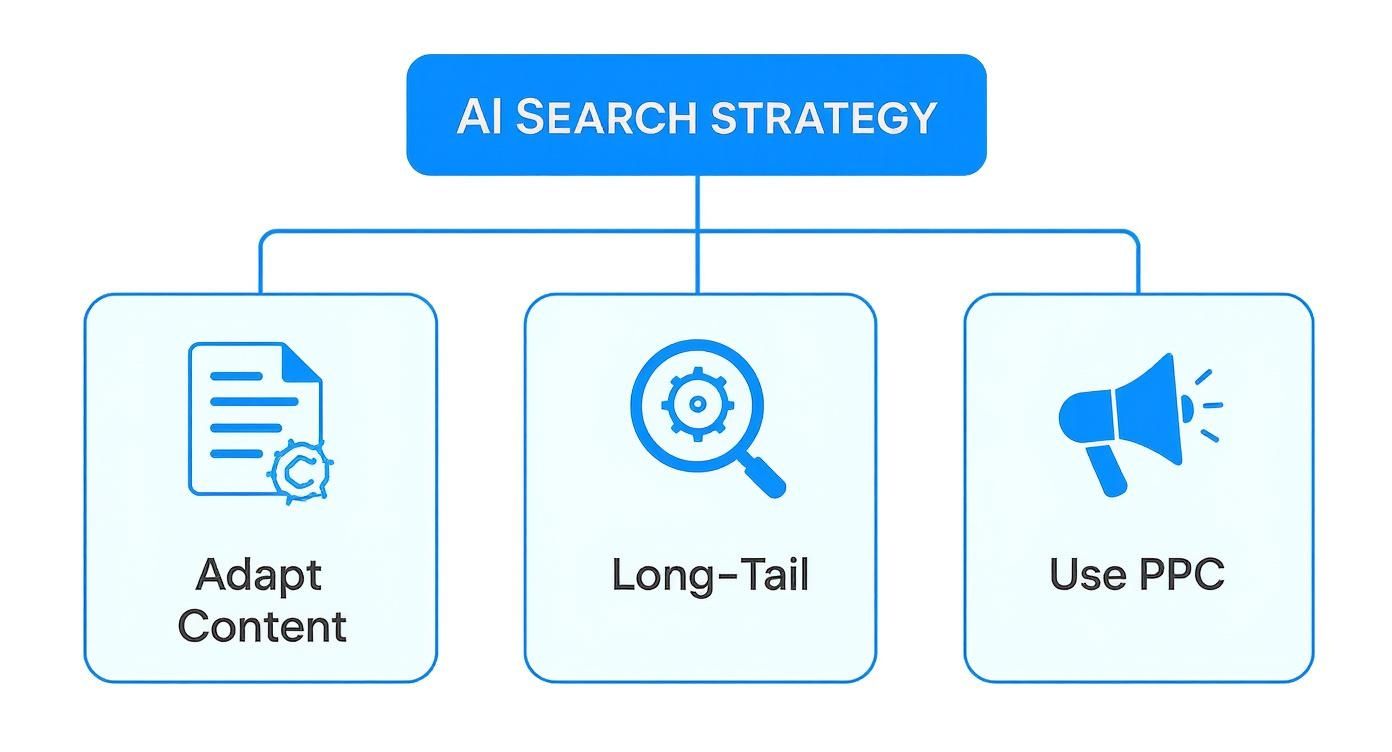
The takeaway here is that a smart search strategy today means adapting your content for AI, getting super-specific with long-tail keywords, and using PPC when you absolutely need guaranteed visibility.
When to Prioritize Paid Search (PPC)
Paid search is all about speed and control. It’s your go-to when you need to generate traffic and leads immediately. PPC gives you a predictable way to get your brand in front of customers the very moment they’re ready to pull out their wallets.
You should lean heavily on PPC in these situations:
- New Product or Service Launches: You need to make a splash from day one. PPC gets you instant visibility while your organic rankings are still getting off the ground.
- Time-Sensitive Promotions: Got a Black Friday sale or a limited-time offer? Paid ads ensure your message hits a targeted audience right when it matters most.
- Market Validation: If you have a new business idea, a small PPC campaign is a fast, low-risk way to see if people are actually interested before you invest a ton of time and money.
- High-Intent Keywords: For those "bottom-of-the-funnel" searches where someone is clearly looking to buy, a paid ad guarantees you that prime real estate at the top of the page.
Paid search is your marketing accelerator. It’s for those moments when you need to push a button and see immediate, measurable results. That makes it essential for short-term campaigns and rapid growth.
When to Prioritize Natural Search (SEO)
Natural search, on the other hand, is your engine for sustainable, long-term growth. It's an investment in a digital asset—your website—that will pay you back for years to come. SEO builds your brand’s authority and credibility in a way that paid ads simply can't.
Focus your energy on natural search when your goals are more foundational:
- Building Brand Credibility: Ranking organically for key industry terms shows you're a legitimate player. It builds a level of trust that money can't buy.
- Creating a Sustainable Traffic Source: Unlike PPC, organic traffic doesn't vanish the second you turn off your ad spend. A solid SEO foundation delivers a consistent stream of visitors month after month.
- Becoming a Thought Leader: High-quality, genuinely helpful content that ranks well establishes you as an expert and attracts a loyal following.
- Generating Top-of-Funnel Leads: SEO is perfect for capturing people in the research phase. You can answer their questions, solve their problems, and guide them toward an eventual purchase.
For businesses ready to build for the long haul, a professional Austin SEO services plan can lay the technical and content groundwork needed for lasting success.
To make this crystal clear, here’s a breakdown of which strategy to lean on for common business goals.
Strategic Scenarios for Paid vs Natural Search
| Business Goal / Scenario | Primary Strategy Recommendation | Reasoning |
|---|---|---|
| Urgent Lead Generation | Paid Search (PPC) | PPC delivers immediate traffic and leads from high-intent searchers, ideal for filling a sales pipeline quickly. |
| New Website Launch | Hybrid Approach | Use PPC for instant traffic and data collection while SEO efforts build the long-term organic foundation from scratch. |
| Building Brand Authority | Natural Search (SEO) | Organic rankings for informational keywords establish your site as a trusted resource, which ads cannot replicate. |
| Limited-Time Promotion | Paid Search (PPC) | Ads can be turned on and off instantly, ensuring visibility for the exact duration of your sale or event. |
| Testing a New Market | Paid Search (PPC) | A small, targeted PPC campaign provides fast, low-cost data on market demand before committing to a larger strategy. |
| Long-Term, Sustainable Growth | Natural Search (SEO) | SEO creates a compounding asset that generates "free" traffic over time, reducing reliance on ad spend. |
This table isn't about picking a winner; it's about choosing the right tool for the job at hand.
The Power of a Hybrid Approach
Ultimately, the smartest marketers don't choose one over the other—they make them work together. A hybrid strategy creates a powerful feedback loop where each channel strengthens the other.
For example, you can use PPC to quickly discover which keywords convert best, then use that data to guide your long-term SEO content strategy. In reverse, you can use paid remarketing ads to bring back visitors who first found you through an organic search, nudging them to complete a purchase.
This integrated approach ensures you're capturing customers at every single stage of their journey, maximizing your overall impact and leaving no opportunity on the table.
Building a Powerful Integrated Search Strategy
The whole "paid vs. organic" debate completely misses the point. It’s not about picking a winner. The real goal is building a system where each channel makes the other one stronger, creating a powerful feedback loop that turns two separate tactics into a single, cohesive growth engine.
When you get SEO and PPC working together, the results are always far greater than the sum of their parts. You can dominate the search results page (SERP), drive down your acquisition costs, and build a brand that connects with customers at every single stage of their journey.
Creating a Synergistic Feedback Loop
At its core, an integrated strategy is all about using data from one channel to inform and sharpen the other. Paid search, with its lightning-fast data collection, becomes an invaluable testing ground for your long-term organic search efforts.
Imagine you launch a PPC campaign for a new service. Within days, you have hard data on which keywords actually drive conversions, what ad copy resonates with your audience, and which landing pages perform best. This isn't just paid search data; it's a goldmine of market intelligence.
You can then take those high-converting keywords and winning ad copy themes and feed them directly into your SEO content strategy. Instead of guessing which topics might generate leads, you're building content around proven winners. This drastically increases the ROI of every dollar you put into SEO.
How a Strong SEO Foundation Fuels Better PPC
This relationship is definitely not a one-way street. A solid organic presence directly boosts your paid search campaigns by improving your Quality Score—Google's rating of the quality and relevance of your keywords, ads, and landing pages.
A higher Quality Score is rewarded with lower ad costs and better ad placements. A huge piece of that score is landing page experience. When your SEO efforts produce fast, relevant, and well-structured pages, your PPC campaigns immediately become more efficient and profitable. To get there, you have to follow current technical SEO best practices that keep your site optimized for both users and search engines.
The ultimate goal of an integrated strategy is SERP domination. By locking down both the top paid ad and the top organic result for your most valuable keywords, you build immense brand credibility and capture a massive share of user clicks.
Actionable Integration Tactics
Putting this into practice comes down to a few key strategic plays. These tactics bridge the gap between your paid and organic search teams, making sure everyone is working from the same playbook.
- Shared Keyword Strategy: Use PPC data to pinpoint your "money" keywords—the ones with high commercial intent. Target these aggressively with both paid ads for immediate visibility and in-depth organic content for long-term authority.
- Content Gap Analysis: Find keywords where your competitors are ranking organically but you aren't. You can immediately target those terms with a PPC campaign to get a foothold while your SEO team builds content to compete organically down the road.
- Remarketing for Organic Visitors: Someone might discover your brand through a blog post they found via organic search. With a remarketing campaign, you can then serve them targeted ads across the web, reminding them of your solution and gently guiding them back to convert.
- "Double-Dipping" on Branded Terms: For your own brand name, running a paid ad right alongside your #1 organic ranking is a powerful defensive move. It pushes competitor ads further down the page and reinforces your brand’s authority, effectively letting you own your SERP real estate.
Common Questions About Paid vs. Natural Search
When you're figuring out where to put your marketing dollars, a few questions always come up. Here are some straight-shooting answers to the most common ones we hear from business owners.
Once I’m Ranking on SEO, Should I Just Turn Off My PPC Ads?
It's tempting to think so, but you'd be missing a huge opportunity. Even if you've snagged the #1 organic spot, running a paid ad for that same keyword is a smart power move. It’s a strategy we call SERP domination.
Think about it: by owning both the top paid and organic positions, you're doing two things. First, you're bumping your competitors further down the page, making them almost invisible. Second, you’re capturing way more of the clicks. This "double-dipping" cements your brand as the go-to authority and protects your turf from rivals trying to bid on your name.
Lots of people assume PPC becomes useless once their SEO is solid. The truth is, they work together to create an unbeatable presence, making your brand the most credible and obvious choice on the page.
Which Is Better for a Brand New Website?
For a website that’s fresh out of the box with no history or authority, paid search (PPC) is the undisputed winner for getting results now. SEO is the long game—it can easily take six months or more before you see any real traction. A well-built PPC campaign, on the other hand, can have traffic and leads flowing in from the moment you launch.
This gives you two massive advantages right away:
- Instant Traffic: You’re not stuck waiting for Google to finally notice your site and decide where it belongs.
- Invaluable Data: PPC quickly tells you which keywords actually lead to sales. You can then feed that intel directly into your long-term SEO strategy, so you’re not just guessing what to rank for.
Can Paying for Ads Help My Natural Search Rankings?
Not directly, no. Google has been very clear that buying ads on their platform won't give your organic rankings a direct boost. But there's a powerful indirect connection at play.
A solid PPC campaign drives a lot more traffic and gets your brand name in front of more eyeballs. This can lead to more people searching for your brand by name, mentioning you on social media, or even linking back to your content because they've discovered it through an ad. All of these are positive signals that can indirectly help your organic performance grow over time.
Ready to build a search strategy that actually drives growth? At Gidds Media, we blend expert SEO with precision-targeted Google Ads management to get you seen and deliver results you can measure. Get your free, no-pressure SEO audit today!