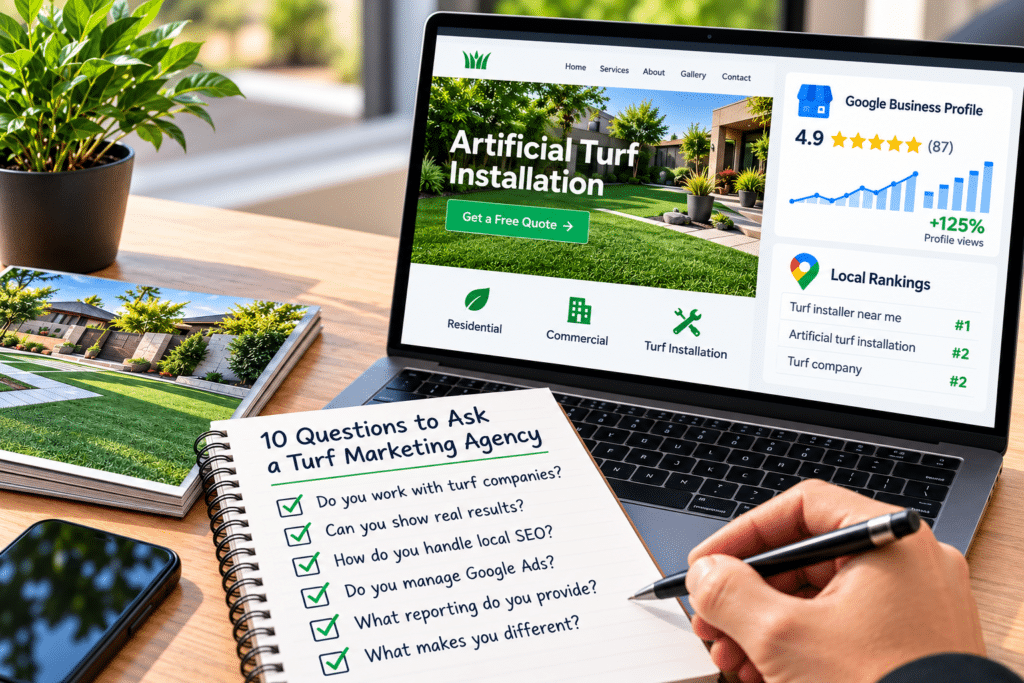
Hiring the wrong marketing partner costs a turf company more than a monthly fee. It burns ad money, ties up your estimators with bad leads, and can leave you locked out of your own accounts.
If you’re working out how to choose a turf marketing agency, this guide gives you the 10 questions we’d ask in your shoes, what a good answer sounds like, and the red flags that should end the call.
Key Takeaway:
The right agency for a turf company is one that:
- Has done this before for turf or landscaping companies, and can show real results.
- Measures booked jobs and revenue, not clicks or “impressions.”
- Lets you own everything: your ad account, website, Google Business Profile, and data.
- Explains its work in plain English and never promises a #1 spot on Google.
- Plans around your margins and crew capacity, not just your budget.
- Won’t market your direct competitor in the same service area.
- Offers clear terms, so you know what you pay, what you get, and how to leave.
If an agency checks all seven boxes, you’re in good shape. The questions below help you find out.
First: Do You Actually Need an Agency?
Not every turf company does. In its guide Do you need an SEO?, Google says small local businesses can often handle much of the work themselves, starting with its free SEO Starter Guide.
An agency starts to make sense when:
- You’re spending on ads but can’t tell which ones lead to signed jobs.
- Your crews have open days, but leads are slow or low quality.
- You’re paying for leads that several other installers also received.
- You’re expanding into new cities and need to show up there quickly.
- Marketing is eating the evenings you need for estimates and installs.
If several of those sound familiar, it’s worth reading about the reasons more owners bring in outside marketing help before you start interviewing.
How to Choose a Turf Marketing Agency: The 10 Questions
Bring these to every sales call. Good agencies will welcome them. Weak ones will dodge.
1. Have You Worked With Turf Companies? Can I See Results?
Turf isn’t like plumbing or HVAC. It’s a large, planned purchase, homeowners collect several quotes, and pet turf, putting greens, and commercial jobs all sell differently.
Ask for turf or landscaping examples and a client you can call. Google’s hiring advice also recommends checking references and asking about experience in your industry and your city.
A good answer: Named clients, numbers tied to qualified leads or booked jobs, and a reference you can phone. You can see the kind of proof we share in our client results.
A red flag: “We’ve grown hundreds of businesses,” with no turf examples to back it up.
2. Will You Ask About My Margins and Crew Capacity?
A good agency conversation starts with your business, not their package. Google’s guide notes that a good provider should want to learn what makes you unique, who you compete with, and how customers find you.
For turf, two numbers matter most:
- What you clear on an average job, broken out by job type.
- How many installs your crews can handle each week.
Ninety leads you can’t service isn’t a win. It means slow callbacks, missed follow-ups, and weaker reviews.
A good answer: “Let’s look at your margins by job type and your weekly capacity, then set a budget.”
A red flag: The first question is “What’s your budget?” and the second is “When can you start?”
3. How Will You Measure Success?
Clicks and impressions are easy to report and easy to inflate. What you care about is booked estimates, signed contracts, and revenue.
Ask how they’ll connect each call or form to a signed job. Call tracking, plus a simple way to mark which leads closed, should be part of the plan.
A good answer: Monthly reports showing cost per booked estimate and revenue from marketing.
A red flag: Reports full of charts with no line for “jobs sold.”
4. Who Owns My Ad Account, Website, and Google Profile?
This matters more than most owners realize. If the agency owns your accounts, leaving can mean losing your ad history, your website, or control of the profile your reviews live on.
Insist on the following:
- Google Ads: The account is in your business’s name, and you hold Admin access. Google’s guide to Google Ads access levels shows that only Admins can grant or remove users and unlink manager accounts. It also notes that an agency’s manager account with “ownership” can change who has access to yours, so ask how they set it up.
- Google Business Profile: You should be the owner, with the agency added as a manager. Google’s Business Profile guidelines explain that taking over a profile requires the current owner to add you and transfer ownership. You don’t want to be asking an ex-agency for that.
- Website and domain: Registered in your name, with logins you control.
- Tracking and reporting data: You have access and can export it.
During an early review, Google also suggests giving an outside provider only view access to Search Console (Google’s free website performance tool), not edit access.
A good answer: “Everything is in your name. We’re users you can remove at any time.”
A red flag: “We build it all inside our own account. It’s simpler that way.”
5. What Exactly Will You Do Each Month?
You should know what you’re paying for. Google advises being careful with any provider that’s secretive or won’t clearly explain its plans, and reminds owners that they’re responsible for what the companies they hire do.
Ask for a written list of monthly work. For a turf company, that usually includes some mix of:
- Google ads for searches like “artificial turf installation near me”
- Your Google Business Profile and Google Maps visibility
- Separate pages for each city you serve
- Landing pages and quote forms
- Follow-up for homeowners who got an estimate but haven’t signed
- Review requests after finished installs
Not sure what’s normal? Here’s a closer look at what a marketing agency typically handles for a small business.
6. How Will You Filter Out Bad Leads?
Plenty of turf searches come from people pricing DIY rolls, shopping for supplies, or comparing turf to new sod. Paying for those clicks drains your budget fast.
Ask how they’ll screen those people out before they reach your phone. Good options include blocking search terms like “DIY” or “turf rolls for sale,” and quote forms that ask about yard size, project type, and timeline.
A good answer: A clear screening plan at the ad, the landing page, and the form.
A red flag: “More leads is always better.”
7. What Results Should I Expect, and How Fast?
Honest agencies give ranges and explain what drives them. Dishonest ones give guarantees.
Google is direct about this: no one can guarantee a #1 ranking on Google, and if someone promises first place, it says to find someone else.
Here’s what realistic timing looks like in our experience with turf companies:
- Google ads: Leads often start in the first week. Making them profitable usually takes 30 to 60 days of tuning.
- Google Maps and search rankings: Meaningful movement typically shows up around four to six months, and keeps building after that.
A red flag: “Page one in 30 days, guaranteed.”
8. How Do You Get Reviews?
Reviews win turf jobs. But how an agency gets them can put your business at legal risk.
In the U.S., the FTC’s final rule on fake reviews bans fake reviews (including AI-written ones), paying for reviews that must be positive or negative, undisclosed reviews from insiders, and using threats to get bad reviews removed. The FTC can seek civil penalties from businesses that knowingly break it.
A good answer: Asking every real customer for an honest review after the install, using a simple text or email link.
A red flag: Offers to “seed,” buy, or write reviews, or to give discounts only for five-star ratings.
9. Do You Work With Other Turf Companies in My Area?
If an agency runs ads for two installers in the same city, it’s bidding against itself for the same homeowners. One of you loses, and it may be you.
Ask directly. Many agencies limit how many clients they take per market. We don’t take on two turf companies competing for the same searches in the same area.
A good answer: A clear yes or no, plus how they define “your market.”
A red flag: “We have lots of turf clients in your city. That’s why we’re so good at it.”
10. What’s in the Contract, and How Do I Leave?
Read the agreement before you sign, not after a bad month. Look for:
- Term length: Month-to-month or a minimum commitment? How much notice to cancel?
- Fees vs. ad spend: Is the agency fee separate from what Google or Meta charges? Do you pay the ad platforms directly?
- What happens at the end: Do your accounts, website, and data stay with you?
- Setup fees: What do they cover?
A red flag: A long lock-in with no performance exit, or agency fees buried inside your ad spend.
Red Flags That Should End the Conversation
Watch for these on any sales call:
- Guaranteed rankings or a “special relationship” with Google. Google’s guidance specifically warns against both.
- Cold emails saying your site “isn’t listed.” Google tells site owners to treat these with heavy skepticism.
- Keywords stuffed into your business name. Adding “Best Artificial Turf Phoenix” to your name breaks Google’s Business Profile guidelines and can get your profile suspended.
- Fake addresses in other cities. Google doesn’t allow virtual offices. Service-area businesses without a storefront should hide their address and set a service area instead.
- Fake or bought reviews. See question 8.
- No logins for you. If you can’t get in, you don’t really own it.
How Much Does a Turf Marketing Agency Cost?
Your total cost has two parts:
- Ad spend: what you pay Google, Meta, and others for clicks and views.
- Agency fee: what you pay the agency to plan, build, and manage the work.
Here are the common ways agencies charge:
| Pricing model | How it works | What to watch for |
|---|---|---|
| Flat monthly fee | Set price for a defined scope | Get the scope in writing |
| Percentage of ad spend | Fee grows as your budget grows | Can reward spending more, not spending well |
| Pay per lead | You pay for each lead delivered | Ask how a “lead” is defined and whether it’s shared |
| Setup fee + monthly | One-time build cost, then ongoing management | Ask exactly what the setup includes |
There’s no single right ad budget. It depends on your average job value, your area, and how many installs your crews can take on.
For most turf companies, we recommend starting at $1,500 a month in ad spend at minimum, then adjusting once we know your cost per booked job. For a number built around your business, the quickest route is a free 30-minute strategy call.
Agency vs. Lead Services vs. Doing It Yourself
| Turf marketing agency | Shared lead services | Doing it yourself | |
|---|---|---|---|
| Who gets the lead | Only you | Often several installers | Only you |
| How you pay | Fee + ad spend | Per lead | Ad spend + your time |
| Builds your own brand | Yes | Mostly no | Yes |
| Your time needed | Low to moderate | Low | High |
| Best for | Growing companies that want steady leads they own | Filling a slow week | Small operators with time to learn |
Shared lead services can fill a gap. But when the same homeowner is sold to several installers, you’re competing on speed and price before you’ve said a word about your work.
What the First 90 Days Should Look Like
A good agency should be able to walk you through a plan like this:
- Weeks 1–2: Setup. Account access, call tracking, a review of your current ads and Google profile, and goals by job type.
- Weeks 2–4: Launch. Ads go live, landing pages and quote forms are tested, and junk searches get blocked.
- Months 2–3: Tune. Budget shifts toward the job types and areas that close best. Follow-up and review requests run in the background.
- Every month: Report. A clear update tied to booked estimates and revenue.
Does the Agency Understand Your Local Rules?
Turf demand often tracks local water rules and rebate programs, and those vary a lot by area. An agency writing your ads needs to understand them, or it risks making promises you can’t keep.
For example, the Southern Nevada Water Authority’s Water Smart Landscapes rebate only accepts artificial turf as a stand-in for mulch. It must be permeable, and the project still has to meet the program’s plant coverage rules.
Homeowners there also need a site visit before removing their lawn, or they lose eligibility. An ad that just says “Get paid to install turf!” could mislead them and cost you the job.
The same page notes that applications tend to rise in spring and fall. That’s the kind of local timing a good agency should build your ad calendar around.
Quick Checklist Before You Sign
- They showed turf or landscaping results and gave you a reference.
- They asked about your margins and crew capacity.
- Their reports are tied to booked jobs and revenue.
- Every account is in your name, with you as owner or Admin.
- The monthly work is written down.
- They have a plan to screen out DIY and supply shoppers.
- They made no ranking guarantees.
- Their review process is honest.
- They won’t market a direct competitor in your area.
- The contract, fees, and exit steps are clear.
Frequently Asked Questions
How long should I give an agency before judging results?
Give paid ads about 60 to 90 days to show whether they can produce profitable jobs. Google Maps and search rankings take longer, often four to six months. You should still see clear progress reports every month.
Should I hire a general agency or one that knows turf?
A turf-focused agency usually ramps up faster. It already knows the buying cycle, which searches waste money, and how pet turf, putting greens, and commercial work differ. A general agency can work too, if it passes the 10 questions above.
Can I keep my current website?
Often, yes. A good agency will review it first and tell you whether it can turn visitors into calls as is, or whether new landing pages would help.
Do I need both ads and Google Maps work?
For most turf companies, both help. Ads bring leads quickly. Strong Google Maps visibility builds more slowly but keeps working even when you pause ad spend.
Talk to Us Before You Sign With Anyone
At Gidds Media, we built our turf work around the same questions in this guide: margins first, crew capacity, booked jobs over clicks, and accounts you own.
See how we help artificial turf companies, then book a strategy call to review your ads, map rankings, and landing pages. If we don’t think we can help, we’ll say so. Prefer to send a message first? Get in touch here.