Most business owners ask the same thing before running their first Facebook or Instagram ad: how much do Meta ads cost? The honest answer is that Meta has no price list. You choose a budget, and the price of each result is set by an auction.
That auction is getting pricier. Meta’s CFO said on the second quarter 2026 earnings call that the global average price per ad rose 12% year over year. Online brands paid a median of $38.99 to win one customer, according to Triple Whale.
This guide covers both parts of the bill: what you pay Meta to show your ads, and what you might pay an agency to manage them. You’ll also see recent benchmark numbers, a simple way to set your budget, and the mistakes that waste money.
Key Takeaways
- There is no fixed price. You set a daily or lifetime budget, and an auction sets the cost of each result.
- Typical costs for online stores: a median of $15.06 to show an ad to 1,000 people and $38.99 to win one customer, according to Triple Whale’s 2026 report.
- Prices are rising. Reaching 1,000 people cost 13.24% more than the year before, and winning a customer cost 3.14% more.
- Your industry matters. Cost per customer ranged from $26.80 to $51.86 across the industries Triple Whale tracked.
- Agency fees are a separate bill. Clutch reports an average of about $5,107 a month for social media marketing projects, on top of your ad spend.
- Set your budget by working backwards. Multiply the customers you want by your cost per customer.
- Ad quality, tracking and your website can lower your costs as much as a bigger budget can.
How Much Do Meta Ads Cost?
There is no fixed price. You decide how much to spend, and the cost of each click, view or sale depends on competition and on how well your ad performs.
Here is what online businesses were paying between August 2025 and July 2026, according to Triple Whale’s report covering more than 40,000 brands:
- Showing your ad to 1,000 people: a median of $15.06
- Winning one customer: a median of $38.99
- Agency fees (if you hire help): a separate bill on top of your ad spend
On the agency side, Clutch reports an average of about $5,107 per month for social media marketing projects reviewed on its platform. That figure covers social media work in general, not Meta ads alone.
Treat these numbers as a starting point, not a quote. Your own costs depend on your industry, your offer and your website.
How Meta Charges for Ads
Meta’s pricing has two moving parts: the budget you set and the auction that decides what each result costs.
You Set the Budget
Meta lets you choose between two budget types, set at the ad set level. An ad set is the group of settings that decides who sees your ads, when, and where.
- Daily budget: the average amount you’re willing to spend each day. According to Meta’s developer documentation, Meta may spend more on days with better opportunities and less on quieter days.
- Lifetime budget: the total you’re willing to spend over the whole run of the campaign. Meta says you won’t be charged more than this amount unless you change your delivery settings.
If you want a firm ceiling for a short promotion, a lifetime budget is the easier way to get one.
How Meta Sets the Price of Each Ad
Every time someone opens Facebook or Instagram, Meta runs an auction for the available ad space. According to PPC Land’s explainer on Meta’s ad system, which draws on Meta’s Business Help Center, the ad with the highest “total value” wins.
Total value is built from three things: your bid, how likely the person is to take the action you want, and the quality and relevance of your ad.
That means the highest bidder doesn’t automatically win. A clear, relevant ad can hold its own against a bigger bid.
Typical Meta Ad Costs Right Now
Benchmarks come from companies that track thousands of ad accounts. The most recent large dataset we found is Triple Whale’s 2026 benchmark report, based on online brands from August 2025 to July 2026.
| What you’re measuring | Typical (median) result |
|---|---|
| Cost to show your ad to 1,000 people | $15.06 |
| Cost to win one customer | $38.99 |
| Share of people who click your ad | 2.39% |
| Share of visitors who buy | 1.53% |
| Sales for every $1 spent on ads | $1.88 |
Prices Are Rising
Compared with the year before, Triple Whale found that reaching 1,000 people cost 13.24% more, and winning a customer cost 3.14% more. Sixteen of the 17 industries it tracked saw the cost of reaching people go up.
The report links this to a crowded auction, with more advertisers competing for the same audiences.
Costs Vary a Lot by Industry
Triple Whale’s data shows a wide spread between industries:
- Cheapest cost per customer: online courses at $26.80, then baby products at $29.61
- Most expensive cost per customer: electronics and medical equipment, both at $51.86
- Cheapest to reach 1,000 people: baby products at $11.50
- Most expensive to reach 1,000 people: health and wellness at $21.80
One caution: these figures come from online stores. If you sell services and collect enquiries, such as a clinic, law firm or home-service business, your cost per enquiry will differ. Use the numbers as a rough range, not a promise.
What Makes Your Ads Cost More or Less
Five things move your price the most:
- Your industry. As the figures above show, some categories are simply more competitive.
- Ad quality. Quality and relevance are one of the three inputs to Meta’s auction, so weak ads lose out or cost more to show.
- Your goal. Asking people to buy is harder than asking them to click, so a sale usually costs more than a click.
- Competition and timing. More advertisers means higher prices, and busy shopping periods tend to be more competitive.
- Your website. If visitors click but don’t buy, your cost per customer climbs. Triple Whale points to this in electronics, where clicks rose but fewer visitors bought, and calls it a warning sign about the website or offer.
How Much Should You Budget?
Skip the guesswork and work backwards from the customers you want. Here is a simple method:
- Work out how much profit a new customer brings you.
- Estimate your cost per customer. Start with a benchmark, then replace it with your own numbers as results come in.
- Decide how many new customers you want each month.
- Multiply steps 2 and 3.
Example: if you want 30 new customers a month and your cost per customer matches the $38.99 median, that’s roughly $1,170 in ad spend. This is an illustration, not a prediction.
If the result is more than you can afford, aim for fewer customers rather than spreading a small budget thin. In general, a tight budget works best when it is focused on one offer and one audience.
Plan to judge results over weeks, not days. If you’d like help turning your own numbers into a realistic budget, you can book a consultation with our team.
What Agency Fees Look Like
Ad Spend and Agency Fees Are Two Separate Bills
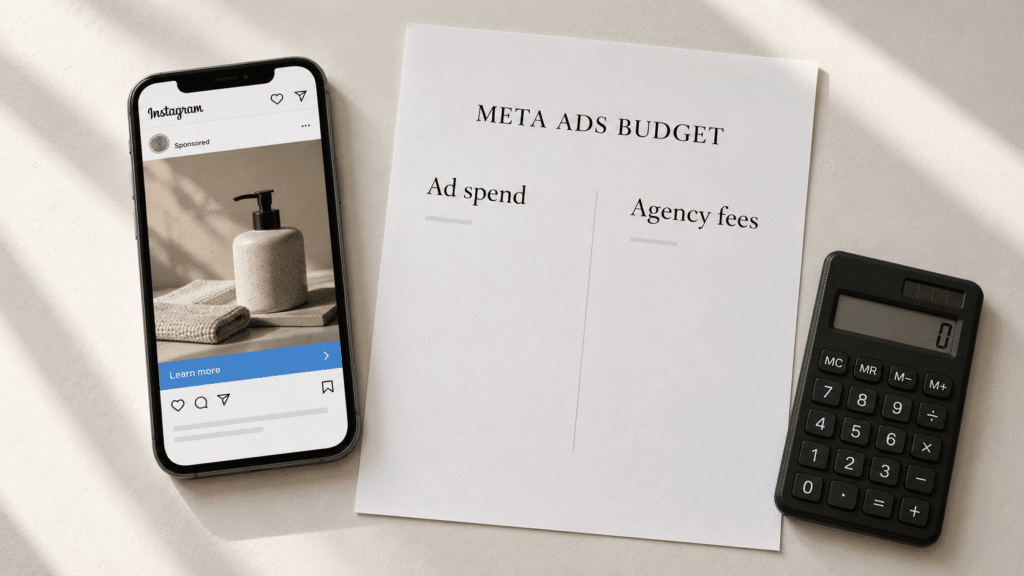
Money for ads goes to Meta. The agency fee pays for the people and work behind your campaigns. Clutch’s pricing guide makes the same point: agency fees are separate from ad spend, so you need to budget for both.
Common Ways Agencies Charge
Agencies usually use one of three models:
- Flat monthly fee: you pay the same amount each month, whatever you spend on ads.
- Percentage of ad spend: the fee grows as your ad budget grows.
- A mix of both: a smaller flat fee plus a percentage.
Clutch advises asking any agency you’re considering exactly how they charge, whether on a sliding scale or a flat fee. Pricing models differ, so compare the total cost and what’s included, not just the headline number.
What the Pricing Data Says
Clutch’s guide, updated in September 2026, offers a useful reference point for social media agencies in general:
- The average monthly cost of a social media marketing project reviewed on Clutch is about $5,107.
- The typical hourly rate across providers on its platform is $25 to $49, but US agencies are listed at $100 to $149 an hour, and some countries fall below $25.
These numbers cover social media services broadly. Meta ads management alone may cost less or more, depending on scope.
Example: Your Total Monthly Cost
Here is a made-up example to show how the two bills add up:
| Item | Monthly cost |
|---|---|
| Ad spend paid to Meta | $2,000 |
| Agency management fee | $500 |
| Total | $2,500 |
Your real figures will depend on your agency’s pricing and your budget.
What Your Agency Fee Should Cover
A good management fee should include:
- Setting up your campaigns, audiences and tracking
- Writing and designing ads, or a clear price if creative costs extra
- Testing new ads and adjusting campaigns as results come in
- Plain-language monthly reports that show cost per customer, not just clicks
- Your ownership of the ad account, so you can leave with your data
You can see how we handle this on our Meta ads management service page.
Should You Hire an Agency or Run Ads Yourself?
Both can work. The right choice depends on your time, budget and experience.
| Run ads yourself | Work with an agency | |
|---|---|---|
| Cost | Ad spend plus your time | Ad spend plus a management fee |
| Learning curve | You learn as you go | Handled by people who run ads regularly |
| Speed | Slower while you learn | Faster to launch and adjust |
| Ad creative | You make or buy your own | Sometimes included, sometimes extra |
If you’re weighing the decision, our post on what an outside team can do for your marketing covers the main benefits. And if you decide to hire, these tips for picking the right partner will help you compare your options.
Extra Costs to Plan For
Ad spend and agency fees aren’t the whole picture. Budget for these too:
- Ad creative: photos, video and copy. Weak creative makes every other cost worse.
- A website that turns visitors into customers: fast, clear and easy to use on a phone.
- Tracking: a way to tell Meta which ads led to sales. Meta made one key tracking connection a one-click setup in April 2026, so it needs less developer help than before.
- Your own time: replying to leads and reviewing reports.
Common Mistakes That Waste Ad Budget
- Running ads without tracking. If you can’t see which ads lead to sales, you can’t improve.
- Judging results too early. The first days are for testing, not for final verdicts.
- Changing everything at once. If you edit every ad daily, you won’t know what worked.
- Adding budget to a weak ad. More money behind an ad people ignore only burns budget faster.
- Ignoring the website. Good ads can’t fix a page that confuses visitors.
- Slow follow-up. A lead that waits days for a reply is often a lost lead.
When Meta Ads Are a Good Fit
Meta ads tend to work well when:
- You have a clear offer and know what a customer is worth to you
- Your website can turn visitors into enquiries or sales
- You can track results and follow up quickly
- You can afford to keep testing for a few weeks
It may be better to wait if you have no way to track sales, your offer is still unproven, or your budget is too small to buy enough results to learn from.
Frequently Asked Questions
Is there a minimum budget for Meta ads?
You choose your own budget, and Ads Manager will flag a budget that is too low for your goal and currency. A very small budget can run, but it may deliver too few results to tell you what works.
Do I pay Meta even if nobody buys?
Yes. Meta charges for delivering your ads, not for guaranteed sales. That’s why tracking and a good website matter so much.
Are agency fees included in my ad budget?
No. Agency fees are a separate cost from ad spend, as Clutch’s pricing guide explains.
Can I cap how much I spend?
Yes. With a lifetime budget, Meta says you won’t be charged more than your total unless you change your delivery settings. A daily budget is an average, so spend can vary from day to day.
Is Instagram priced differently from Facebook?
Both are bought through the same tool, Meta Ads Manager. By default, Meta’s automatic placements setting lets it spread your budget across more than 25 places on Facebook, Instagram, Messenger and partner apps.
Find Out What Your Ads Should Cost for Your Business
The best way to estimate your costs is to start with your own goals, your own margins and your own website. Benchmarks help, but your numbers matter more.
If you’d like a second opinion, book a consultation or get in touch with our team. You can also learn more about Gidds Media and how we approach paid advertising. For the bigger picture, see how much advertising costs for a small business.