If you typed “what is search engine optimization” into Google to land here, you just watched SEO do its job. Somewhere, a page answered your question well enough that Google decided to show it to you first.
Search engine optimization (SEO) is the practice of making a website easier for search engines to find, understand, and recommend — so when someone searches for something your business offers, your site can show up without you paying for that click. It’s one of the few marketing channels that keeps working after you’ve stopped actively working on it.
This guide covers what SEO actually is, how it works behind the scenes, what it costs, how long it takes, and when it’s worth hiring someone to handle it for you.
What Is Search Engine Optimization?
At its core, search engine optimization is the process of improving a website so it earns a higher, more relevant spot in unpaid (“organic”) search results. Google’s own SEO Starter Guide describes it as helping search engines understand your content, and helping people decide whether to visit your site through search.
SEO isn’t a single trick or setting you switch on. It’s a mix of technical setup, content quality, and reputation that together signal to search engines a page deserves to be shown for a given query.
It’s also not the same as buying ads. Google has stated plainly that no one can pay to rank higher or get crawled more often in its organic results — that placement has to be earned.
How Does SEO Work?
Search engines work in three basic stages, laid out in Google’s own documentation on how Search works. Once you understand these three steps, the rest of SEO makes a lot more sense.
Crawling
Search engines use automated programs (Google’s is called Googlebot) that follow links from page to page across the web, downloading what they find as they go. A page with no links pointing to it can be hard for a crawler to ever discover.
Indexing
Once a page is crawled, the search engine studies its text, images, and other content, then stores what it learned in a massive database called the index. A page has to be indexed before it can ever show up in results.
Ranking (Serving Results)
When someone runs a search, the engine scans that index and returns the pages it believes are the most relevant and highest quality for that exact query. Relevance is judged using hundreds of signals, including the words on the page, how trustworthy the site appears, and even the searcher’s location and device.
The Main Types of SEO
Most SEO work falls into four categories. A complete strategy usually touches all four.
On-Page SEO
This covers everything on the page itself — the words you write, your page titles, and how well the content actually answers what someone searched for. Google is direct about this one: well-organized, genuinely useful content, as described in its SEO Starter Guide, influences rankings more than almost anything else on this list.
Technical SEO
This is the plumbing behind the scenes — making sure search engines can actually access and read your pages, and that your site loads quickly on both desktop and mobile. Site speed and stability are measured through a set of metrics Google calls Core Web Vitals.
Off-Page SEO (Link Building)
This is about earning links from other reputable websites. Other sites linking to yours acts like a vote of confidence, and it remains one of the main ways search engines discover new pages in the first place.
Local SEO
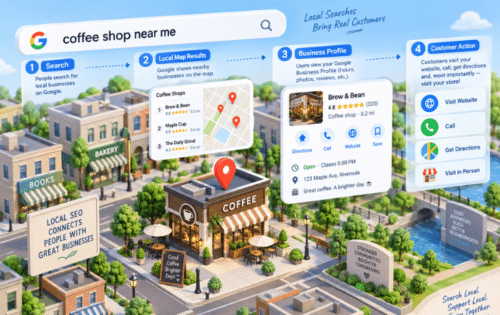
For businesses that serve a specific area — home services, medical offices, retail — local SEO is about showing up in map results and “near me” searches. That starts with a complete, accurate Google Business Profile. If you run a local service business, this is usually where the fastest wins are, which is exactly what our SEO services are built around.
Benefits of SEO
- Free, compounding traffic. Once a page ranks, it can keep bringing in visitors without an ongoing cost per click.
- Can’t be bought. Organic placement has to be earned rather than paid for, which is part of why people trust it.
- Higher-intent leads. Someone actively searching for a service is usually further along than someone scrolling past an ad.
- Works alongside paid ads. SEO and Google Ads can target the same keywords from two different angles at the same time.
- A long-term asset. Unlike an ad campaign, the content and rankings you build largely stay in place after the active work slows down.
SEO vs. Paid Advertising: What’s the Difference?
SEO earns placement in the organic results — the listings a search engine doesn’t charge you for. Paid ads, like Google Ads or Meta Ads, buy placement right away, but that visibility disappears the moment you stop paying.
SEO usually takes longer to show results, but the traffic it earns doesn’t need an ongoing per-click budget to keep flowing. Paid ads can produce leads almost immediately, which is why many businesses run both at once — ads for speed, SEO for long-term stability.
How Long Does SEO Take to Work?
There’s no fixed timeline, and anyone who promises an exact number of weeks is guessing. Google’s own SEO Starter Guide says some changes can show up within hours, while others take several months, and recommends waiting a few weeks before judging whether a change actually worked.
In practice, timelines depend on how competitive your industry is, how established your site already is, and how consistently the work gets done. Most local service businesses start seeing real movement within a few months, with results building from there.
How Much Does SEO Cost?
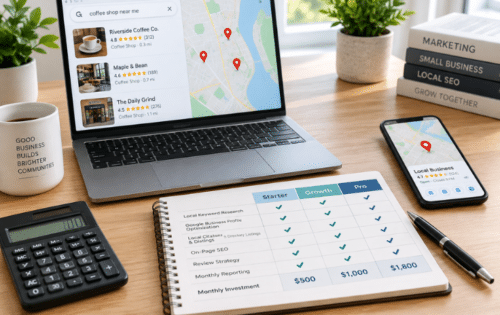
There’s no single price tag for SEO. Cost depends on how competitive your market is, how much content and technical work your site needs, and whether you handle it yourself, hire a freelancer, or work with an agency. Doing it yourself can cost very little beyond your own time, while an ongoing professional engagement is usually billed monthly, more like a subscription than a one-time purchase.
We break down the actual price ranges and what drives them in our guide to what SEO really costs for a small business.
Is SEO Worth It for Your Business?
For most businesses that rely on local or ongoing search traffic, yes — because the leads it generates keep arriving without an ongoing per-click cost. But it isn’t free (it takes real time or budget) and it isn’t instant, so it isn’t the right fit for every situation.
We go deeper into the actual payoff, and when SEO is (and isn’t) the right call, in this breakdown of whether it’s worth the investment.
Common SEO Risks and Mistakes to Avoid
Some tactics that promise fast rankings can get a site penalized or dropped from search results entirely. Google’s spam policies spell out the behaviors that can trigger this, including:
- Keyword stuffing — cramming the same words into a page unnaturally.
- Buying or trading links purely to manipulate rankings.
- Cloaking — showing search engines different content than what a visitor actually sees.
- Thin or scraped content — pages built by copying or lightly rewriting someone else’s material instead of adding real value.
Any agency or freelancer suggesting these tactics is trading a short-term bump for long-term risk to your site’s visibility.
How to Maintain Your SEO Results
SEO isn’t a one-time project — rankings can slip if a site goes quiet for too long. A basic maintenance routine includes:
- Publishing new, genuinely useful content on a regular schedule
- Keeping older pages accurate and up to date
- Monitoring site speed and fixing technical errors as they appear
- Watching for lost or broken links, especially after a site redesign
- Reviewing your Google Business Profile and local listings for accuracy
Should You Hire an SEO Professional or Do It Yourself?
If you run a small, local business, Google itself says you can probably handle a lot of the basics yourself by working through its starter guide. Hiring a professional tends to make more sense once you’re short on time, competing in a crowded market, or planning a site redesign from the ground up.
If you do bring in outside help, Google’s own advice is to ask for past results, stay skeptical of anyone guaranteeing a #1 ranking, and understand exactly what changes they’re making to your site. We cover the full list of questions worth asking in our guide to picking the right marketing partner.
Getting Started With SEO
Search engine optimization isn’t magic, and it isn’t optional if you want to be found without paying for every single click. It’s a mix of technical setup, useful content, and reputation-building that compounds over time.
If you’d rather have someone handle it for you, Gidds Media works specifically with local service businesses, and our full range of services covers SEO alongside Google Ads, Meta Ads, and the landing pages that turn that traffic into booked jobs.