
Running a small business means you’re already the sales team, the customer service line, and probably the person unclogging the office sink. Marketing tends to get squeezed into whatever time is left over — which is usually not much.
So it’s a fair question: what does a digital marketing agency do for small businesses, exactly, and is it worth handing over that piece of the job? Below is a direct answer, plus what it costs, how long it takes, and what to watch out for before you sign anything.
What Does a Digital Marketing Agency Do for Small Businesses?
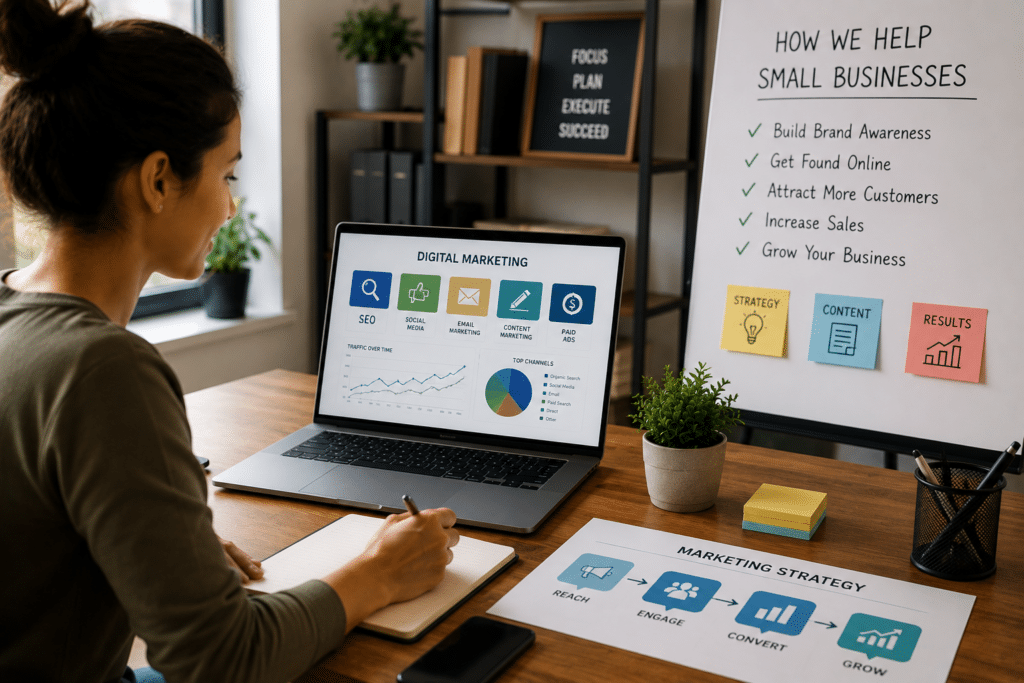
In simple terms, a digital marketing agency plans, builds, and manages your online marketing so you don’t have to. That includes making sure people can find your business in search results, running paid ads, keeping your social media active, and tracking which of it is actually turning into paying customers.
Most agencies handle some combination of the following:
- Strategy and research — figuring out who your customers are, what they search for, and where your competitors are winning or losing
- Search engine optimization (SEO) — improving your website so it ranks higher in Google and other search engines
- Paid advertising (PPC) — running ads on Google, Facebook, Instagram, or other platforms
- Social media management — posting, responding to comments, and building a following
- Content creation — blog posts, videos, graphics, and other material that supports SEO and social efforts
- Email marketing — newsletters and automated messages to existing customers and leads
- Website design and maintenance — building or updating the site that all of this traffic lands on
- Reporting and analytics — tracking what’s working and adjusting the plan
Not every agency does all of this. Some are full-service; others specialize in just one or two channels, like SEO or paid ads. It’s worth knowing which one you actually need before you start comparing options.
The Core Services a Digital Marketing Agency Provides
Here’s what each of those services actually looks like in practice.
Search Engine Optimization (SEO)
SEO is the work of making your website show up when someone searches for what you sell. That includes fixing technical issues on your site, writing content around the terms your customers search for, and earning links from other reputable websites.
For a local business, this also covers your Google Business Profile — the listing that shows up on Google Maps with your hours, reviews, and directions.
Pay-Per-Click Advertising (PPC)
PPC means paid ads where you’re charged each time someone clicks — think Google Ads or paid social media posts. Unlike SEO, which builds up over time, PPC can start sending traffic to your site almost immediately.
An agency typically handles the keyword research, ad copy, targeting, and budget management so you’re not paying for clicks that don’t convert.
Social Media Marketing
This covers the day-to-day posting, community management, and often paid promotion on platforms like Instagram, Facebook, LinkedIn, or TikTok. The goal is usually brand awareness and customer relationships rather than an immediate sale.
Content Marketing
Content marketing is the blog posts, guides, videos, and other material that supports both SEO and social media. Good content answers real questions your customers are already asking, which is also what search engines reward.
Email Marketing
Email remains one of the most direct ways to reach people who already know your business. Agencies typically set up newsletters, promotional campaigns, and automated sequences — like a welcome email for new customers.
Website Design and Development
Many agencies also build or redesign the website itself, since it’s the destination for all the traffic the other channels generate. This includes making sure the site loads quickly and works well on mobile devices, both of which affect SEO too.
Analytics and Reporting
This is the part that ties everything together: tracking traffic, leads, and sales back to the specific channel that produced them, so you can see what’s actually paying off.
How the Process Usually Works
Most agencies follow a similar sequence, whether you’re working with a small local shop or a larger team.
1. Audit and discovery. The agency reviews your current website, marketing efforts, competitors, and goals before recommending anything.
2. Strategy and goal-setting. Based on that audit, they build a plan — which channels to prioritize, what budget makes sense, and what success actually looks like (more calls, more online orders, more foot traffic, etc.).
3. Execution. This is the ongoing work — writing content, launching ad campaigns, publishing posts, fixing technical SEO issues.
4. Reporting and optimization. Good agencies review performance on a regular cadence (usually monthly) and adjust the plan based on what the data shows.
How Much Does a Digital Marketing Agency Cost?
Pricing depends heavily on scope, but there are a few common models:
- Monthly retainer — a fixed fee for an ongoing set of services, which is the most common arrangement for small businesses
- Project-based pricing — a one-time fee for something with a clear endpoint, like a website redesign
- Hourly billing — less common for full campaigns, but used for consulting or smaller tasks
- Performance-based — fees tied to results, most often used for paid advertising management
According to pricing data from Clutch, a research firm that tracks agency rates, digital marketing services typically bill at $100 to $149 an hour, with full monthly packages commonly ranging from a few thousand dollars up to $50,000 depending on scope, location, and agency size. Smaller, locally focused engagements — a single-location business running local SEO and social media, for example — tend to sit toward the lower end of that range.
For comparison, the U.S. Small Business Administration suggests that businesses earning under $5 million a year budget somewhere around 7-8% of gross revenue for marketing overall, which can help you sanity-check what a reasonable agency spend looks like relative to your total revenue. If you’re comparing packages, Gidds Media’s services and pricing page is a useful starting point.
How Long Before You See Results?
This depends heavily on the channel:
- Paid ads (PPC) can start driving traffic within days, since you’re paying to appear immediately.
- Social media engagement can build within weeks, though real audience growth takes longer.
- SEO is the slowest to show results, but it also tends to be the most durable once it kicks in.
On the SEO timeline specifically, a former lead on Google’s own Search team has said businesses should generally expect somewhere between four months and a year before meaningful improvements show up, according to reporting from Search Engine Land. If an agency promises page-one rankings within a few weeks, treat that as a red flag rather than a selling point.
Is Digital Marketing a One-Time Fix or an Ongoing Job?
It’s ongoing. Search engines change their ranking systems regularly, competitors keep marketing too, and ad platforms need continuous adjustment to stay cost-effective.
That’s why most agency relationships are structured as monthly retainers rather than one-off projects. A website redesign might be a single project, but SEO, social media, and ad management are more like maintaining a garden than building a fence — they need regular attention to keep working.
Key Benefits of Hiring a Digital Marketing Agency
Time back. A 2024 survey covered by Forbes found that more than half of small business owners spend an hour or less a day on marketing, and most aren’t confident that what they are doing is actually working. Handing that off frees up hours for running the actual business.
Expertise you’d otherwise have to hire for. An agency typically brings specialists across SEO, ads, design, and content — a team you’d struggle to build in-house on a small business budget.
An outside perspective. It’s easy to lose objectivity about your own business. An outside team can spot gaps or opportunities you might miss.
Flexibility to scale. You can usually adjust spend up or down as your business needs change, without the overhead of hiring or laying off staff.
For a deeper look at the case for outsourcing versus keeping it in-house, this breakdown of the reasons businesses bring in outside marketing help covers the tradeoffs in more detail.
Agency vs. Freelancer vs. In-House Team vs. Doing It Yourself
| Option | Best for | Typical cost | Tradeoff |
|---|---|---|---|
| Digital marketing agency | Businesses wanting a full team without hiring one | Monthly retainer, often a few thousand dollars up | Less day-to-day control than in-house |
| Freelancer | A single, well-defined task (e.g., one-off SEO audit) | Lower, project or hourly | Limited bandwidth, single point of failure |
| In-house hire | Businesses with steady, larger marketing budgets | Full-time salary and benefits | Highest cost, narrower skill set per person |
| DIY | Very early-stage or extremely tight budgets | Time instead of money | Steep learning curve, slower results |
There’s no universally “right” answer here — it depends on your budget, how fast you need results, and how much marketing knowledge already exists on your team.
Risks and Things to Watch Out For
Not every agency is a good fit, and a few warning signs are worth knowing before you sign a contract:
- Guaranteed rankings or results. No legitimate agency can guarantee a #1 Google ranking — search engines don’t work that way, and this kind of promise is often a sign of tactics that could get your site penalized later.
- Vague or infrequent reporting. You should know what’s being done and how it’s performing, on a regular schedule.
- Long lock-in contracts with no ownership. Make sure you retain ownership of your website, ad accounts, and analytics — some agencies build these under their own accounts, making it hard to leave.
- One-size-fits-all packages. A strategy that isn’t shaped around your specific business and goals is a bad sign.
If you’re not sure how to vet an agency against these risks, this guide to picking the right marketing partner for your business walks through what to ask before you sign anything.
Signs Your Small Business Might Be Ready for an Agency
You might be a good fit for hiring an agency if:
- Marketing keeps getting pushed to the bottom of your to-do list
- Your growth has plateaued and you’re not sure why
- You don’t have anyone in-house with real SEO, ad, or content expertise
- You’re ready to invest consistently, not just for a single month or campaign
- You’ve tried DIY tools and hit a ceiling on results
Is Hiring a Digital Marketing Agency Worth It?
It depends on the match. An agency is generally worth it when your goals are clear, your budget can support consistent effort (not just a single month), and you choose a partner whose specialty lines up with what you actually need.
It’s a weaker fit if you’re not ready to commit budget for at least a few months, or if your business goals aren’t defined yet — no agency can hit a target that hasn’t been set. For a closer look at the actual return small businesses tend to see, this look at whether the investment pays off goes deeper into the numbers.
Frequently Asked Questions
Do small businesses really need a digital marketing agency? Not always. Very early-stage businesses with minimal budgets sometimes get more value from DIY tools or a single freelancer until they have more to invest.
What’s the difference between an agency and a marketing consultant? A consultant typically advises on strategy but doesn’t execute the work. An agency usually does both — planning and hands-on execution.
Can I just do digital marketing myself? Yes, especially early on. The tradeoff is time and a learning curve, since channels like SEO and paid ads have real technical depth.
How do I know if it’s actually working? Ask for regular reporting tied to real business outcomes — leads, calls, sales — not just vanity metrics like impressions or followers.
The Bottom Line
A digital marketing agency’s job is to take the parts of marketing that require ongoing time and specialized skill — SEO, ads, content, social, and reporting — off your plate, so you can focus on running the business itself. The right fit depends on your budget, your goals, and how hands-on you want to stay.
If you’re ready to see what that looks like in practice, Gidds Media’s services page lays out the available packages and where to start, or you can reach out directly to talk through what your business actually needs.


