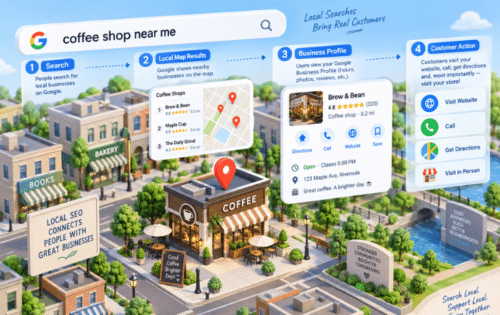
If you’ve ever searched “plumber near me” or “best HVAC company in Austin” and clicked one of the map listings, you’ve already experienced local SEO in action. Local SEO services are the ongoing work an agency or specialist does to get your business showing up in those exact searches — so people nearby find you before they find your competitor.
This guide breaks down what’s actually included in local SEO services, how the process works month to month, what it tends to cost, and how to know whether your business needs it right now.
What Are Local SEO Services?
Local SEO services are a set of marketing tasks designed to improve how a business ranks in geographically specific search results — think Google Maps, the “local pack” (the group of three map listings that appear above the standard organic results), and location-based searches like “roofer in Austin” or “dentist near me.”
Unlike traditional SEO, which focuses on ranking a website broadly for a topic, local SEO is built around proximity and location intent. Google is direct about what drives this: local search results depend mainly on how well a business profile matches what someone is searching for, how close the business is to the searcher, and how well-known the business is — what Google calls relevance, distance, and prominence.
A local SEO service typically manages all three of those levers on your behalf: cleaning up your business information, building your online reputation, and making sure your website and profile give Google (and your customers) exactly what they’re searching for.
If you want the deeper explanation of how this differs from general SEO, we cover the fundamentals in more detail here.
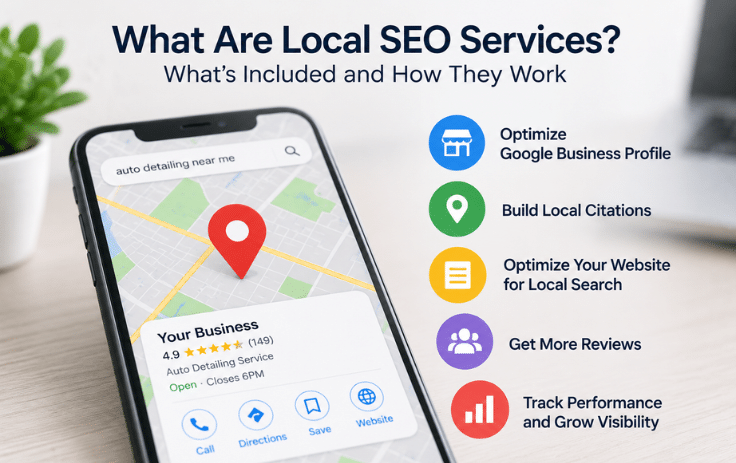
What’s Included in Local SEO Services
Scope varies by provider, but most local SEO packages cover the same core pieces.
Google Business Profile Optimization
Your Google Business Profile (formerly Google My Business) is the single biggest lever in local search. It’s the listing that shows your hours, phone number, photos, and reviews in Maps and the local pack.
A good local SEO service will typically:
- Fill out every relevant field — categories, services, service areas, attributes
- Keep hours, address, and phone number accurate and current
- Add and refresh photos on a regular basis
- Post updates and respond to customer questions
This matters because Google’s own local business guidelines emphasize representing your business exactly as it’s recognized in the real world — consistent across signage, branding, and address details as a foundational trust signal.
Local Citations and NAP Consistency
A “citation” is any place online your business Name, Address, and Phone number (NAP) appears — directories, industry associations, the Better Business Bureau, and similar sites. When your NAP matches everywhere, it signals reliability to both Google and customers.
Local SEO services usually start by auditing existing citations for errors, fixing inconsistencies, and building new ones on directories relevant to your industry.
On-Page Local SEO
This is the work done directly on your website: adding your city or service area to page titles and headers, building out location-specific service pages, and embedding a map.
It also includes technical work like schema markup — a structured data format that tells search engines specifics like your business hours in a standardized way they can read and classify, instead of leaving Google to guess from page text alone.
Reviews and Reputation Management
Reviews influence both your rankings and whether a customer actually picks up the phone. A local SEO service usually sets up a system for requesting reviews after every job, plus a process for responding to them — the good ones and the bad ones.
One line you should never cross: buying, selling, or fabricating reviews is illegal in the U.S. The FTC finalized a rule specifically banning fake and incentivized reviews, with real civil penalties for businesses that knowingly violate it. Any agency pitching fake reviews as a shortcut is a liability, not a strategy.
Local Content and Link Building
Blog posts, service pages, and local guides that reference your service area reinforce relevance. Earning mentions or links from local news outlets, chambers of commerce, and community organizations builds prominence — the third ranking factor.
Reporting and Tracking
You should expect regular reporting on rankings, Google Business Profile activity (views, calls, direction requests), website traffic from local search, and — most importantly — actual leads and booked jobs, not just clicks.
How Local SEO Services Work, Step by Step
Most providers follow a similar process, even when the terminology differs.
1. Audit. The team reviews your current Google Business Profile, website, citations, and competitors to find gaps — missing categories, inconsistent NAP, thin content, weak review volume.
2. Strategy. Based on the audit, they prioritize what to fix first and build a plan around your specific services and service area(s).
3. Implementation. This is the hands-on work: profile optimization, citation cleanup, page builds, review-request setup, and initial content.
4. Ongoing optimization. Local SEO isn’t set-and-forget. Competitors adjust their own listings, reviews accumulate, and Google’s local algorithm evolves — so most services include monthly maintenance and reporting.
How Long Does Local SEO Take to Show Results?
There’s no universal timeline, and any agency promising an exact number of weeks for every business is guessing. That said, a few general patterns tend to hold:
- Google Business Profile changes (hours, categories, photos) can show up within days
- Citation and NAP fixes typically take a few weeks to fully index across the web
- Competitive local rankings and steady lead flow usually build gradually and compound over months, especially in crowded markets
How Much Do Local SEO Services Cost?
Pricing depends heavily on how competitive your market is, how many locations or service areas you cover, and how much work your existing profile and website already need.
Most providers price local SEO one of three ways:
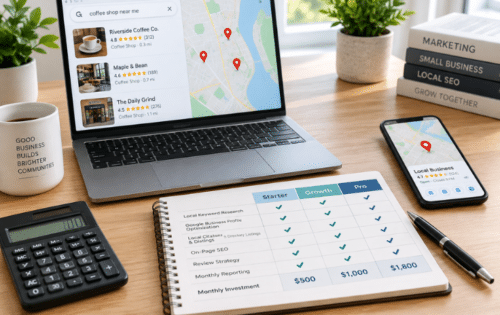
- Monthly retainer — ongoing management; the most common model, since local SEO is an ongoing effort
- Project-based — a one-time cleanup (citations, profile setup) with no continued work afterward
- Hourly or consulting — for businesses that want guidance but plan to handle execution themselves
For a full breakdown of what drives the price up or down, see our complete guide to local SEO pricing.
Local SEO vs. Other Marketing Channels
Local SEO isn’t a replacement for paid ads — the two work differently, and often work best paired together.
- Local SEO builds organic, long-term visibility in Maps and search. It takes longer to build momentum, but it keeps working without a per-click cost once it’s established.
- Paid search and social ads put you in front of customers immediately, but visibility stops the moment you stop paying.
Many service businesses run both at once — paid ads for immediate leads while local SEO builds toward a lower cost per lead over time. A dedicated local SEO service can help map out which mix fits your budget and timeline.
Benefits of Local SEO Services
Done well, local SEO delivers:
- High-intent leads from people actively searching for your service, in your area, right now
- Lower cost per lead over time, since you’re not paying per click for organic rankings the way you do with ads
- Stronger trust signals — a complete, well-reviewed profile makes a customer more likely to call before they even open your website
- Compounding value — unlike ad spend, the work you put in keeps paying off month after month rather than stopping the day you turn it off
For a closer look at why this matters specifically for service businesses, here’s a deeper breakdown of the case for prioritizing it.
Risks and Mistakes to Watch For
- Buying or incentivizing reviews. Beyond the legal risk noted above, it’s also a fast way to get your Google Business Profile suspended.
- Duplicate or inconsistent listings. Multiple profiles for one location, or mismatched NAP across the web, confuse Google and can hurt your rankings.
- Keyword-stuffing city names. Cramming “Austin plumber Austin TX plumbing Austin” into a page reads as spam to both Google and your customers.
- Ignoring negative reviews. Silence tends to look worse than a calm, professional response.
- Chasing the wrong keywords. Ranking #1 for a broad term with no local intent rarely translates into booked jobs.
Do Local SEO Services Need Ongoing Maintenance?
Yes. Local SEO isn’t a one-time project you finish and forget. Competitors update their own listings, reviews accumulate (or don’t), business details change, and Google’s local algorithm continues to evolve.
Businesses that see lasting results tend to treat it as an ongoing function — similar to bookkeeping or equipment maintenance — rather than a single campaign with a defined end date.
When Should You Hire a Local SEO Service?
Local SEO tends to make the most sense when:
- Your business depends on customers finding you within a specific service area — most home services, healthcare, and local retail fall into this category
- Competitors consistently outrank you in the map pack for searches you should be winning
- Your Google Business Profile is incomplete, outdated, or has few (or no) reviews
- You want to reduce reliance on paid ads over time
If you’re already stretched thin running the business, staying on top of profile updates, review requests, and citation cleanup is easy to let slip. That’s usually the point where handing it to a dedicated local SEO service starts paying for itself.
The Bottom Line
Local SEO services exist to do one thing: make sure that when someone nearby searches for what you offer, your business is the one they find, call, and book. Whether you handle it in-house or bring in a specialist, the fundamentals don’t change — a complete profile, consistent business information, real reviews, and a website built around your actual service area.
If you want a clear picture of where your business currently stands, Gidds Media offers a free audit covering your Google Business Profile, local rankings, and a competitor snapshot — no obligation.