Figuring out your small business advertising costs can feel like you’re trying to hit a moving target. But thankfully, there’s a well-worn starting point most experienced business owners use. A solid rule of thumb is to set aside 5% to 10% of your total revenue for advertising and marketing.
So, if your business brings in $500,000 a year, you’re looking at an investment of $25,000 to $50,000 per year.
What Should Your Initial Advertising Budget Be
Thinking about your advertising budget isn't just about picking a number. It’s a strategic decision about how fast you want your company to grow. The 5% to 10% rule gives you a realistic framework that grows right along with your business.
A brand-new startup, for example, might lean closer to the 5% mark to keep cash flow tight and controlled. On the other hand, a business hungry for aggressive growth could push toward 10%—or even more—to capture market share quickly.
Think of it like putting fuel in your car. The amount you need depends entirely on how far and how fast you want to go. A quick trip across town doesn’t take much gas, but a cross-country road trip requires a full tank and then some. In the same way, a modest budget can keep your business visible, while a larger one can power you through a period of rapid expansion.
Finding Your Starting Point
To make this less abstract, let’s break down what these percentages look like for businesses of different sizes. Remember, these aren't rigid rules, just a practical guide to help you find your footing.
Sample Monthly Advertising Budget Ranges by Annual Revenue
Here’s a quick reference table showing how this simple percentage-based approach scales. We’ve broken down the annual figures into monthly amounts to make it easier to plan.
| Annual Revenue | Conservative Budget (5%) | Growth-Focused Budget (10%) |
|---|---|---|
| $100,000 | $5,000 ($417/month) | $10,000 ($833/month) |
| $250,000 | $12,500 ($1,042/month) | $25,000 ($2,083/month) |
| $500,000 | $25,000 ($2,083/month) | $50,000 ($4,167/month) |
| $1,000,000 | $50,000 ($4,167/month) | $100,000 ($8,333/month) |
Using your revenue as a guide ensures your advertising spend is sustainable. As you grow, so does your ability to invest back into that growth. It’s a simple, effective cycle.
The Shift to Digital Dominance
This framework is more relevant than ever, especially since most of that money is now flowing into online channels. A recommended minimum for any serious effort is around $1,000 per month, but as you can see from the table, that number climbs quickly.
The proof is in the numbers. The global digital marketing industry is on track to hit a staggering $870 billion by 2027, which tells you everything you need to know about where businesses are putting their money. It’s all moving online. You can find more data on small business ad costs at DesignRush.
Your budget is a declaration of your priorities. A well-planned advertising spend isn't an expense—it's the engine that drives visibility, generates leads, and ultimately secures your place in the market.
For new companies, getting this right from the start is absolutely critical. A clear budget is a cornerstone of a successful startup digital marketing strategy because it forces you to align every dollar you spend with a specific business goal. This isn't just about spending money; it's about making sure every dollar is accounted for and pushing your business forward.
Decoding Digital Advertising Channels and Their Costs
Once you’ve got a budget in mind, the million-dollar question becomes: where do you actually spend it? Stepping into the world of digital advertising can feel like walking into a crowded bazaar, with every vendor shouting that their channel is the best.
Each platform has its own unique strengths, but the key to a smart investment is understanding how their costs work. Let's break down the most powerful channels and what you can really expect to pay.
This infographic gives you a quick visual on how businesses typically slice up their revenue for advertising. It helps you see where your budget fits into the grand scheme of things.
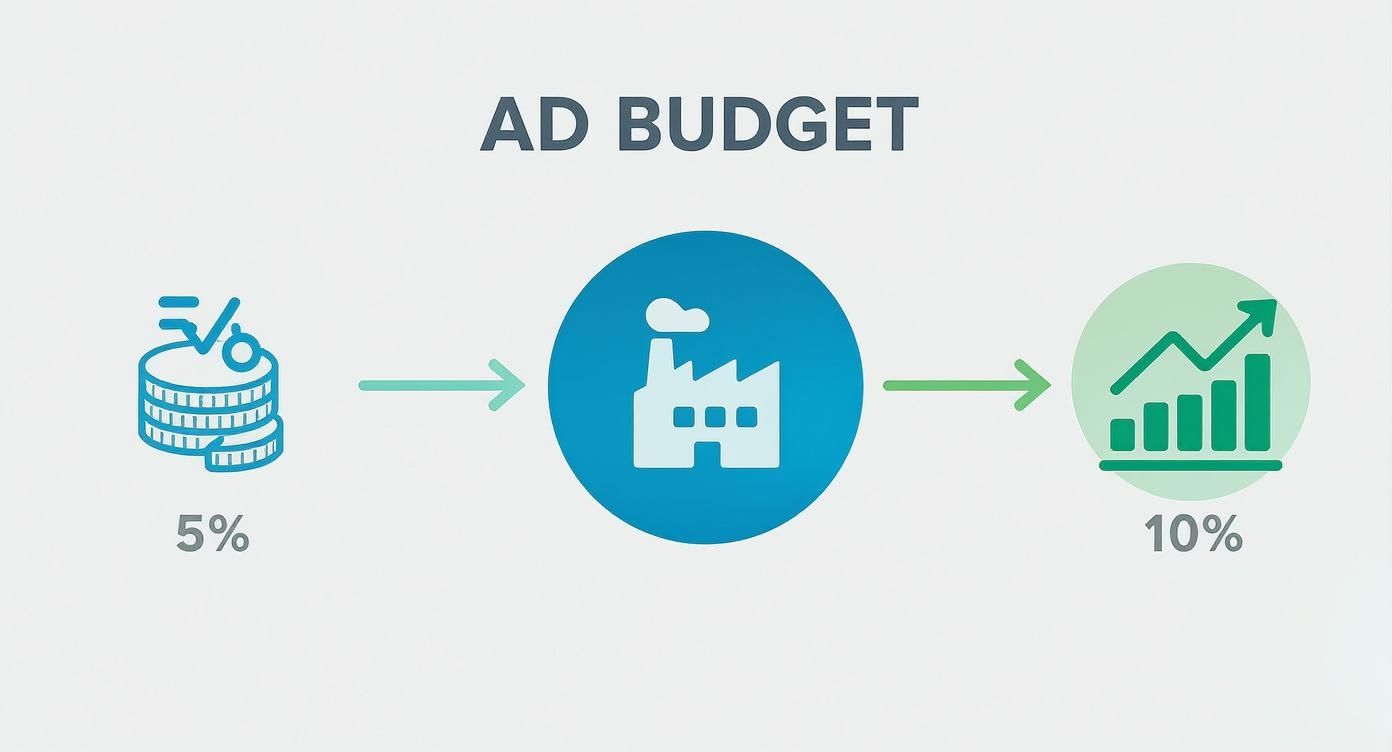
As you can see, there's a clear line from your total revenue to what you can invest in ads, with different paths for businesses playing it safe versus those pushing hard for growth.
Google Ads: The Digital Auction House
Think of Google Ads as a lightning-fast auction. You're bidding for the chance to show up right when someone is actively looking for what you sell.
When a potential customer types "emergency plumber in Austin," they aren't just window shopping—they have a pipe bursting right now. This is exactly where Google Search Ads prove their worth.
The model is called Pay-Per-Click (PPC), meaning you only pay when someone actually clicks on your ad. But the price of that click—the Cost-Per-Click (CPC)—is anything but fixed. It’s influenced by a few key things:
- Keyword Competition: High-value keywords like "lawyer near me" cost more because every law firm in town is bidding on them.
- Ad Quality: Google actually rewards you for good, relevant ads by giving you better placement at a lower cost.
- Industry: Some fields are just pricier. Expect to pay more for clicks in competitive industries like insurance or legal services than you would for niche hobbies.
The average CPC across all industries is around $4.66, but that number can swing wildly. The real magic of Google Ads is that it’s driven by intent, which is why it’s a cornerstone for almost any business looking for immediate leads.
Social Media Advertising: Grabbing Their Attention
While Google is fantastic at capturing existing demand, platforms like Meta (Facebook and Instagram) and LinkedIn are masters of creating it. Here, you aren't waiting for someone to search for you. You're putting your message directly in front of the right people.
You can target users based on their demographics, interests, recent life events—you name it. That level of precision is what makes social media so powerful. The cost models are a bit different, too:
- Cost-Per-Click (CPC): Just like Google, you can pay when someone clicks. This is perfect for driving traffic to your website.
- Cost-Per-Mille (CPM): Here, you pay for every 1,000 times your ad is shown (an "impression"). This is the go-to for building brand awareness.
For instance, a local coffee shop could run an Instagram ad targeting people within a five-mile radius who have shown an interest in "specialty coffee." It’s this ability to layer targeting options that helps control your small business advertising costs and ensures you’re not wasting money on the wrong audience.
The difference is simple: Google Ads helps you find new customers, while social media ads help new customers find you. A smart strategy uses both to make sure you're covered at every stage of the customer journey.
The advertising world is definitely shifting online, with mobile ad spending expected to rocket past $400 billion in 2025. For context, Google Ads has a strong average click-through rate (CTR) of 5.07%, making it a fantastic tool for engagement. Small businesses should brace for an average cost-per-lead of about $66.69 for search ads, a number that’s critical for smart budget planning.
Search Engine Optimization: The Long-Term Asset
Paid ads give you instant visibility, but Search Engine Optimization (SEO) is about earning it for the long haul. SEO is the process of fine-tuning your website so that it naturally ranks higher in Google’s organic (non-paid) search results.
Think of it this way: paid ads are like renting a billboard on the busiest highway in town. The moment you stop paying, your billboard comes down. SEO, on the other hand, is like buying the land and building your own permanent storefront right on that same highway. It takes more work upfront, but once it’s established, it brings in traffic day after day without you paying for every single click.
The "cost" of SEO is really an investment of time and resources into:
- Content Creation: Writing genuinely helpful blog posts and guides that your customers are looking for.
- Technical Optimization: Making sure your site is fast, easy to use on a phone, and simple for Google to understand.
- Link Building: Earning links from other trusted websites, which tells Google that you're a credible authority.
The payoff isn't overnight, but a solid SEO foundation is a sustainable asset that can deliver compounding returns for years. It's an absolutely essential part of any serious local business digital marketing strategy, building a level of trust and authority that paid ads just can't buy.
Exploring Costs in Traditional Advertising
So far, we've been deep in the digital weeds. But let's be clear: "old-school" advertising hasn't gone anywhere. For a small business trying to win over its local community, getting offline can be a game-changer. These methods create real-world, tangible touchpoints that a screen just can't match.
But what does it actually cost to get your message out there, from the local paper to that billboard on the highway? Let's break it down.

Costs of Print and Direct Mail Advertising
Placing an ad in a local newspaper or magazine is a direct line to an already engaged audience. The small business advertising costs here can swing wildly, though, based on a few key things.
Think of it like buying real estate. A full-page ad on the inside front cover is prime property with a price to match. A small classified in the back? Far more accessible.
- Ad Size and Placement: A simple quarter-page ad in a local paper might run you $200 to $500. Go for a full-page spread, and you could easily be looking at $2,000 or more.
- Circulation and Readership: Publications with a bigger, more affluent readership will charge more. You're paying for access to their audience.
- Color vs. Black and White: A full-color ad pops off the page, but it'll typically cost 25-40% more than a black-and-white version.
Direct mail gets even more personal, landing your message right in someone's hands. The costs are layered: you've got design, printing, and postage. A simple postcard campaign hitting 1,000 local homes will likely cost between $500 and $1,500 all-in.
Breaking Down Radio and Outdoor Advertising
Radio is powerful. It reaches people in their cars, at their desks, or at home, making it incredible for repetition and brand recall. The cost has two main parts: making the ad and paying for the airtime.
Creating a professional 30-second spot can range from $300 to over $1,000, depending on whether you need voice actors or special effects. Then you have to buy the airtime, which is all about the station's listenership and when your ad runs.
A slot during the morning commute is the radio equivalent of a Super Bowl commercial—it costs the most because it reaches the largest audience. Expect to pay a premium for those peak hours.
Outdoor advertising, like billboards, gives you constant visibility in a specific geographic area. It’s a fantastic way for a local restaurant, shop, or service provider to build name recognition.
- Billboard Rental: In a smaller town, a billboard might cost $500 to $1,500 per month. In a high-traffic city center, that number can easily jump to $5,000 or more.
- Printing and Installation: Don't forget the one-time cost to get the vinyl ad produced and installed. That can tack on another $300 to $700 to your initial investment.
Sponsoring Events and Building Community Ties
Finally, don't overlook event sponsorships. This is a unique way to build goodwill and connect with your community on a personal level. It's not just about slapping your logo on a banner; it's about tying your brand to a local cause or celebration people care about.
Sponsorships can run from $100 for a spot in a local 5K fun run to thousands for a major community festival. The return isn't just about immediate sales—it's about building long-term trust and becoming a recognized, respected part of your town. Each of these traditional methods has its place, giving you a different way to connect with customers beyond their screens.
How to Build an Advertising Budget That Actually Works
Having a rough number in mind for your ad spend is a good start, but it's not a strategy. An effective advertising budget is more than just a number you pulled out of thin air—it’s a game plan that connects every dollar you spend to a real business goal.
It’s the difference between blindly throwing money at ads and making a calculated investment in your growth. To get there, you need to shift from simple, reactive models to a goal-first approach. In other words, start with the finish line and work your way backward.
Start with Clear Business Objectives
Before a single dollar leaves your account, you have to know what winning looks like. Vague goals like “get more customers” or “increase brand awareness” are basically useless for budgeting. You need specific, measurable targets.
For example, a solid objective sounds more like this:
- Generate 50 new qualified leads per month through Google Ads.
- Increase online sales by 15% in the next quarter.
- Boost website traffic from social media by 25% in the next 60 days.
When you have a concrete target, you can start to realistically estimate the small business advertising costs needed to hit it. This is the core of the objective-and-task method—you define the goal, then you map out the tasks (and their costs) required to get you there.
Choosing Your Budgeting Model
Different businesses require different approaches. While the old-school percentage-of-sales method is wonderfully simple, the objective-and-task model is far more powerful because it forces you to justify every single dollar.
Let’s quickly break down the two most common models:
| Budgeting Model | Pros | Cons |
|---|---|---|
| Percentage-of-Sales | Easy to calculate and it scales with your revenue. A low-risk starting point. | Totally arbitrary. It ignores market opportunities and specific growth goals. |
| Objective-and-Task | Strategic and goal-driven. Every dollar has a job to do. | Takes more work to set up. You need to do your research and understand channel costs. |
For most small businesses, the sweet spot is a hybrid approach. Use the 5-10% of revenue rule as a general guideline to keep you grounded, but build the actual budget using the objective-and-task method. This ensures your money is working as hard for you as you do for it.
Uncovering the Hidden Advertising Costs
Your budget isn’t just about paying for clicks or airtime. A whole host of "hidden" costs can blow up your plan if you don't see them coming.
A classic mistake is fixating on ad spend while completely ignoring the support costs. That's like budgeting for gas on a road trip but forgetting about oil changes, new tires, and insurance.
Make sure you factor in these essential extras:
- Creative Production: This is the cost of actually making the ads. Think graphic design for display ads, video production for social media, or a copywriter to nail your messaging.
- Software and Tools: You’ll likely need subscriptions for analytics platforms, scheduling tools, or keyword research software. As you set aside funds, remember to check out different advertising tool pricing to find what fits.
- Management Fees: Hiring a freelancer or an agency? Their fees are a major part of your total cost, whether it’s a percentage of ad spend or a flat monthly retainer.
The advertising world is absolutely exploding, with global spending projected to smash $1.17 trillion in 2025. Nearly all of that growth—a whopping 90% of it—is coming from digital platforms. Social media is leading the charge, which makes a well-planned, all-inclusive budget more critical than ever.
By setting clear goals from the start and anticipating all the associated costs, you can build a budget that’s both realistic and incredibly powerful. It stops being a spending limit and becomes your strategic roadmap for growth.
Measuring Success and Optimizing Your Ad Spend
Putting money into advertising is just the first step. The real magic happens when you start figuring out what’s working, cutting what isn’t, and making every single dollar pull its weight for your business. This is how you shift from simply spending money to strategically investing in predictable growth.
Think of your ad budget like a bucket of water for your garden. Just tossing it everywhere won't get you very far. You have to know which plants are thriving and which ones need more (or less) attention. Measuring ad performance is how you figure out exactly where to point the hose.
Key Metrics That Tell the Real Story
Diving into advertising analytics can feel like staring at a wall of acronyms and data points. It's easy to get overwhelmed. The good news? A handful of core metrics tell you almost everything you need to know about your campaign's health.
Don't get lost in the noise. Start by focusing on these crucial key performance indicators (KPIs).
To really get a handle on your performance, it's essential to understand the story your numbers are telling. The table below breaks down the most important metrics for any small business owner.
Key Advertising Metrics and What They Mean
| Metric (KPI) | What It Measures | Why It's Important |
|---|---|---|
| Return on Ad Spend (ROAS) | The total revenue generated for every dollar spent on ads. | This is the ultimate bottom-line number. A 4:1 ROAS means you’re making $4 for every $1 you spend. |
| Customer Acquisition Cost (CAC) | The average cost to acquire one new paying customer from a campaign. | If your CAC is higher than your average sale, you're losing money. This tells you if your advertising is actually sustainable. |
| Lifetime Value (LTV) | The total revenue you can expect from a single customer over time. | LTV gives your CAC critical context. A high CAC might be perfectly fine if your customers stick around and spend a lot over the years. |
These metrics don't live in a vacuum—they work together to paint a complete picture. A low ROAS, for instance, might be a red flag that your Customer Acquisition Cost is too high, pushing you to figure out why your ads aren't converting efficiently. Getting comfortable with these numbers is the first step toward optimizing your small business advertising costs.
Smart Tactics to Optimize Your Budget
Once you know your numbers, you can start making data-driven moves to improve them. Optimization isn't a one-and-done fix; it's a constant cycle of testing, learning, and refining your approach to squeeze more value from your budget.
The goal of optimization is simple: stop wasting money on what isn't working and double down on what is. It’s about trimming the fat so you can invest more in the muscle of your advertising strategy.
Here are a few practical ways to make your ad spend more effective:
- A/B Test Your Creative: Never assume you know what will work. Create two versions of an ad—maybe with different headlines, images, or calls-to-action—and let them compete. You’d be surprised how small tweaks can lead to huge improvements in click-through rates and conversion costs.
- Refine Your Audience Targeting: Are your ads actually reaching the right people? Dig into your analytics to see the demographics and interests of who is converting. If you're a local plumber and see clicks coming from three states away, you're just lighting money on fire. Tighten that targeting to focus only on your ideal customers.
Reallocating Your Budget for Maximum Impact
If you optimize continuously, clear winners and losers will emerge among your advertising channels. You might discover your Google Ads campaigns are consistently bringing in a fantastic return while your efforts on another platform are falling flat.
This is where you get strategic. Don't be afraid to shift funds away from underperforming channels and reinvest that money into the ones that are proven winners. For example, if you find that search ads are your most powerful tool, it might be time to get expert help to scale what’s already working. Many businesses find that working with specialists can fine-tune their campaigns even further. You can learn more about how professional Google Ads management services drive that kind of growth.
Ultimately, knowing where you stand in the market is also a huge piece of the puzzle. To really grasp your marketing's impact and make sure your budget is well-spent, check out this real guide to Share of Voice in advertising. It gives you valuable context on how your brand's visibility stacks up against competitors, helping you make smarter decisions about where to focus your resources next.
Got Questions About Advertising Costs? We’ve Got Answers.
Alright, let's talk about the questions that are probably bouncing around in your head. After digging into budgets, channels, and all the metrics, it's natural to still have a few "what ifs" and "how to's." This is where we clear the fog.
We've heard these same questions from hundreds of business owners. Think of this as the final, practical chat you need before you can confidently build a plan and, more importantly, take action.
How Much Should a Brand New Business Spend on Ads?
When you’re just starting out, every single dollar feels massive. Cash flow is everything. So that classic advice to spend 5-10% of your revenue on marketing? It’s a great long-term target, but it’s pretty useless when your revenue is zero.
A much better way to think about it is as an investment to get your first customers and prove your concept. You're not spending money; you're buying data.
A good starting point is to set aside a fixed amount you're comfortable "risking" to learn what works. For most new businesses, this lands somewhere between $500 and $2,500 per month for the first 3-6 months.
Think of this initial budget as the seed money for your revenue engine. Its main job isn't to generate a huge profit right away. Its job is to buy you crucial data and attract your first real customers.
This is your learning phase. You’ll find out which keywords actually lead to sales, what ad copy people respond to, and what it really costs to get a new customer (your Customer Acquisition Cost, or CAC). Once you have that real-world data and cash starts flowing, you can shift over to the percentage-of-revenue model.
Is It Better to Hire an Agency or Run Ads Myself?
This is the ultimate "time vs. money" question, and there's no single right answer. It all comes down to your situation—your budget, your skills, and how fast you want to grow. Understanding the trade-offs is key to making a smart call.
Let’s break down what each path looks like.
| Approach | Who It's For | The Upside | The Downside |
|---|---|---|---|
| DIY (Do It Yourself) | Owners with more time than money, a genuine interest in marketing, and the grit to learn the platforms inside and out. | You have total control. No management fees, so every dollar goes straight to ads. It's a fantastic learning experience. | The learning curve is steep. It's easy to make expensive mistakes, and it eats up a ton of time you could be using elsewhere. |
| Hiring an Agency | Owners with more money than time, those in super-competitive markets, or businesses that are ready to scale up, fast. | You get instant access to experts, powerful tools, and proven strategies. It frees you up to run the business. Results usually come faster. | It’s a real financial commitment (management fees on top of ad spend). Finding the right agency you can trust can be a challenge in itself. |
Going the DIY route is an incredible way to learn the ropes, but expect some bumps and bruises along the way. Hiring an agency is like hitting the accelerator—it gets you there faster and with less risk, but it costs more. A hybrid approach also works well: start by managing things yourself to get a feel for it, then bring in an agency when you’re ready to grow beyond what you can handle alone.
How Long Does It Realistically Take to See Results?
Patience is a must in advertising, but how much patience you need really depends on the channel. The timeline to see a real return on your money can vary wildly.
Here’s a realistic breakdown:
- Paid Ads (Google & Social Media): You’ll see traffic and data almost instantly—often within 24-48 hours of launching a campaign. But seeing traffic isn't the same as being profitable. It usually takes a solid 1-3 months to collect enough data to properly optimize your campaigns and see a consistent, positive return.
- Search Engine Optimization (SEO): This is the long game. You might see a little bit of movement in a few months, but it realistically takes 6-12 months of steady work to achieve significant, traffic-driving results. The payoff, though, is huge: a sustainable flow of organic traffic that you don’t have to pay for with every click.
What Is the Single Biggest Budgeting Mistake to Avoid?
If there's one mistake that kills more ad campaigns than any other, it's inconsistency. Too many business owners treat advertising like a leaky faucet—they turn it on when they're desperate for leads and shut it off the second things get busy or cash feels tight.
This "start-stop" approach is a disaster for modern ad platforms.
The algorithms on Google and Meta feed on consistent data. When you keep pausing your campaigns, you kill all your momentum. You force the algorithm to start its learning process all over again, which leads to unpredictable results and a whole lot of wasted cash.
It’s far better to commit to a smaller, steady budget you know you can maintain every single month. Seriously, spending $500 per month consistently will get you much better results than spending $2,000 one month and then zero for the next three. Consistency builds momentum, gathers reliable data, and ultimately paves the way for predictable growth.
Ready to stop guessing and start growing? At Gidds Media, we specialize in creating and managing targeted advertising strategies that deliver measurable results. Let us help you build a plan that maximizes every dollar of your ad spend. Schedule your free consultation today!