Google Ads keyword research isn't just about finding words people type into Google. It’s the art of pinpointing the exact phrases your ideal customers use when they're ready to buy, then balancing that with search volume, competition, and your budget to get the most out of every ad dollar.
Building Your Foundational Keyword Strategy

Before you even think about opening Google's Keyword Planner, let's talk strategy. The campaigns that consistently deliver leads are built on a solid foundation, long before a single keyword is chosen. This initial planning is what separates the money-pits from the money-makers.
It all comes down to getting inside your customer's head. We need to move beyond what they're searching for and dig deep into why they're searching. This is the core concept of user search intent, and it’s everything in paid search. Understanding intent lets you show up at the exact moment a user is ready to make a decision.
Understanding User Search Intent
Search intent is just a fancy way of saying "What does this person really want?" It's the goal behind the search query. We can break it down into a few key categories, but for Google Ads, three matter most.
The following table breaks down the different types of search intent. It's a simple but powerful framework to help you classify keywords and align them with the right campaign goals from the very beginning.
| Intent Type | Description | Example Keyword | Campaign Goal |
|---|---|---|---|
| Informational | The user is looking for answers or learning something new. | "how to fix a leaky faucet" | Brand awareness (rarely profitable for direct response) |
| Navigational | The user wants to go to a specific website or brand. | "Gidds Media login" | Brand defense, customer retention |
| Transactional | The user is ready to buy, sign up, or take action now. | "buy Nike Pegasus size 10" | Leads, sales, direct conversions |
Focusing on the right intent prevents you from wasting your budget on clicks that were never going to convert in the first place.
Your primary mission is to find and prioritize keywords with strong transactional intent. These are the terms that bring in revenue. While you're brainstorming, it's also worth checking out some related strategies for choosing the best keywords for SEO, as many of the core principles overlap.
A classic mistake is throwing big money at high-volume informational keywords. Sure, they'll get you traffic, but it's usually the wrong kind of traffic that rarely converts. Always start by capturing the users who are closest to pulling out their credit cards.
Applying Keyword Match Types Strategically
Once you know the why behind a search, you need to control the who. That’s where keyword match types come in. This setting is your lever for telling Google how closely a user's search query needs to match your keyword.
- Broad Match: This gives Google the most freedom. It shows your ad for searches related to your keyword, including synonyms and topics Google thinks are relevant. It offers massive reach but zero control. Use with extreme caution.
- Phrase Match: A solid middle ground. Your ad appears for searches that include the meaning of your keyword. A keyword like "lawn mowing service" could trigger an ad for "local lawn mowing service prices."
- Exact Match: This gives you the most control. Your ad only shows for searches with the same meaning or intent. For example, "lawn mowing service" would match "lawn service for mowing" but not "how to start a lawn service."
Getting your match types right is fundamental to controlling your budget. It ensures you’re paying for the right clicks from day one. This strategic groundwork is critical, especially when you remember the sheer scale of the platform. In 2023, Google's ad revenue hit an incredible $264.59 billion, accounting for 39% of all digital ad spending worldwide. You have to be precise to compete effectively.
Generating Your Initial Keyword List
Alright, with our strategy mapped out, it's time to get our hands dirty and start building your keyword arsenal. This is where we translate all that thinking about business goals and customer personas into an actual, concrete list of search terms.
The goal right now isn't perfection. It's about casting a wide net to create a comprehensive "seed list" that we'll refine and sharpen later on.
Think of yourself as a detective. The first clues are always the most obvious ones: your own products and services. If you're a plumber in Austin, you’re definitely going to start with terms like "plumber in Austin" and "emergency plumbing Austin." Get those down first.
But that's just the starting line. The real magic happens when you stop thinking about what you sell and start thinking about what your customer needs.
Brainstorming Beyond the Obvious
That same Austin plumber doesn't just get calls from people searching for "plumbers." They get calls from people with a specific problem. Someone frantically typing "leaky faucet repair" or "how to unclog a drain" is a customer with incredibly high intent.
Here are a few ways to get the creative juices flowing and uncover these gems:
- Talk Like Your Customers: What exact words and phrases do your customers use on the phone or in emails? Dig through your contact forms and support tickets. Their language is your keyword gold.
- List Your Features & Benefits: Go beyond the core service. For a roofer, this could be "metal roof installation" or "24/7 storm damage repair." Each unique feature is a new path for keywords.
- Answer Their Questions: Brainstorm all the "what," "why," and "how" questions your audience might have. A personal trainer could tap into searches like "how to find a personal trainer" or "what are the benefits of a personal trainer."
As you pull these ideas together, a dedicated keyword extractor tool can be a huge time-saver, quickly pulling potential terms from your website or competitor pages.
A classic mistake is getting stuck in your own industry bubble, using jargon that real customers would never, ever search for. Always bring your brainstorming back to the simple, direct language of the person with the problem.
Spying on Your Competition
One of the smartest ways to build out your list is to see what's already working for your competitors. They've already spent the time and money testing keywords, so you might as well learn from their investment.
Start simple. Google your main service keywords and see who consistently shows up in the paid ad spots. Click through to their landing pages. What headlines are they using? What problems are they solving? Those pages are often built around their core keyword targets.
This isn't about copying them. It's about finding gaps. If three of your competitors are all battling it out for "affordable web design," you might spot an opportunity with something more specific, like "custom WordPress sites for small business."
Using Google Keyword Planner
Now we bring in the tools, and there's no better place to start than Google's Keyword Planner. It’s free with a Google Ads account, and the data comes straight from the source.
Head over to "Discover new keywords" and plug in your core service terms. Google will spit back hundreds of related ideas, complete with some seriously valuable data.
Let's say we're researching terms for "lawn care services." Here's what the planner might show you:
The screenshot shows you everything you need to start making informed decisions: search volume, competition, and how much you might have to bid.
At this stage of your Google Ads keyword research, pay attention to these three columns:
- Avg. monthly searches: This is your potential traffic. Is anyone actually looking for this?
- Competition: This tells you how many other advertisers want this keyword. "High" competition means you'll have to fight for it, which usually means higher costs.
- Top of page bid (low and high range): This gives you a ballpark idea of what a click might cost to get your ad in a prime position.
Now, dump everything—your brainstorming ideas, your competitor analysis, and your tool research—into a master spreadsheet. This is your seed list. Don't worry if it's messy or way too long. Right now, volume is the name of the game. We'll sort, filter, and structure it all in the next step.
Analyzing and Refining Your Keyword Data
Alright, you’ve done the heavy lifting and now you're sitting on a massive list of potential keywords. It's a great start, but it's just raw material. A long, unfiltered list is a surefire way to burn through your ad budget with nothing to show for it.
This is where the real work—and the real profit—begins. We're about to shift from just gathering data to actually interpreting it. We'll trim the fat, prioritize the winners, and organize everything into a logical structure that sets your campaign up for success from day one. This isn't just about being tidy; it's about creating laser-focused ad groups that lead to higher relevance, better Quality Scores, and ultimately, more conversions for less money.
The process is simpler than it sounds. Think of it like this:
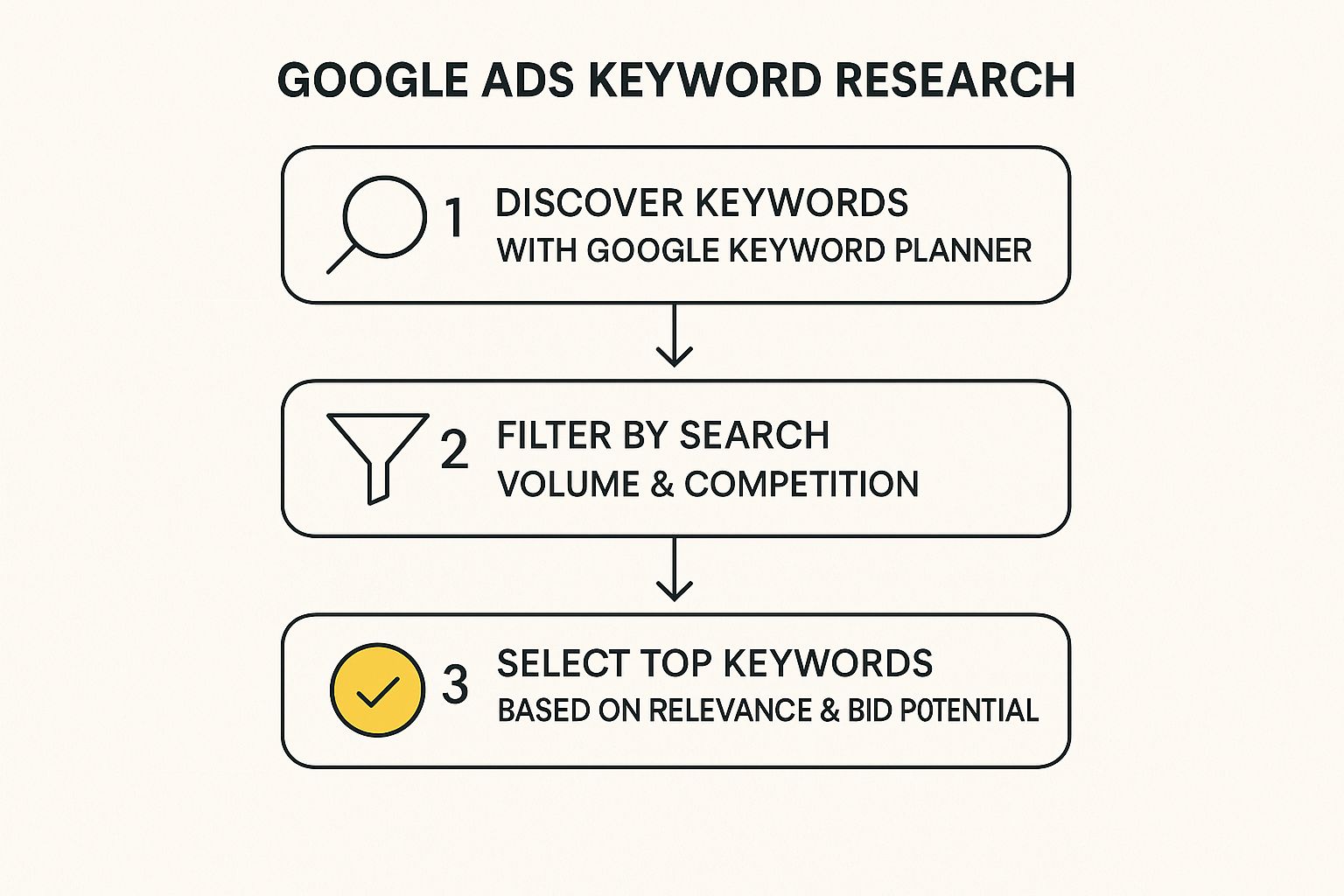
This discover, filter, and select flow is the backbone of turning a messy spreadsheet into a strategic asset.
Filtering by the Numbers
Your keyword spreadsheet is probably swimming in data from Google Keyword Planner, with metrics like search volume, competition, and bid estimates. It’s time to use those numbers to make some smart cuts.
First, sort your list by search volume. This is the low-hanging fruit. Immediately get rid of any keywords with zero or extremely low monthly searches. Unless you're in a hyper-niche B2B space, a keyword with only 10 searches a month isn't going to move the needle. Be realistic.
Next up, the competition column. "High" competition isn't always a red flag; in fact, it often signals a keyword with strong commercial intent. But if you're working with a tight budget, targeting only high-competition terms is like willingly jumping into a bidding war with giants you can't beat. Look for a healthy mix, and pay close attention to keywords with "Medium" or "Low" competition that still have decent search volume.
This is what I call finding the "sweet spot." It's that perfect intersection of reasonable search demand and manageable competition. These keywords often represent the most cost-effective opportunities to get in front of qualified buyers without breaking the bank.
Finally, take a hard look at the estimated cost-per-click (CPC). These are just estimates, but they provide a vital reality check. If your dream keyword has a top-of-page bid of $50 and your daily budget is only $20, it's just not a sustainable place to start. Filter out keywords that are obviously way outside your budget for now. You can always revisit them later.
Prioritizing by Commercial Intent
Metrics are a great starting point, but intent is everything. I'll take a keyword with 100 monthly searches and clear buying intent over one with 10,000 informational searches any day of the week.
Go through your list and ask this critical question for each keyword: "What does the searcher actually want to do?" Keep an eye out for transactional modifiers—words that signal someone is ready to pull out their wallet.
- Urgent Needs: "emergency," "24/hour," "near me"
- Service Queries: "services," "company," "for hire"
- Product Queries: "buy," "for sale," "deals," "discount"
- Brand Comparisons: "vs," "reviews," "alternatives"
Think about it: a local plumber should be all over "emergency plumber Austin," not "how to fix leaky faucet." The first is a customer in distress, ready to hire. The second is a DIY-er looking for a free tutorial on YouTube. Nailing this distinction is the core of profitable Google Ads keyword research.
A Practical Keyword Prioritization Framework
To help tie all this together, you can use a simple framework to score and prioritize your keywords. It forces you to look at each term holistically, balancing raw data with strategic intent.
This framework is designed to evaluate and prioritize keywords based on key performance indicators and your specific business goals.
| Keyword | Search Volume | Competition | Estimated CPC | Commercial Intent | Priority Level |
|---|---|---|---|---|---|
| emergency plumber near me | 5,400 | High | $45.50 | Very High | High |
| best drain cleaning services | 1,200 | Medium | $22.00 | High | High |
| affordable plumbing company | 880 | Medium | $18.75 | High | Medium |
| how to install a toilet | 14,800 | Low | $1.50 | Very Low | Low |
| water heater repair cost | 2,900 | High | $35.00 | Medium | Medium |
| tankless water heater coupon | 320 | Low | $15.00 | Very High | High |
By mapping your keywords out like this, the winners and losers become much clearer. The goal isn't just to find keywords, but to find the right keywords that align with your budget and business objectives.
Structuring for a High Quality Score
The final piece of the puzzle is organizing your prized keywords into tightly-themed ad groups. I can't overstate this: this is arguably the most crucial step for long-term campaign success. An ad group is simply a small collection of highly related keywords that will all trigger the exact same ad.
The golden rule here is relevance. If you can't write a single ad that feels perfectly tailored to every keyword in an ad group, you need to break that group down further.
Let's say you run a running shoe store. A poorly structured ad group might be called "Running Shoes" and contain all of these:
- nike running shoes men
- brooks trail running shoes
- best running shoes for flat feet
A much smarter, more relevant structure would look like this:
- Ad Group 1 Nike Men: "nike running shoes men," "men's nike pegasus," "buy nike running shoes men's"
- Ad Group 2 Brooks Trail: "brooks trail running shoes," "brooks cascadia trail shoes," "brooks trail shoes for sale"
- Ad Group 3 Flat Feet: "best running shoes for flat feet," "supportive running shoes flat feet," "overpronation running shoes"
This granular approach ensures your ad for "Nike running shoes" is shown to someone searching for exactly that. The result? A higher click-through rate (CTR). Google sees this relevance and rewards you with a higher Quality Score, which directly translates to lower ad costs and better ad positions. Your analysis isn't truly done until your keywords are neatly structured into these hyper-relevant groups.
Refining Your List: Negative and Long-Tail Keywords

This is the part of the process where great advertisers really separate themselves from the amateurs. So far, all our Google Ads keyword research has been about finding what to target. Now, we flip the script and master the art of defining what not to target.
It’s all about precision. Telling Google which search terms are completely irrelevant to your business is one of the fastest ways to make a campaign profitable. This strategic subtraction forces your budget to work harder, ensuring it's only spent on clicks with a genuine shot at converting.
Cut the Waste with Negative Keywords
Think of negative keywords as the bouncers for your ad budget. You add these terms to your campaigns to stop your ads from showing up for irrelevant searches. Without them, you’re basically leaving the door wide open for clicks that will never, ever convert.
Let's say you're a high-end kitchen remodeler, and you're bidding on the phrase match keyword "kitchen cabinet installation." Without a solid negative list, your ad could easily pop up for searches like:
- "kitchen cabinet installation DIY"
- "free kitchen cabinet installation course"
- "kitchen cabinet installation jobs"
None of these people are looking to hire you. Every single click is just money down the drain. By adding "DIY," "free," and "jobs" as negative keywords, you instantly filter out that unqualified traffic and protect your bottom line.
Your positive keywords get you into the game, but negative keywords are how you win it. A proactive negative keyword list is the single most effective tool for improving your return on ad spend (ROAS) right from the start.
You absolutely should build a "pre-launch" negative list based on pure common sense. Just brainstorm all the ways someone might search for your service without having any intention of becoming a customer.
Common Pre-Launch Negative Categories to Build:
- Informational Intent: "how to," "what is," "tutorial," "guide"
- Job Seekers: "jobs," "hiring," "careers," "salary"
- Bargain Hunters: "free," "cheap," "discount," "DIY"
- Unrelated Materials: If you only work with wood cabinets, you'd add terms like "laminate" and "metal" as negatives.
Building this list before you even launch saves you money from day one. Then, once the campaign is live, you have to regularly check your Search Terms Report to find new, unexpected bleeders that are slipping through.
Uncover High-Intent Long-Tail Keywords
Now, let's look at the other side of the coin. While negatives cut waste, long-tail keywords are all about capturing pure, unadulterated intent. These are longer, more specific search phrases—usually three or more words—that signal someone is much further down the buying funnel.
Sure, a broad term like "running shoes" gets a ton of search volume. But a long-tail keyword like "buy Brooks Ghost 15 men's size 11" gets very little. The difference? The person typing that long-tail search isn't just browsing; they have their credit card out and are ready to buy now.
These super-specific queries almost always have lower competition, which means cheaper clicks and much higher conversion rates. For local service providers, this is an absolute goldmine. To see how this fits into a broader plan, check out our complete guide to local business digital marketing strategies.
How to Actually Find These Long-Tail Gems
So, how do you dig up these profitable terms? It's a mix of using the right tools and getting inside your customer's head.
Here’s a simple workflow I use to uncover these opportunities:
-
Let Google's Autocomplete Do the Work: Start typing one of your main keywords into the Google search bar and just watch what it suggests. Those aren't random guesses; they're actual searches people are making. "custom wood cabinets for…" might reveal valuable endings like "…small kitchens" or "…modern farmhouses."
-
Mine the "People Also Ask" Box: This section in the search results is a treasure trove. It literally shows you the exact questions your potential customers have. These questions often make for perfect, high-intent long-tail keywords.
-
Spy on Your Competitors' Landing Pages: Go look at the headlines, subheadings, and service descriptions on your top competitors' websites. The specific language they use to sell their services is often built around the valuable long-tail keywords they're already targeting.
When you combine a strong negative keyword strategy with a focused hunt for long-tail keywords, you create a powerful one-two punch. You're simultaneously cutting out the waste while attracting your most qualified, ready-to-buy customers.
Keeping Your Keyword Strategy Sharp Over Time
Here’s a hard truth: effective Google Ads keyword research is never a "set it and forget it" task. Your initial setup gets you in the game, but the real wins—the ones that drive consistent profit—come from constantly refining your strategy based on real-world data.
Think of your keyword list as a living document, not a static spreadsheet carved in stone. It has to evolve with market trends, competitor moves, and most importantly, your own campaign performance. Launching your campaign is just the starting line; winning the marathon means adjusting your pace and reacting to what's happening on the track.
Master the Search Terms Report (This is Non-Negotiable)
Your absolute best friend in this process is the Search Terms Report. Buried inside your Google Ads account, this report shows you the exact, unfiltered search queries people typed into Google that triggered your ads. It's a direct window into the minds of your potential customers.
Make it a weekly ritual to dive into this report. You’re on a mission to hunt for two things: new negative keywords and potential positive keywords.
-
Spot the Budget Wasters: Look for queries that are completely irrelevant and just eating your budget. For example, if you sell "premium leather dog collars," you might find you're paying for clicks from searches like "free dog collar patterns" or "how to repair dog collars." Instantly add "free," "patterns," and "repair" to your negative keyword list to stop the bleeding.
-
Discover Hidden Gems: You’ll also uncover long-tail keywords you never thought of. You might see that a query like "hypoallergenic leather collar for small dogs" is driving high-quality, converting traffic. That's your cue to build a new, dedicated ad group around that specific, high-intent theme.
This simple habit—reviewing the Search Terms Report—is the single most impactful activity you can do to improve your Return On Ad Spend (ROAS). It ensures every dollar is spent on the most relevant traffic possible.
Evolve Your Match Type Strategy
Google’s AI is getting smarter every day, which means your approach to match types has to adapt, too. The lines between broad, phrase, and exact match are getting blurrier, with Google focusing more on a user's intent than the literal words they type.
When you're starting out, sticking to phrase and exact match is smart. It gives you maximum control and lets you gather clean performance data. But once you've built a solid negative keyword list and have a good handle on what converts, it might be time to test broad match.
Pairing a broad match keyword with a Smart Bidding strategy like Target CPA or Maximize Conversions lets Google's algorithm find new conversion paths you might have missed. Just keep a close eye on it—broad match can quickly veer into irrelevant territory if it isn't managed carefully.
The evolution of match types is a clear signal of Google's push towards automation. In fact, some projections suggest that by 2025, the traditional system might be simplified even further, with phrase match potentially being phased out for more dynamic, intent-based targeting. You can read more about the future of Google Ads keywords at WordStream.
Adjust Bids Based on What’s Working
Finally, ongoing optimization is all about putting your money where the results are. Your campaign data will paint a clear picture of which keywords are your workhorses and which are just dead weight.
Don't be afraid to get aggressive with your top performers. If a keyword consistently delivers a strong ROI, increase its bid to maximize its impression share and grab more of those high-value clicks. This is how you scale a successful campaign. This kind of granular control is just as vital in PPC as having a solid foundation is for organic rankings. To learn more about that, check out these essential technical SEO best practices.
On the flip side, be ruthless with keywords that aren't pulling their weight. If a keyword has spent a significant chunk of your budget without a single conversion, it’s time to either slash its bid or pause it entirely. This frees up your budget to be reinvested into the keywords that are actually growing your business.
Common Questions About Google Ads Keyword Research
Even with a rock-solid plan, questions always come up when you get into the weeds of keyword research for Google Ads. Over the years, I've seen the same handful of questions pop up again and again.
Getting these details right is often what separates a campaign that just breaks even from one that becomes a predictable profit machine. Here are some quick, no-fluff answers to help you get past those common hurdles and sharpen your approach.
How Many Keywords Should Be in an Ad Group?
There's no magic number here. The one principle that should always guide you is theme. The goal is to create super-focused ad groups where every single keyword is so closely related that one ad speaks perfectly to the user's intent for all of them.
In practice, this usually means an ad group ends up with somewhere between 5 to 20 keywords.
Here’s the gut check: if you find yourself struggling to write one specific, hyper-relevant ad for every keyword in the group, that's your sign. It means your theme is too broad, and it’s time to break it out into a new, more specific ad group. This tight focus is what drives up your Quality Score, and Google rewards that with lower costs and better ad positions.
Resist the urge to dump hundreds of keywords into one ad group. It feels efficient, but it's a fast track to low ad relevance, miserable click-through rates, and a whole lot of wasted money. Granular, focused ad groups always win.
What Is a Good Search Volume to Target?
This is easily one of the most common questions, and my answer is always the same: "it's relative." There's no universal number for "good" search volume. Its value is completely dependent on your niche, your location, and what you’re trying to achieve.
Think about it this way: a local plumber in Austin might find a keyword with only 50 monthly searches to be a goldmine if it brings in high-ticket emergency calls. On the other hand, a national e-commerce store selling sneakers needs thousands of searches a month to move the needle.
Instead of just chasing big numbers, focus on keywords with strong commercial intent. A lower-volume term like "emergency roof repair service near me" is infinitely more valuable than a high-volume, informational one like "roofing ideas." Start with a mix of volumes and let your conversion data be the ultimate judge of which keywords are actually making you money.
How Often Should I Update My Keyword List?
Managing your keywords isn't a "set it and forget it" task—it's an ongoing process of refinement. How often you need to dig in really depends on how old your campaign is.
-
For New Campaigns (First Month): You should be living in your Search Terms Report, checking it every few days. This is the most critical time to add negative keywords to stop budget leaks and to spot new, high-intent queries you might have missed.
-
For Mature Campaigns: A weekly or bi-weekly check-in is usually enough. At this stage, you’re looking for performance shifts, new negative opportunities, and any emerging search trends that you can jump on.
Always be ready to do a deeper dive when you see a major change in performance, launch a new product or service, or when seasonal trends kick in. A healthy keyword list is never static; it breathes and adapts to real-world data.
Effective Google Ads management is an ongoing commitment to optimization. For businesses that want to maximize their return without getting bogged down in the day-to-day, partnering with a specialist can make all the difference. You can learn more about how our dedicated Google Ads management services can help you stay ahead of the curve.