Think of a digital marketing strategy consultant as the architect of your company’s online growth. They aren't just laying bricks—like running a few ads or posting on social media. They're designing the entire blueprint, making sure every single marketing effort builds something valuable that’s perfectly aligned with your business goals.
What Is Digital Marketing Strategy Consulting
Digital marketing strategy consulting is a high-level partnership. It’s all about creating a comprehensive, data-driven roadmap for your company’s online presence. This goes way beyond simple tasks, like managing a PPC campaign, and gets to the fundamental "why" behind every marketing move you make. A consultant’s real job is to diagnose the underlying business challenges, spot hidden opportunities in the market, and build a plan for sustainable, measurable growth.
Imagine your business is a ship trying to reach a distant island—that's your main business goal. If you just start rowing in random directions—launching a social media campaign one day, redesigning your logo the next—you’ll just waste energy and go nowhere. A consultant acts as the expert navigator. They study the maps (market research), check the weather (competitive analysis), and plot the most direct and efficient course to get you where you want to go.
The Strategist vs. The Technician
It’s absolutely critical to understand the difference between strategy and tactics. Lots of businesses hire freelancers or agencies for tactical work, which is essential, but it’s not the same as getting strategic guidance.
- A Technician will build you a Google Ads campaign with the keywords you give them.
- A Strategist will first figure out if Google Ads is even the right place to find your customers. If it is, they'll then determine how it should work with your SEO and content marketing to get the best possible ROI.
A consultant’s job is to tie every single marketing activity back to your core business goals. They ensure your budget, team, and technology are all working together to hit a specific, defined outcome. This prevents the disconnected, siloed efforts that drain resources and kill all momentum.
A consultant's job isn't just to give you answers, but to ask the right questions. They challenge your assumptions and force you to get crystal clear on what success actually looks like for your business. This ensures every dollar you spend on marketing has a clear purpose and a measurable impact.
Core Functions of a Consultant
At the end of the day, digital marketing strategy consulting is about building a scalable growth engine for your business. A consultant focuses on creating a system where every part supports the others, leading to compounding returns over time.
This involves a deep dive into your business to truly understand your unique value proposition, your customer’s journey, and where you stand against the competition. From there, they build a custom framework designed for long-term success—not just quick, short-term wins. They provide the clarity and direction needed to turn marketing from a cost center into a predictable revenue driver.
The Core Pillars of a Winning Digital Strategy

A powerful digital strategy isn't a random collection of tasks. It’s a complete ecosystem. An expert consultant knows better than to treat your marketing channels like separate items on a checklist; instead, they weave them into a single, cohesive growth engine where every part works together.
Think of it like building a high-performance car. The engine, chassis, and wheels are useless on their own. But when engineered to work in perfect harmony, they create a vehicle that can take you anywhere you want to go. Let's break down the essential pillars a digital marketing strategy consulting expert orchestrates to get you there.
SEO: The Foundation of Your Digital Presence
Search Engine Optimization (SEO) is the bedrock of your entire digital operation. It’s the behind-the-scenes work that makes your website structurally sound, easy for search engines to crawl, and—most importantly—visible to people actively looking for what you offer. If this foundation is weak, everything else you build on top of it is at risk.
Done right, SEO is what makes your business discoverable. When a potential customer types a problem into Google, SEO is what puts your website on the first page of the results. It’s a long-term play that builds organic, sustainable traffic and establishes your brand as an authority over time. The first step is always getting inside your customer's head, which makes mastering how to keyword research an absolute must.
A consultant will typically focus their SEO efforts in three key areas:
- Technical SEO: This is all about making sure your website is fast, secure, and mobile-friendly. A good user experience is something search engines reward, and you can learn more about these critical elements by reviewing technical SEO best practices.
- On-Page SEO: This involves fine-tuning individual pages with the right keywords, compelling meta descriptions, and genuinely helpful content that answers a searcher's question.
- Off-Page SEO: This is how you build your site's reputation across the web, earning high-quality backlinks and mentions that signal to Google that you're a trusted resource.
PPC: The Turbo-Boost for Immediate Traffic
If SEO is the sturdy foundation, then Pay-Per-Click (PPC) advertising is the turbo-boost. While SEO builds momentum over months, PPC delivers immediate, highly targeted traffic. It lets you jump to the front of the line, placing your business right in front of customers at the very moment they're ready to make a decision.
A consultant uses PPC to capture high-intent leads, quickly test different marketing messages, and drive a surge of traffic for specific campaigns or promotions. This isn’t just about "buying ads"—it’s about surgically precise budget allocation, audience targeting, and relentless optimization to maximize your return on ad spend (ROAS).
PPC and SEO aren't competitors; they're partners. PPC generates priceless keyword and conversion data that can fuel your long-term SEO strategy. Meanwhile, strong SEO improves your site's Quality Score, which can actually lower your PPC costs.
Content Marketing: The Engine of Trust and Authority
Content marketing is the fuel that powers your entire digital strategy. It’s the art of creating and sharing valuable, relevant, and consistent content—think blog posts, videos, and guides—to attract and hold the attention of your ideal audience. This isn't about the hard sell. It's about educating, solving problems, and building a real relationship with your customers.
When you consistently produce high-quality content, you position your brand as a credible expert in your field. This is how you build trust, guide leads through the buying journey, and create the assets needed to make your SEO and social media efforts truly take off.
Social Media Marketing: The Hub for Community Engagement
Finally, social media is where you build your community and let your brand’s personality shine. It’s the place for two-way conversations, sharing your content, and showing the human side of your business. Each platform has a unique role, from professional networking on LinkedIn to visual storytelling on Instagram.
A consultant will craft a social media plan that aligns with your brand's voice and business goals, turning passive followers into passionate advocates.
To give you a clearer picture, here’s a breakdown of how these channels fit together within a cohesive strategy.
Key Digital Marketing Channels and Their Strategic Role
| Channel | Primary Objective | Key Performance Indicators (KPIs) |
|---|---|---|
| SEO | Build long-term organic visibility and authority. | Organic Traffic, Keyword Rankings, Backlink Profile, Click-Through Rate (CTR) |
| PPC | Drive immediate, targeted traffic and generate leads. | Return on Ad Spend (ROAS), Cost Per Acquisition (CPA), Conversion Rate |
| Content Marketing | Educate the audience, build trust, and support SEO. | Engagement Rate, Time on Page, Leads Generated, Shares & Mentions |
| Social Media | Foster community, build brand personality, and drive engagement. | Follower Growth, Engagement Rate, Reach, Social-Driven Traffic & Conversions |
These channels aren't islands; they are interconnected systems that amplify one another when managed by an expert.
In fact, new research shows that half of consumers discovered new products through social platforms in 2023, and 59% went on to complete their purchases right there. This just underscores how vital a strategic social presence has become in a world where 91% of marketers already credit SEO with boosting their website’s performance.
The Consulting Journey from Audit to Optimization
Working with a digital marketing strategy consulting expert isn't a one-off meeting; it's a structured journey. A real partnership unfolds in clear phases, starting with a deep-dive into your business and moving all the way to constantly refining your marketing. This process makes sure every move is intentional, backed by data, and built to drive you toward your biggest goals.
The journey kicks off with a comprehensive discovery and audit. This isn't just a quick glance at your website—it's more like a forensic investigation. The consultant gets fully immersed in your business model, how you make money, who you're up against, and most importantly, who your ideal customer really is. They'll dig into all your existing data, from website analytics to past campaign results, to get a clear baseline of where you stand today.
Deep-Dive Discovery and Audit
Think of this first phase like a doctor diagnosing a patient before writing a prescription. A consultant will meticulously review your entire digital footprint to pinpoint strengths, weaknesses, opportunities, and threats. This audit goes way beyond surface-level numbers to uncover the "why" behind your current performance.
For example, they might see that you get a ton of website traffic, but your conversion rate is dismal. The audit aims to find the root cause. A thorough analysis could show that your real problem isn't attracting visitors, but convincing them to act. The fix would involve learning how to create an engaging and converting homepage instead of just throwing more money at ads.
Strategic Roadmap Development
Once the diagnosis is clear, the next step is building the strategic roadmap. This is where all the insights from the audit get translated into a custom, actionable plan. This roadmap is your blueprint for growth, laying out specific objectives, the channels you’ll use to hit them, the key performance indicators (KPIs) you'll track, and a realistic timeline.
This is the point where we get rid of all the ambiguity and replace it with crystal-clear direction. The plan will spell out exactly how different marketing pillars—like SEO, PPC, and content—will work in sync to create a compounding effect. It’s not just a to-do list; it’s a cohesive strategy where every single piece supports the others.
This infographic breaks down the foundational steps for setting clear goals and measuring what matters.
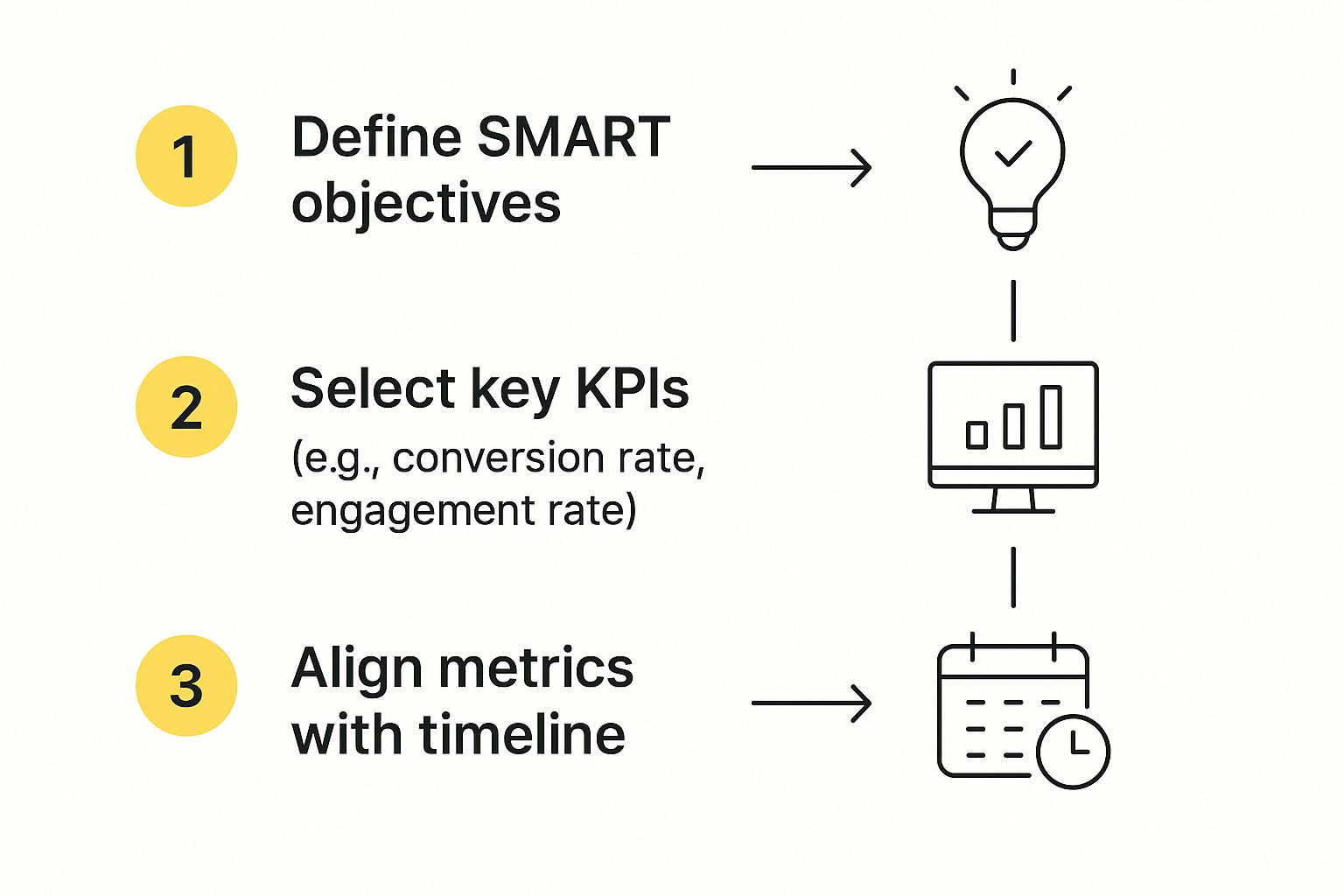
This process ties every marketing activity to a measurable outcome, making it easy to track your progress and prove the ROI.
Collaborative Implementation and Iteration
The final stages are all about bringing the strategy to life and then continuously tweaking it for better results. Implementation is a team effort where the consultant guides your in-house team or other vendors to execute the plan. They provide the oversight, answer the tough questions, and make sure every tactic stays true to the bigger strategy.
But the work doesn’t stop once a campaign goes live.
The most successful strategies aren't set in stone; they are dynamic and responsive. A great consultant builds a system for performance analysis and iteration, using real-time data to make smart adjustments and capitalize on new opportunities.
This ongoing cycle of measuring and optimizing is what separates a static plan from a living, breathing growth engine. It ensures your marketing investment is always working as hard as it possibly can to get you results. The consulting industry itself is built on this principle of constant adaptation and growth. In fact, the global management consulting market is valued at over $1 trillion and is expected to grow 8% annually through 2028, showing just how much businesses rely on expert guidance to stay competitive.
How Consultants Navigate Modern Marketing Trends

A marketing strategy that crushed it last year can easily fall flat today. The pace of change is just relentless, with new tech, platforms, and user behaviors popping up constantly. This is where an expert in digital marketing strategy consulting becomes your guide, helping you sort the game-changing trends from the fleeting fads.
Their job isn't to chase every shiny new object that comes along. It's about making calculated, forward-thinking moves. They help you invest in the right emerging channels—the ones that offer a real competitive edge—to keep your business ahead of the curve. The goal is to build an agile strategy that can pivot without losing sight of your core business goals.
Tapping into Artificial Intelligence for Personalization
Artificial intelligence isn't some far-off concept anymore; it's a hands-on tool that’s completely reshaping what customers expect. People now demand hyper-personalized experiences, and AI is the only way to deliver that at scale. A consultant helps you graduate from generic marketing blasts to using AI to forge genuine, one-to-one connections.
This often means putting AI-powered tools to work for things like:
- Dynamic Content: Automatically tweaking website content, emails, or product suggestions based on what a user has looked at before.
- Predictive Analytics: Figuring out which leads are most likely to buy, so your sales team can focus their energy where it matters most.
- Customer Service Chatbots: Offering instant, 24/7 support to answer common questions and point users in the right direction.
By weaving in AI thoughtfully, a consultant makes sure you're using technology to create a genuinely better customer experience—one that builds loyalty and drives sales. This is especially crucial for companies refining their startup digital marketing strategy and looking to build a strong foundation for growth.
Rethinking Influencer Marketing and Social Commerce
The way people discover and buy things has been turned on its head. This is especially true for younger crowds like Gen Z, who live on social media platforms not just for entertainment, but for product research and shopping. A good consultant helps you adapt to this new reality.
For example, influencer marketing is no longer just about follower counts. A strategic consultant will help you find and build real partnerships with micro-influencers whose followers are a perfect match for your ideal customer. The focus is on creating authentic engagement that leads to real business, not just racking up likes.
The modern customer journey often begins and ends on a social platform. A consultant's job is to ensure your brand is not just present but is an active, valuable participant in the conversations where your customers are making their buying decisions.
And the data backs this up in a big way. The global social media ad market is projected to grow by 12% in 2025, fueled heavily by influencer partnerships. This is a direct response to how people behave—a staggering 90% of Gen Z consumers say social content heavily sways their purchasing decisions.
Even more telling, 41% of Gen Z now prefer using social media for research over traditional search engines. You can dig into more of these 2025 digital marketing statistics on Marketing Dive. A consultant uses this kind of intel to build strategies that meet customers exactly where they are.
Measuring the True ROI of Your Consulting Partnership
So, how do you actually measure the value of a strategic blueprint? When you bring in a digital marketing strategy consultant, the return on investment (ROI) goes way beyond vanity metrics like a spike in website traffic or a few more social media followers. A real partnership delivers value that hits your bottom line and builds a competitive advantage for the long haul.
The impact of a well-designed strategy shows up in two ways: direct returns you can see on a spreadsheet, and indirect value that builds over time. While the direct ROI is easier to track, it's often the indirect benefits that create lasting, sustainable growth for your business. It's about building a smarter, more resilient, and more profitable company from the inside out.
Tracking Direct Financial Returns
The most immediate and tangible results will pop up in your key financial metrics. A consultant's main job is to flip marketing from a cost center into a predictable revenue driver. That means zeroing in on the numbers directly tied to sales and profit.
You can measure this direct impact by tracking improvements in a few key areas:
- Lead Quality and Conversion Rates: Are you getting more leads that actually become customers? A sharp strategy doesn't just pump up the volume of leads; it improves their quality. This means your sales team isn't wasting time chasing dead ends.
- Customer Lifetime Value (CLV): By attracting the right kind of customer and giving them a better experience, a solid strategy helps you keep them around longer. This increases the total amount of money each customer brings to your business over their entire relationship with you.
- Return on Ad Spend (ROAS): For your paid campaigns, the consultant’s work should directly translate to a higher return for every single dollar you put into advertising.
Measuring success requires a clear framework. A consultant helps you define and track the specific performance metrics that matter most to your business, ensuring every part of the strategy is financially accountable and aligned with your growth objectives.
Understanding Indirect Long-Term Value
Beyond the immediate numbers, a consulting partnership delivers strategic value that compounds over time. This is the indirect ROI—the stuff that strengthens your business against market shifts and keeps competitors at bay. It creates a powerful moat that's tough for anyone else to copy.
These less obvious, but equally critical, returns include:
- Stronger Brand Positioning: A clear strategy carves out a unique space for your brand in the market. It makes you the no-brainer choice for your ideal customer.
- Increased Market Share: As your strategy picks up steam, you’ll naturally start to capture a larger piece of the market from competitors who are just winging it.
- Upskilling Your Internal Team: A great consultant doesn’t just hand over a plan and walk away. They teach your team, transferring valuable knowledge and building in-house skills that stick around long after the project is over.
To really evaluate the success of any consulting engagement and nail down the ROI, it's critical to have a clear understanding key digital marketing performance metrics. This knowledge allows you to see both the quick wins and the long-term strategic gains.
Ultimately, the true ROI of consulting isn't just measured in the dollars you make today, but in building a more competitive and capable business for tomorrow.
How to Choose the Right Digital Marketing Consultant

Picking a strategic partner is one of the biggest calls you'll make for your business. The right consultant acts as a true growth catalyst, but the wrong one can burn through your time and budget with nothing to show for it.
The key is learning how to spot a genuine strategist versus a tactician who just knows how to execute tasks. You need to look past the slick slide decks and dig into their actual process, expertise, and—most importantly—their results.
Verify Expertise Through Proven Results
A consultant’s track record is everything. Don’t just take their word for it; you need to see concrete proof of their success. A confident expert will be excited to show you exactly how their digital marketing strategy consulting has delivered measurable wins for businesses like yours.
Ask for detailed case studies. These should clearly outline the client's initial problem, the strategy the consultant built, and the specific results they achieved. Be wary of vague claims like "we increased their traffic."
You want to see hard numbers that tie directly to business outcomes, like:
- "Grew organic search leads by 150% in nine months."
- "Lowered customer acquisition cost by 30% while scaling ad spend."
- "Improved sales conversion rates from 1.5% to 4% with a new content strategy."
This kind of detail proves they understand how to connect marketing activities to real revenue. It shows their work generates a tangible return on investment.
Assess Their Strategic Approach and Communication
A true strategist always starts with "why" before they even get to "what." In your first conversations, pay close attention to the questions they ask you.
Are they digging deep into your business model, your ideal customer, your profit margins, and where you want to be in five years? Or are they immediately jumping to tactics like SEO or social media ads?
A great consultant is a diagnostician first and a strategist second. They must fully understand your business's health and competitive environment before they can prescribe a credible plan for growth.
On top of that, their communication style should be crystal clear and educational. They should be able to break down complex ideas into simple terms, making sure you understand the logic behind every recommendation. They should feel like a partner who is educating you, not just a vendor taking orders.
This collaborative vibe is non-negotiable for a successful long-term partnership. You're not just hiring someone to do a job; you're investing in a relationship built on shared goals and a deep understanding of your company's vision.
Common Questions About Digital Marketing Consulting
Business leaders usually have a few questions before they bring a consultant into the fold. Getting these answers upfront helps take the mystery out of the process, ensuring you can make a smart decision and set clear expectations for your investment.
Let's clear up a few of the most common ones.
What Does Digital Marketing Strategy Consulting Cost?
This is never a one-size-fits-all answer. The cost really depends on the scope of the work and what your business actually needs. Most consultants, including us, structure pricing in one of three ways.
- Project-Based Fees: This is a set price for a specific, defined outcome. Think of it like buying a complete digital audit and strategic roadmap. It’s perfect when you have a clear start and finish line.
- Monthly Retainers: For ongoing strategic guidance and oversight, a monthly retainer is the way to go. This model works best for long-term partnerships where the consultant is constantly in your corner, analyzing performance and guiding the team.
- Hourly Rates: Some consultants charge by the hour, which is common for smaller, quick-hit tasks or initial discovery calls. It offers flexibility but can get tricky to budget for bigger, more involved projects.
Consultant vs. Agency: What Is the Difference?
This is a huge—and critical—distinction. Both are valuable, but they play fundamentally different roles. The easiest way to think about it is this: a consultant is the architect who draws up the blueprint, while an agency is the general contractor who builds the house.
A consultant is all about the high-level "why." They dig deep to diagnose your business challenges, map out the overarching strategy, and create the roadmap for growth. Their job is to set the direction and make sure every marketing dollar is spent in a way that aligns with your real business goals.
An agency, on the other hand, is built for the "how" and the execution. They're the specialists who run the campaigns, manage the social media, and build the website based on that strategic direction.
A consultant provides the strategic framework and expert oversight. An agency provides the hands-on execution to bring that strategy to life. Many of the most successful businesses use both to get the best of both worlds.
How Long Until We See Results?
The timeline for results really depends on the tactics we put in play. Any solid strategy will mix long-term foundational work with short-term initiatives designed to get some quick wins on the board.
Foundational strategies like SEO and content marketing are marathons, not sprints. You might start seeing real traction in 3-6 months, but the results will keep compounding and growing over time.
On the flip side, tactics like a highly targeted PPC campaign can deliver results almost immediately, driving traffic and leads within just days or weeks. A good consultant will build a strategy that balances both, securing that early momentum while building a sustainable engine for long-term, predictable growth.
Ready to stop guessing and start growing with a clear, data-driven plan? The team at Gidds Media combines strategic insight with expert execution to deliver measurable results. Get your free SEO audit today and discover your path to predictable growth.
Article created using Outrank