A site plan is the master blueprint for your entire project. It's the scaled drawing that maps out property lines, existing structures, and every single proposed change. You'll pull together property documents like surveys and deeds, do a deep-dive site analysis, and use all that info to draft the plan. This document becomes the single source of truth for your architect, contractors, and the local permit office.
Why a Solid Site Plan Is Your Most Important First Step
Before a single shovel ever breaks ground, the entire success of your project really comes down to one critical document: the site plan.
Think of it as the strategic map showing exactly how your new building or addition fits into the bigger picture of the property. It’s so much more than a simple drawing. It’s the key communication tool that gets everyone—from the architect designing the space to the landscaper planting the trees—working from the exact same script.
This detailed plan acts as the project's true foundation, giving a clear visual guide to property boundaries, setbacks, and the precise placement of all the important features. A well-thought-out plan stops costly mistakes in their tracks and ensures every element is positioned just right, saving you from headaches, on-site arguments, and expensive rework.
The Role of a Site Plan in Project Success
Let's be clear: a professionally drafted site plan is a non-negotiable legal document you'll need to get most building permits. It’s how you prove to the local authorities that your project plays by the rules—zoning laws, environmental regulations, and safety codes. Without an approved plan, your project is dead in the water. It’s an absolute necessity.
But beyond the red tape, the site plan is your strategic guide. It’s what helps you make the most of your land by forcing you to visualize and plan for crucial factors like:
- Drainage and Topography: You need to understand how water flows across the property. Get this wrong, and you're looking at future flooding or serious foundation issues.
- Utility Placement: It accurately pinpoints where existing water, sewer, and electrical lines are buried. Hitting one of those is a dangerous and incredibly expensive mistake.
- Accessibility and Flow: This is where you map out driveways, walkways, and entrances for logical, efficient movement. You want the layout to feel natural, not awkward.
A poorly conceived site plan is a recipe for disaster. I've seen it lead to massive budget overruns, unexpected construction delays, and frustrating legal battles with neighbors or city officials. Getting this right from the very beginning is the single best investment you can make in your project's success.
The need for this kind of precise, expert planning is only growing. The global Architecture & Urban Planning Market was valued at a massive USD 586.58 billion in 2024 and is expected to grow significantly. This reflects just how complex modern development has become. You can read the full research on architecture and urban planning market trends to get a better sense of where the industry is headed.
Assembling Your Site Planning Toolkit

Before you draw a single line of your site plan, you need to gather your intel. A solid, legally sound plan starts with the right information and the right tools. It’s a lot like building a house—you wouldn't start framing walls without a solid foundation. Skipping this prep work is just asking for headaches down the road.
Your first move? Round up all the official paperwork. This isn't just busywork. These documents are the source of truth for your property, containing the non-negotiable facts that will shape every decision you make.
Start by getting your hands on these core documents:
- Property Survey: This is your MVP. A recent, professionally certified survey gives you the exact legal boundaries, dimensions, and any easements or rights-of-way you have to work with.
- Property Deed: Your deed legally describes the property and confirms you're the owner. Always cross-reference this with the survey to make sure everything lines up perfectly.
- Local Zoning Ordinances: You’ll need a copy of your local municipality's zoning rules. Pay close attention to specifics like setbacks (how far your structures must be from property lines), lot coverage limits, and height restrictions.
Choosing Your Measurement and Drafting Tools
With your documentation in hand, it’s time to think about the physical and digital tools you'll use. The quality of your toolkit directly impacts the accuracy and professionalism of your final plan—which is critical when you're trying to create a site plan that will actually get approved.
For on-site measurements, you’ve got a few options. A classic 100-foot steel tape measure is surprisingly reliable for smaller, straightforward properties. But if you’re dealing with larger or more complex terrain with slopes, you might want to upgrade to a laser distance measurer or even professional-grade GPS equipment to nail the accuracy.
When it comes to the actual drafting, pen and paper just don't cut it anymore. Software is the standard, and for good reason. It’s where you’ll translate all your field notes and legal docs into a clean, scaled drawing.
The Floor Plan Tool market, which is a huge part of modern site planning, was valued at USD 809.7 million in 2025 and is projected to hit USD 1,700.3 million by 2032. This isn't just a random stat—it shows how quickly the industry is ditching old-school methods for more advanced digital solutions. You can dive deeper into the latest floor plan software market analysis to see where this tech is headed.
Choosing the right software is key to a smooth process. Here's a quick look at some popular options to help you decide what fits your project.
Essential Site Plan Toolkit Comparison
| Tool Category | Examples | Best For | Key Consideration |
|---|---|---|---|
| Manual Drafting | Pencils, Rulers, Graph Paper | Quick sketches, initial brainstorming, very small and simple projects. | Lacks professional polish and is difficult to edit or share digitally. |
| Mobile Apps | Magicplan, RoomScan Pro | On-the-fly measurements, creating basic digital plans directly from the site. | Can be less precise for complex sites; best for smaller-scale projects. |
| CAD Software | AutoCAD, SketchUp | Professionals, complex projects requiring high accuracy and detailed layers. | Steeper learning curve and can be expensive for a single project. |
| Web-Based Tools | SmartDraw, Lucidchart | Collaborative projects, creating clean diagrams and flowcharts without CAD skills. | May lack the technical precision of dedicated architectural software. |
Ultimately, the best tool depends on the complexity of your site and the requirements of your local planning department. Many pros rely on heavyweight Computer-Aided Design (CAD) software, but for many projects, user-friendly mobile apps are more than capable of creating detailed, accurate plans.
Whether you tackle this yourself or bring in an expert, understanding what’s available is the first step. Our team often helps clients figure out the right level of complexity for their projects as part of our digital marketing and web design services. Having the right tools from the get-go makes the entire process smoother, faster, and far more reliable.
First, Conduct a Thorough Site Analysis
You can't create an effective site plan without first getting to know the land intimately. Before you even think about drawing a single proposed change, you have to map out what's already there—both the stuff you can see and the critical elements hidden underground. This analysis is way more than just measuring property lines; it's about capturing the unique character, opportunities, and constraints of your specific piece of land.
Think of it like being a detective gathering clues. A really good site analysis tells the story of the land, giving you the hard data you need to make smart design choices. Skipping this step is like building on a mystery foundation. It's just asking for expensive surprises and potential failures down the road.
Mapping the Physical Landscape
Your first job is to document everything tangible on the property. This always starts with topography—the shape and contours of the ground itself. Identifying slopes is incredibly important because they dictate drainage patterns, influence how a foundation needs to be designed, and affect the overall accessibility of the site. A gentle slope might be a huge asset, but a steep one can turn into a major engineering headache.
Next up, you'll need to locate and measure every existing structure. This isn't just the main building. We're talking sheds, garages, fences, retaining walls—everything. Each one needs to be accurately placed on your base map.
And don't forget the natural features:
- Significant Vegetation: Mark the location and approximate canopy size of large trees. You'll have to decide whether you can work around them, which adds value and shade, or if they need to be removed, which adds cost and might even require a permit.
- Water Features: Any ponds, streams, or low-lying wet areas have to be identified. These features often come with specific building setbacks and environmental regulations you can't ignore.
This physical inventory creates the visual skeleton of your plan. It ensures your new design works with the existing environment, not against it.
Uncovering the Invisible Essentials
Often, what you can't see is just as important as what you can. A crucial part of any site analysis is mapping out the network of underground utilities. Before any excavation begins, you absolutely must identify the location of all buried water, sewer, gas, and electrical lines. Hitting a utility line isn't just expensive to fix; it's extremely dangerous.
Beyond the utilities, you need to think about the environmental factors that will affect the property all year long.
Analyzing solar paths and prevailing winds is a step many people overlook, but it's key to smart design. Knowing where the sun hits in summer versus winter can inform window placement for passive heating and cooling, while understanding wind patterns can help you design comfortable outdoor living spaces.
For truly next-level accuracy in depicting your site's topography and features, it's worth looking into what's possible with drones with LiDAR for 3D mapping. This tech creates a hyper-precise 3D model of your property, capturing details that are nearly impossible to get with traditional ground measurements. Having this kind of holistic view ensures that when you finally sit down to create your site plan, your design is responsive, efficient, and built on a foundation of solid data.
Drafting Your Site Plan From Scratch
Alright, you've done the legwork with your site analysis and now you have a pile of solid data. It's time to turn those numbers and notes into a professional drawing. This is the moment your vision really starts to come to life—not on paper, but on your screen. The key is to build your plan layer by layer, starting with what’s already there and then adding your proposed changes on top.
The very first thing you need to lock down is a consistent scale. For most residential projects, a scale of 1/8" = 1'-0" or 1/4" = 1'-0" is standard. Getting this right from the start ensures every single element is proportionally correct and lets anyone reading the plan pull accurate measurements from it. With your scale set, you'll begin by drawing the property lines exactly as they appear on your official survey. This creates the foundational frame for everything else.
Placing Existing and Proposed Elements
Once the boundaries are established, the next move is to fill in the plan with all the existing features. Using the field measurements from your site analysis, you’ll carefully place every structure—the house, garage, shed—along with any big trees, retaining walls, and driveways. Accuracy here is everything; these fixed points are the anchors for all the new work you’re planning.
After you've mapped the "as-is" conditions, you can finally start drafting your proposed changes. This is where it gets exciting. You'll add the new building footprint, outline that new patio, or trace the path for a new walkway. A good practice is to use different line types or colors to clearly show the difference between what’s already there and what you plan to build.
This process is a direct reflection of your site analysis, from the lay of the land to the specific locations of structures and utilities. It all comes together in this draft.
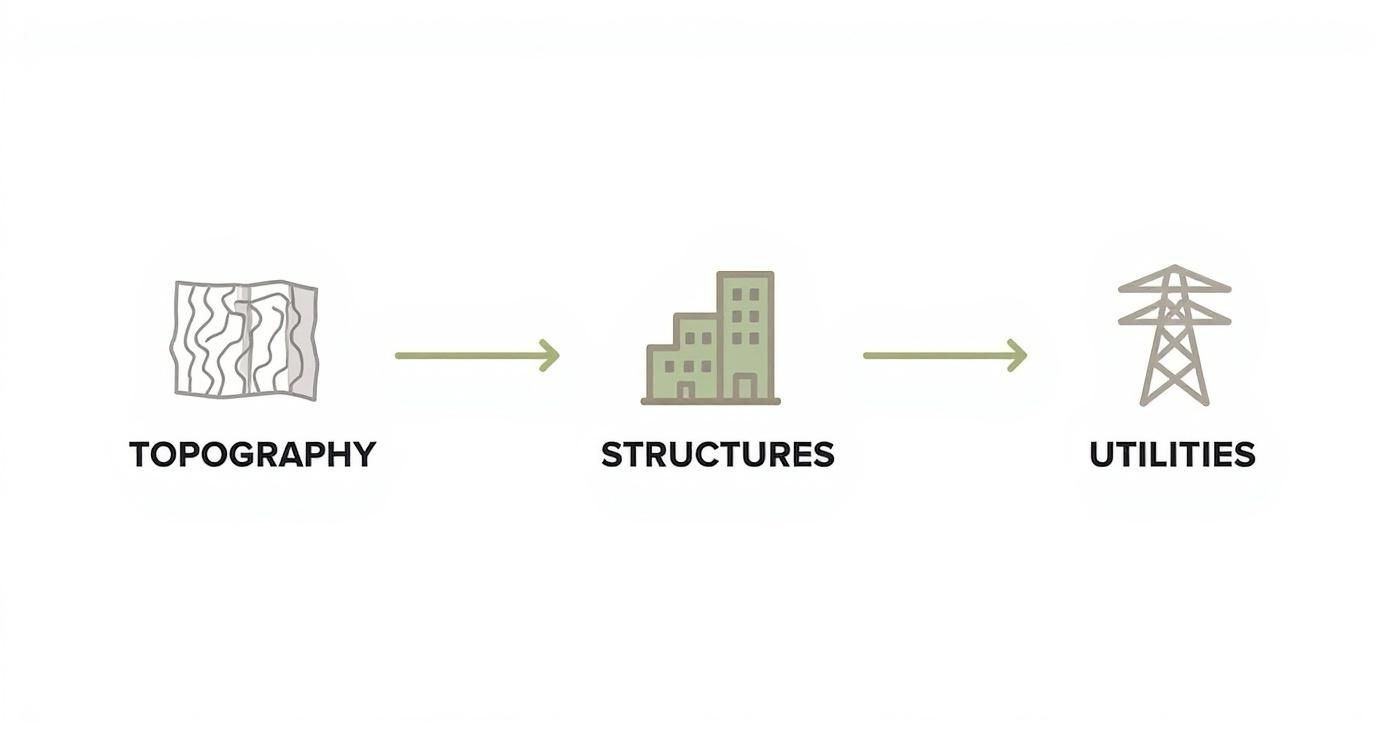
As the visual shows, a solid draft is completely dependent on the comprehensive data you gathered earlier. It’s what keeps you from overlooking critical details.
Using Standard Symbols and Annotations
A site plan is a technical document, and it needs to speak a universal language. To make sure it's crystal clear, you have to use standard architectural and landscaping symbols. There are specific, recognized symbols for everything from different types of trees (like deciduous vs. coniferous) to utility lines and material types like concrete or gravel.
But symbols alone aren't enough. Your plan needs detailed annotations to be truly useful. Every new feature should have clear dimension lines showing its length, width, and its exact distance from property lines or existing structures.
Pro Tip: Don't just slap dimensions on there. Add specific notes directly on the plan itself. Label the proposed driveway with "New Poured Concrete Driveway" or the new patio with "12'x16' Paver Patio." This level of detail removes any guesswork for contractors and permit reviewers.
This kind of meticulous approach is the backbone of the entire industry. The global construction market, which lives and breathes off of clear site plans, hit an incredible USD 2,154.4 billion in 2024. As projects get more complex, tools like Building Information Modeling (BIM) are becoming the norm to make this planning phase even more precise. You can learn more about the growth of the construction market to see how technology continues to shape its future.
By combining dead-on measurements with clear, standardized notation, you're creating more than just a drawing. You’re creating a precise set of instructions, ready for anyone to review and build from.
Finalizing Your Plan for Official Submission
You’ve got a solid draft, but it’s not quite ready for the permit office. Now comes the critical final stage: transforming your drawing from a good idea into a professional, legally defensible document that contractors and officials can trust at a glance.
This is where you add the small but essential details that give your plan authority. Without these finishing touches, you’re holding just a sketch. It’s missing the professional polish needed for official review, which can cause major headaches and delays down the road.
Adding Professional Documentation Elements
Think of this part as building the "user manual" for your project. These elements are standardized for a reason—they ensure anyone, from a building inspector to a concrete contractor, can immediately understand the plan's context without having to track you down for answers.
Every official site plan needs these four key items:
- A Professional Title Block: This is the boxed-off section, usually in the corner, that contains all the project vitals. It should clearly list the property address, owner’s name, who drafted the plan, the date, and the drawing scale.
- A Clear North Arrow: Orientation is everything on a job site. A prominent north arrow is non-negotiable. It allows everyone to orient the plan to the actual property correctly.
- A Detailed Legend: Your plan is full of symbols representing everything from property lines to specific tree types or utility connections. The legend (or key) is where you define exactly what each symbol and line type means. No guesswork allowed.
- An Unambiguous Scale Bar: Yes, you noted the scale in the title block (e.g., 1/8" = 1'-0"), but a graphical scale bar is also a must-have. It allows someone to verify measurements directly on the drawing, even if it’s been photocopied or printed at a weird size.
A site plan missing a complete title block, legend, and scale is an amateur document. To a permit office, it signals that other key details are likely missing, too, and almost guarantees it gets rejected on the first review.
The Importance of Detailed Notes and Final Review
Beyond the standard elements, your plan needs specific, written notes to eliminate any chance of confusion. These are direct instructions written right on the plan itself.
For example, don't just draw a rectangle for a patio; label it clearly with "Proposed 10'x12' Concrete Paver Patio." Specify details like a "6-foot Cedar Privacy Fence" along a property line. This level of detail prevents costly misinterpretations by your construction team.
To create a truly persuasive and clear picture of your design, mastering site plan rendering techniques can be a game-changer for your final submission. It helps transform a flat, technical drawing into a compelling visual that helps everyone understand the vision.
Before you even think about submitting, there's one last, crucial step: a final, exhaustive review. Go over your entire plan and check it against local building codes and zoning regulations one last time. Meticulously verify all your setbacks, lot coverage calculations, and any other specific requirements for your area.
This self-audit is your last chance to catch a small error that could send you all the way back to square one. If you're unsure about any part of the process, getting an expert opinion is invaluable. Don't hesitate to contact a professional for guidance to make sure all your hard work gets the green light it deserves.
Common Site Plan Questions Answered
When you're diving into the world of site plans, a few common questions always seem to pop up, especially if this is your first rodeo. Getting clear, straightforward answers is the best way to move forward with confidence and sidestep those frustrating roadblocks. Let's tackle some of the most frequent uncertainties people have when they start mapping out a project.
So, one of the first things people wonder is whether they can just sketch out the plan themselves. The answer? Well, it really depends on what you're building.
Do I Always Need a Professional
For tiny projects, like mapping out a new garden bed or a simple paver walkway for your own use, a DIY plan is totally fine. But the moment your project needs a building permit—think a home addition, a new garage, or even a sizable deck—the game changes.
Most cities and counties will require that the site plan be created and stamped by a licensed professional. This could be a land surveyor, civil engineer, or architect. Their official stamp is more than just a signature; it’s a guarantee to the city that your plan is accurate, follows local codes, and is legally sound.
Site Plan vs. Plot Plan: What Is the Difference
It's easy to get these two mixed up because people often use the terms interchangeably. While they're similar, they are definitely not the same thing. A plot plan is usually a much simpler drawing that just shows the proposed structure located within the property lines. Think of it as the basic outline.
A site plan, however, is the full story. It includes everything a plot plan does plus all the critical details: topography (the slope of the land), drainage, locations of all utilities (both above and below ground), landscaping, and every other existing structure on the property. When you're applying for official permits, "site plan" is the term you'll hear because it implies this much higher, necessary level of detail.
The most significant mistake you can make is submitting an incomplete or inaccurate plan. Common errors include using outdated property boundaries, failing to show underground utilities (a major safety hazard), and forgetting essentials like a north arrow and scale. Always double-check your data before drafting.
How Much Does a Professional Site Plan Cost
Cost is always a huge consideration, and the truth is, it varies—a lot. The final price tag depends on your project's size, how complex your property is, and even your geographic location.
- For a simple residential addition on a flat, standard lot, you might pay anywhere from a few hundred to a couple of thousand dollars.
- For larger commercial projects or properties with tricky terrain that demand a brand new, detailed survey, the cost can easily jump into the many thousands.
Try to think of it as an investment in your project's success. A quality plan from a pro can save you multiples of its cost by preventing construction mistakes and ensuring you sail through the city's approval process. For more insights on project planning and execution, feel free to explore the Gidds Media digital marketing blog. This upfront expense buys you peace of mind and a solid foundation to build on, and that’s invaluable.
Ready to build a digital presence that gets results? At Gidds Media, we create websites that work as hard as you do. Get your free, no-pressure SEO audit today